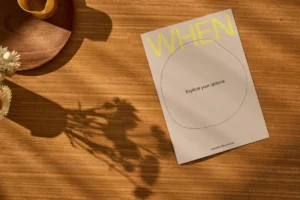

Something is breaking down inside the optimization economy, and the brands that notice it first will have access to territory that the next generation of performance tools can’t reach. Here’s a contradiction worth considering: at the precise moment when self-improvement infrastructure has never been more capable—when you can track your sleep cycles, your heart rate variability, your recovery score, your zone-two cardio minutes, your body fat to a decimal—a growing number of people are electing to leave their fingernails alone. Natural nails, slightly imperfect, visibly themselves, are displacing a decade of elaborate gel art. Walk into any independent bookshop or art market in a major city, and you’ll find the same logic repeating in print: zines, deliberately punky, visibly handmade, impossible to algorithmically reproduce, are everywhere—not as nostalgia, but as a chosen format. And in cities across Europe and the US, supper clubs—unlicensed, imperfect, deliberately unhurried—are filling faster than restaurants. Not the tasting menu as performance, but the long table, the shared dish, the three hours with no agenda. Duration, intimacy, and incompleteness as the design. These aren’t aesthetic accidents. They’re signals—small refusals of the premise that the improved version of a thing is always preferable to the actual version. What they point toward is a shift in what people find worth paying attention to, and it has direct implications for how brands build relationships at scale.
The invisible logic of constant improvement has quietly become the operating system of contemporary life. Wearable technology, once a niche pursuit, has become ubiquitous. Devices like Whoop, which track recovery and strain, have become commonplace, offering users data-driven insights into their physical readiness. This trend extends to lifestyle brands, where Skims, initially lauded for celebrating body diversity, now often features campaigns with models exhibiting a more uniform physique, suggesting an alignment with an optimized ideal. Even fitness giants like Equinox have redesigned flagship spaces to emphasize pure function, seemingly stripping away design ambiguity in the pursuit of perceived performance gains. These shifts, while often framed as aesthetic or functional choices, reflect a deeper ideological current: the belief that the self is a quantifiable system, that constant improvement is the ultimate imperative, and that anything resistant to measurement is inherently inefficient or undesirable. Brands, rather than creating this logic, have become adept at translating and amplifying it, a process that carries a significant, and increasingly apparent, cost in their relationship with consumers.
The Evolving Definition of "Softness" in a Performance-Driven World
Optimization culture fundamentally treats the present moment as purely instrumental, a stepping stone toward a future, idealized self. However, beneath the surface of data analytics and subtle cultural cues, a different demand is emerging: the desire for the present moment to be intrinsically sufficient. This involves a renewed appreciation for sensation, imperfection, and the authentic texture of experience, not as mere inputs for self-improvement, but as ends in themselves.
This concept is at the heart of what is being termed "softness" in contemporary discourse, a notion distinct from mere gentleness, minimalism, or the absence of ambition. Softness, in this context, is defined as the capacity to remain in sustained contact with the present reality—within one’s body, within the flow of time, within the occupied space—without an immediate impulse to convert it into measurable progress. It is precisely this capacity that optimization culture is designed to circumvent, and it is precisely this quality that a growing segment of the market now actively seeks.
Extensive research into softness as a lived and cultural phenomenon, involving interviews with neuroscientists, artists, chefs, historians, and sex workers, has yielded a sharp definition from Dr. Tara White, a neuroscientist at Brown University: "Softness is the expression of a system with bandwidth." This analogy, drawn from biology, suggests that resilience is not found in rigidity but in the capacity for dynamic range—the ability to expand, contract, and return, much like an athlete’s cardiovascular system. As Dr. White explains, "We are not machines. Yet culturally we’ve absorbed this idea that we should operate with machine-like consistency. That mindset is fundamentally at odds with the biology of dynamic range."
This understanding of softness as a system’s capacity to navigate a full spectrum of human states—without breaking, deflecting, or forcing immediate forward motion—is gaining traction. Brands that possess this "bandwidth" can connect with consumers not only during periods of peak performance but also during moments of vulnerability or stasis. This represents a significant, largely untapped, market opportunity.
Cultural Signals of a Shift Away from Unrelenting Optimization
The subtle but persistent refusal of the optimization imperative is already evident in numerous cultural phenomena. The rise of "bed rotting," a trend characterized by extended periods of passive rest, is not indicative of a generation giving up, but rather a response to the sheer exhaustion of maintaining a constant state of performance. Similarly, "quiet quitting," while often misinterpreted, represents a withdrawal from the implicit bargain that an employer’s ambitions should dictate an individual’s identity. The increasing normalization of therapeutic language in everyday conversations—terms like "capacity," "limits," and "co-regulation"—functions less as a clinical lexicon and more as a permission structure. It provides individuals with the vocabulary to articulate their lived experience: the realization that maintaining a perpetual performance identity has become an unsustainable, full-time job.
These are not fleeting lifestyle trends but rather manifestations of a fundamental structural refusal: the rejection of the premise that self-optimization and self-actualization are synonymous endeavors. This same logic is observable in consumer choices regarding leisure and experience. For instance, Rome’s Romeo Roma restaurant, described as maximalist and technologically ambitious, derives its cultural interest not from ostentatious displays of wealth but from its organized focus on sensory experience. Its design, including a glass-floor pool revealing archaeological ruins below, offers an immersion in layered time, embodying a philosophy closer to carpe diem than relentless aspiration. The underlying message is not about becoming one’s "best self," but about being fully alive in the present moment.
Natural nails, handmade zines, the communal supper table, and hotel rooms designed for presence rather than performance all share a common underlying principle: the present moment, in its authentic texture, is sufficient. Softness, in this context, is not a sentimental reaction to these signals but a pragmatic market adaptation to widespread psychic exhaustion. Recognizing this distinction is crucial for brand strategists, yet it remains a gap in the understanding of many marketing teams.
The Strategic Breakdown: Beyond Aesthetic Softness
When the term "softness" is introduced in branding circles, the immediate association is often with superficial aesthetic elements: muted color palettes, rounded typography, minimalist design, and a pervasive wellness-adjacent visual language. While these elements can contribute to a sense of calm, they represent "aesthetic softness," which is a distinct and arguably dated concept. The more profound strategic implication of softness lies in its behavioral architecture.
A brand can be visually maximalist and behaviorally soft. A brand can be visually minimal and behaviorally brutal.
Strategic softness is about designing systems, interactions, and communications that actively reduce what can be termed "cognitive aggression"—the inherent pressure a brand exerts on its audience simply by being in relation to them. This manifests across various touchpoints: the tone of voice, the pacing of user experience, the logic of customer service, the choreography of retail spaces, and even the structure of campaign briefs. The visual presentation and the relational register are independent variables.
Consider the divergent approaches to loyalty programs. One might employ gamified pressure tactics, such as maintaining streaks, time-sensitive rewards, and manufactured urgency. In contrast, another might adopt the principles of a thoughtful host, offering attentive support without demanding engagement and rewarding presence without penalizing absence. Both are valid loyalty mechanics, but only the latter treats its audience as a person to be accompanied rather than a system to be optimized.
Brands are already demonstrating this strategic shift. Jacquemus has cultivated a powerful cultural position in contemporary fashion not through aloofness but through a deliberate cultivation of proximity. This is evident in their farm dinners, lo-fi video content, and the transparent showcasing of their creative process. The softness here is relational, creating a sense of access to an individual rather than submission to an institution. In a fashion landscape often defined by aspiration through exclusion, this relational register was a territory largely unavailable to established luxury houses.
Duolingo, a prominent language-learning app, quietly removed its aggressive streak-loss notifications in 2024. These notifications, once a defining feature of its engagement model, had created a system of pressure loops and manufactured urgency. The decision to cease penalizing absence represented a strategic pivot, demonstrating that non-coercion can retain users whom coercion was alienating.
Loewe has carved out a distinctive niche in contemporary luxury by centering craftsmanship—the visible, imperfect, human trace embedded within its products. This approach is further amplified through artist residencies, a deliberate embrace of slowness, and cultural programming that defies easy categorization. In a luxury market increasingly characterized by smooth, seamless, and frictionless surfaces, Loewe reintroduces productive friction, positioning imperfection as a premium attribute.
Conversely, the missteps of brands like Skims, which shifted from celebrating body diversity to promoting a more uniform aesthetic, represent not merely a visual error but an ideological one. The brand moved away from a genuinely underserved conversation about the reality of diverse bodies and into the highly saturated discourse of bodies as optimization projects. Similarly, Equinox’s decision to remove design ambiguity from its flagship spaces signals a bet that its audience desires an environment akin to a performance machine. While this may retain its existing clientele, it is likely to alienate a broader, evolving demographic.
The Saturation of Hardness and the Emergence of a New Frontier
The core assertion worth examining is that "hardness" is not declining but is, in fact, saturating the market. Leading brands across various sectors are competing on assurance, authority, and protection—valid and valuable propositions. Luxury, in particular, has historically traded in hardness: the clarity of established standards, the rigor of craftsmanship, and the unambiguous signal of achievement. This aspect is unlikely to diminish. The challenge, however, is not that hardness ceases to be effective, but rather that it has become the singular strategy employed by most brands. This leads to a homogenization of market signals, where differentiation becomes increasingly difficult, and a significant register of human experience remains unaddressed and uncontested. When brands within a category converge on identical competitive grounds, their distinctiveness erodes. Collectively, they leave a vast, unclaimed whitespace.
Emotional range represents the last frontier of differentiation that cannot be algorithmically replicated. This is where the next wave of competitive advantage will be found.
Hardness provides brands with authority. Softness offers them longevity.
Brands built on an ethos of invincibility often become "trained soldier" brands: precise, directive, relentlessly forward-facing, and emotionally unsustainable in long-term relationships. Such brands can only effectively engage when their audience is performing at their peak. When individuals experience setbacks, question their goals, or suffer from an exhaustion that transcends mere sleep deprivation, these brands offer little beyond an implicit suggestion to perform better.
This exhaustion is structural. The prevailing brand promise—to become more, achieve more, be more—necessitates a state of perpetual self-dissatisfaction as its operational condition. The desire for optimization is predicated on the belief that one’s current state is insufficient. Brands founded on this logic are, at their core, in the business of manufacturing inadequacy. While this is a viable commercial strategy, it ultimately leads to relationships that consumers eventually outgrow.
The Practical Shift: From Trainer to Companion
The dominant brand posture of the past decade has been directive—the brand as an expert system dictating to audiences who they could become and the path to achieving it. This approach conveys confidence, inspires aspiration, and simplifies the brand proposition. However, it possesses a critical limitation: it is effective only when the audience is motivated, actively improving, and singularly oriented toward a predefined goal.
In contrast, the "companion" posture offers utility across a broader spectrum of conditions. It involves being present during difficult stretches as much as during successful ones, maintaining a register that is not solely aspirational while remaining true to the brand’s core values. This fundamentally reorganizes downstream strategies, influencing tone, campaign logic, and the very definition of creative consistency.
This shift manifests in three concrete ways:
- Expanding the definition of "good": Brands must move beyond defining success solely through metrics of improvement and instead embrace a broader understanding that includes presence, resilience, and the capacity to simply "be."
- Redefining consistency: Instead of adhering to a rigid, unchanging tone or visual identity, consistency will be redefined as the ability to maintain a brand’s core essence across a diverse range of emotional states and user experiences.
- Prioritizing relational intelligence: The most critical question for brand teams will evolve from "What are we saying?" to a more profound inquiry: "What does it feel like to be in a relationship with this brand across different emotional states?"
Most brand teams currently focus on the former question: what messages are being conveyed? The more impactful question, and one for which very few teams possess a systematic process, is about the felt experience of the brand relationship. This includes how the brand feels when an individual is confident and progressing, confused and stuck, or simply tired in a way that cannot be optimized away. It encompasses the experience of being fully embodied, navigating the middle of time, or existing in a space that demands more than currently available resources allow. A brand that can only engage during specific, favorable states is not a companion but rather a highly specialized product for particular conditions. However, the realities of most individuals’ lives are far more varied.
The Implication: Designing for Emotional Resilience
The next competitive frontier in branding is not a more compelling optimization narrative. Instead, it lies in the design of what can be termed "emotionally load-bearing systems"—brands, spaces, and communications that individuals can rely on across the full spectrum of their experiences, without the brand immediately pivoting to aspiration.
The human body, time, and space—when observed and understood rather than flattened into simplistic metrics—reveal that individuals are not coherent, linear, or continuously improving systems. They are inherently volatile, cyclical, embodied, and deeply susceptible to exhaustion. Their capacity fluctuates. Their grief can disrupt the perception of time. Their internal states resist constant exposure. The brands that will achieve enduring relevance in the coming decade are those that design for the entirety of this reality—not solely for peak performance moments, but also for the plateaus, the setbacks, and the quiet periods where resolution is elusive, yet life continues.
The optimization era trained brands to ask: "How do we make people want to be better?" The next era belongs to brands capable of posing a more challenging question: "How do we remain present and supportive with people as they actually are?" This fundamental shift from a directive "trainer" to a supportive "companion" is the strategic imperative for brands seeking to build deeper, more sustainable connections in an increasingly complex world.