
The digital marketing landscape has long been defined by algorithmic unpredictability, but the rise of generative artificial intelligence has introduced an entirely unprecedented layer of instability for search engine optimization professionals. Unlike traditional search engine result pages, where ranking drops can be systematically diagnosed via rank-tracking software, modern answer engines—including OpenAI’s ChatGPT, Google’s Gemini, and Perplexity—operate on non-deterministic language models. These systems frequently alter the brands, webpages, and sources they choose to cite from one prompt to the next, making traditional visibility metrics difficult to interpret. According to data from HubSpot’s State of AEO report, 58% of surveyed marketers were actively optimizing their content specifically for answer engines in early 2026, highlighting a massive industry-wide pivot toward Answer Engine Optimization.
Understanding the root cause of sudden traffic or visibility dips has thus become a primary operational challenge for marketing teams. When an organization experiences an unexpected decline in AI-referred traffic, leadership naturally demands answers. Disentangling whether a performance dip stems from internal strategic missteps or external platform-wide model updates requires robust market-wide benchmarking. By comparing proprietary brand visibility data against broad industry indices, communications teams can accurately determine whether a downturn is an isolated incident or part of a broader macroeconomic shift in how LLMs synthesize information.
Defining and Measuring AI Search Instability
AI search volatility refers to the daily fluctuations in which brands and online resources are cited by conversational agents. Because large language models are inherently non-deterministic, they do not inherently output identical responses to identical queries. Research published by SparkToro and Gumshoe.ai underscores this inconsistency, demonstrating that repeat recommendation prompts run on ChatGPT and Google’s AI Overviews had less than a 1-in-100 chance of returning an identical list of recommended brands.

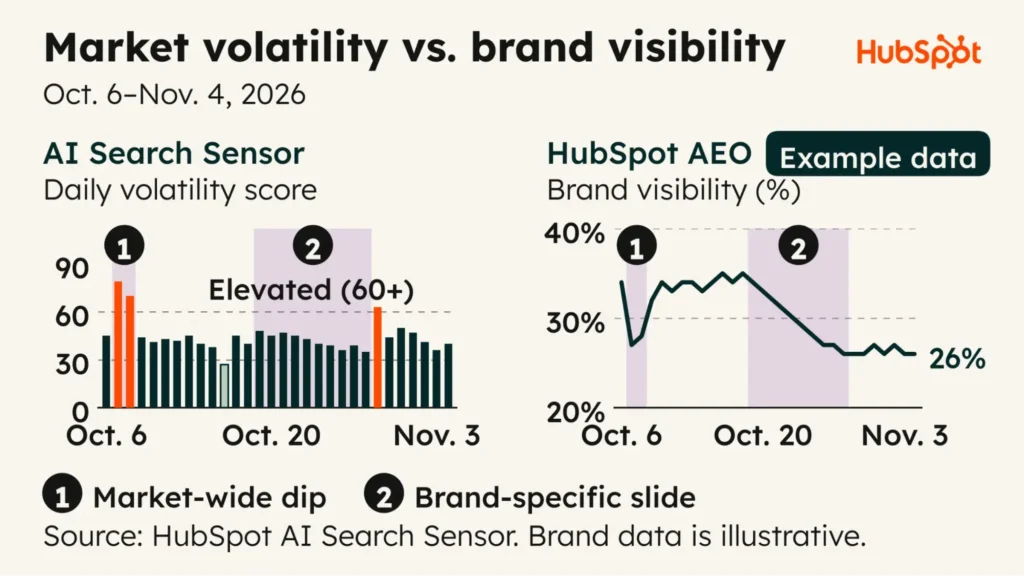
This inherent randomness presents a significant challenge for brand managers. A sudden contraction in visibility does not inherently indicate a decline in content quality. To differentiate routine algorithmic noise from genuine strategic failures, modern analytics requires macro-level contextualization. Tools such as the HubSpot AI Search Sensor track these shifts on a daily basis, utilizing indices that monitor mention rates, citation types, and referral traffic across major conversational platforms. Establishing a reliable baseline requires maintaining consistent parameters across prompt tracking, execution schedules, and engine selection while allowing daily scores a buffer of up to three days to stabilize.
Contrasting Traditional SERP Volatility with Answer Engine Fluctuations
In conventional search engine optimization, ranking volatility measures the degree to which specific webpages shift up and down within static keyword lists, often scored on a numerical scale via tools like the Semrush Sensor. Conversely, AI search volatility measures the shifting citation patterns of conversational models. While these two metrics frequently intersect—empirical research demonstrates that pages ranking higher in traditional organic search are statistically more likely to be cited within AI Overviews—they behave independently regarding user engagement.
Data from the Pew Research Center indicates that the presence of an AI summary significantly depresses click-through rates on traditional links, dropping user interaction from roughly 15% down to 8%. Consequently, a website can successfully maintain its traditional organic search rankings while simultaneously experiencing a sharp reduction in inbound traffic due to generative summaries absorbing user intent directly on the search page. This decoupling of rank and traffic has forced organizations to expand their key performance indicators well beyond conventional keyword positioning.
Methodologies for Diagnosing Market-Wide Shifts

Determining whether an optimization setback is internal or external hinges on comparative data analysis. When daily volatility trackers register elevated or extreme readings across an entire industry, marketing teams are generally advised to hold steady rather than execute knee-jerk strategic pivots. Reacting hastily to platform-level updates frequently induces more disruption than the underlying model change itself.
To conduct a valid comparative analysis, organizations must evaluate their proprietary brand data against aggregated industry benchmarks over identical timeframes. If an entire market experiences a concurrent contraction in citation frequency, the movement is undeniably platform-driven, often coinciding with a major foundational model update, such as the release of new LLM iterations. Conversely, if market benchmarks remain steady while a specific brand’s visibility plummets, the diagnostic focus must shift inward toward technical site health, crawler accessibility, or content relevance.
Reporting Volatility and Business Impact to Executive Leadership
Communicating technical search volatility to corporate leadership presents a persistent communications hurdle. B2B and B2C marketers frequently cite the attribution gap as a primary operational barrier, largely because legacy CRM and analytics attribution models have been slow to natively categorize conversational search referrals. To bridge this communication gap, executive reporting must be structured around demonstrable business outcomes—specifically leads, pipeline growth, and revenue generation—rather than abstract algorithmic metrics.
An effective leadership report on AI search volatility typically follows a five-part framework:

- High-level summary of business impact on pipeline and revenue.
- Market context derived from broad industry benchmarks.
- Brand-specific visibility and citation trends.
- Identification of specific platform updates or technical factors.
- Actionable next steps and strategic adjustments.
Organizations can significantly improve attribution accuracy by monitoring properties such as AI referrals within customer relationship management platforms and supplementing digital tracking with qualitative data collection, such as implementing direct-inquiry fields on conversion forms to capture buyers who initially discovered the brand through an AI-generated interface.
Strategic Implications and Future Outlook
As conversational search continues to mature, the methodologies governing search visibility must similarly evolve. The historical reliance on static keyword tracking and rudimentary traffic volume is rapidly giving way to holistic share-of-voice and citation-tracking paradigms. Industry surveys indicate that a substantial portion of modern consumers now make direct purchasing decisions based on brands initially discovered through conversational AI responses, cementing AEO as a core component of modern digital marketing strategies.
Successfully navigating this volatile landscape requires a disciplined commitment to multi-day data analysis, disciplined benchmarking, and patient observation. By avoiding panic during periods of extreme market-wide fluctuation and anchoring executive reports to concrete commercial outcomes, marketing organizations can effectively manage the complexities of the generative search era while safeguarding their long-term digital visibility.