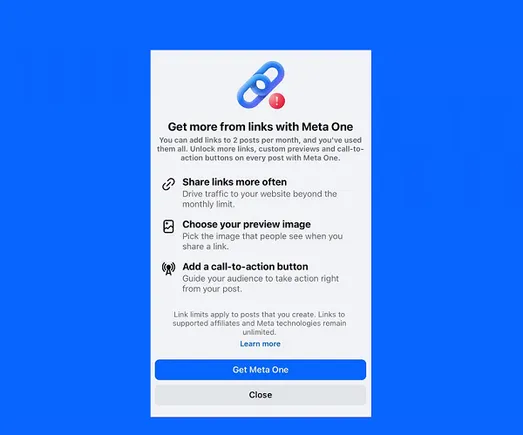

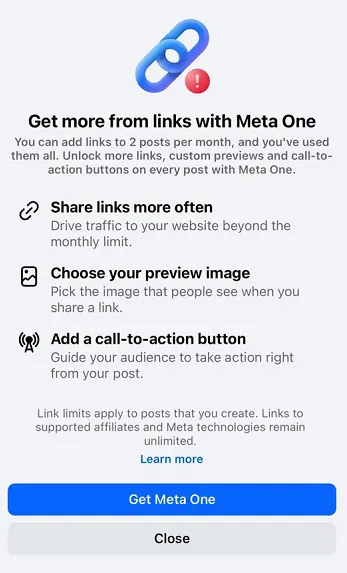
Meta has significantly broadened its testing phase regarding the restriction of outbound links on professional Facebook and Instagram accounts, tying the ability to share external URLs directly to its newly introduced Meta One for Business subscription packages. Following the rollout of these paid tiers earlier this week, numerous page administrators have reported encountering pop-up alerts notifying them that their organic capacity to share external website links has been capped at just two posts per month.
While the initial trial targeting restricted link-sharing volumes first surfaced in late 2025, the integration of these limitations with the Meta One for Business framework signals a more aggressive monetization strategy for professional pages. As social media managers, small business owners, and corporate communications teams digest the operational ramifications of these changes, the tech giant’s underlying motivations point toward a calculated structural shift in how digital publishers and enterprises distribute external content across the ecosystem.
The Chronology of Link Restrictions and the Introduction of Meta One
The groundwork for Meta’s current policy shift was laid several months ago. In December 2025, Meta initiated a localized test designed to evaluate how restricting the volume of outbound links on business profiles would impact platform dynamics. During the initial rollout, the company stated that the objective was to understand whether increasing the volume of posts containing external links provided genuine, measurable value for commercial users or if it merely contributed to lower-quality engagement loops.
Simultaneously, Meta carved out specific exemptions to protect the broader media landscape. Publisher pages, news organizations, and select informational entities were kept exempt from the initial test restrictions to ensure a steady stream of external news and content continued flowing into user feeds. However, the launch of Meta One for Business has accelerated the timeline. The paid subscription service introduces tiered pricing models that grant varying allowances for posting links on Instagram posts and Reels. Now, evidence indicates that this pay-for-access architecture is formally cascading over to Facebook Pages, where non-subscribing accounts face strict caps of two link-containing posts monthly.
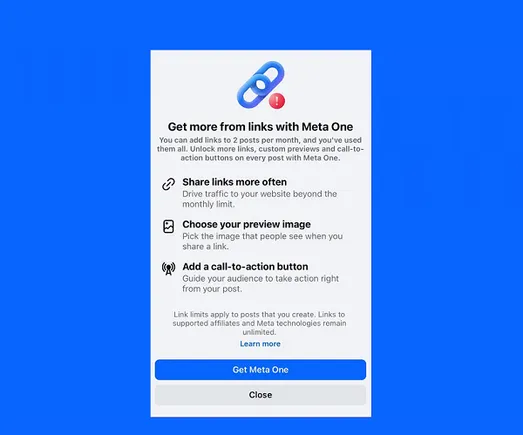
For marketing departments accustomed to utilizing organic social channels to drive web traffic, lead generation, and content discovery, the expansion of these tests transforms what was once a standard publishing feature into a tiered, monetized asset.
Decline of Organic Link Visibility on Facebook
To contextualize Meta’s strategic pivot, industry analysts point to long-term trends regarding how Facebook users consume content. For years, Meta’s algorithmic distribution has systematically deprioritized posts containing external links, favoring native video, images, and text-only formats that keep users within the Facebook and Instagram applications for longer durations.
Data published in Meta’s official Widely Viewed Content Report for the first quarter of 2026 illustrates this sustained trajectory. According to the report, a staggering 98.7% of post views in the United States during that period did not feature an outbound link to an external source outside of Facebook. This figure represents a dramatic acceleration of a multi-year decline. Historical data from Meta’s transparency reports show that in 2022—when the company first began publishing comprehensive widely viewed content metrics—approximately 9.8% of viewed content included an external link. By the Q1 2026 report, that metric plummeted to a new low of just 1.3%.
Because outbound link posts already receive negligible organic reach and visibility within user news feeds, market researchers suggest that the immediate quantitative impact of a two-link monthly cap may be less catastrophic for standard businesses than anticipated. Organic traffic driven directly from standard Facebook posts has steadily diminished in efficacy, forcing brands to rely heavily on paid advertising products like Meta Ads Manager to secure reliable web traffic. Consequently, viewing link restrictions through the lens of pure organic reach reveals that Meta is formalizing a reality that has largely governed the platform for years: organic outbound sharing is effectively a micro-feature rather than a primary driver of web traffic.
Strategic Context: Meta’s Three-Stage Monetization Playbook

The decision to gate basic publishing features behind a subscription tier aligns precisely with Meta’s foundational long-term business strategy. In 2016, during an annual stockholder meeting, Meta Chief Executive Officer Mark Zuckerberg outlined a definitive three-stage monetization framework that has guided the company’s product development for over a decade.
The blueprint dictates that Meta first builds and scales a massive consumer utility, driving widespread adoption and organic habit formation among users and creators. Once the ecosystem reaches critical mass, the second stage focuses on encouraging commercial and business entities to build their presence, establish audiences, and utilize the platform as a core operational tool at little to no initial direct cost. Finally, the third stage involves introducing robust monetization structures—ranging from advanced advertising solutions to premium subscription packages—to capture the economic value generated by commercial entities operating within the network.
Critics frequently characterize this trajectory as a classic bait-and-switch methodology: inviting businesses to cultivate audiences on a seemingly open platform, only to systematically restrict organic utility later and charge fees for baseline access. Conversely, defenders and corporate strategists argue that operating massive global digital infrastructure requires sustainable revenue models, and that commercial enterprises leveraging consumer platforms for profit should rightfully contribute to the maintenance and enhancement of those networks.
Implications for Brands, Marketers, and Small Businesses
The operational implications of Meta’s expanded link restrictions will force marketing teams to reevaluate their distribution strategies across social media channels. Businesses that rely heavily on organic social media to funnel users to e-commerce stores, corporate blogs, or informational landing pages must adapt to a landscape where publishing links is either strictly rationed or financially dependent on a Meta One for Business subscription.
For many small and medium-sized enterprises (SMEs) operating on tight margins, absorbing yet another software subscription fee—this time to maintain basic publishing functionality on a major social network—presents a fresh budgetary challenge. Marketing directors are increasingly tasked with calculating the return on investment (ROI) of subscribing to Meta One versus shifting promotional budgets entirely toward native engagement strategies, such as utilizing the platform’s native messaging tools, community-building features, and paid advertising campaigns.
Furthermore, brands are likely to place greater emphasis on alternative traffic acquisition channels, including search engine optimization (SEO), email marketing, and diversified multi-platform social strategies that do not penalize outbound link sharing to the same degree. By optimizing profile bios, leveraging dark social channels, and utilizing paid promotional formats, businesses can mitigate the bottlenecks imposed by platform-level restrictions.
Looking Ahead: The Future of Professional Social Media Accounts
As Meta continues to refine and deploy the Meta One for Business subscription ecosystem globally, the boundaries between free organic utility and paid professional tooling will continue to solidify. The expansion of link-posting limitations from initial trials to active subscription packages demonstrates the company’s commitment to diversifying its revenue streams beyond traditional digital advertising.
While the restriction of link posts to two per month may draw immediate frustration from digital marketers, the broader data indicates that organic link-sharing on Facebook has long ceased to be a primary driver of external web traffic. Ultimately, businesses navigating this evolving digital landscape must decide whether the investment in Meta’s paid tiers aligns with their broader customer acquisition goals, or if a structural pivot toward native content and alternative traffic sources represents a more sustainable path forward.