Tag: direct

  • Threads Enhances User Experience with Indented Replies and a Redesigned Web Interface Featuring Direct Messaging

    Threads Enhances User Experience with Indented Replies and a Redesigned Web Interface Featuring Direct Messaging

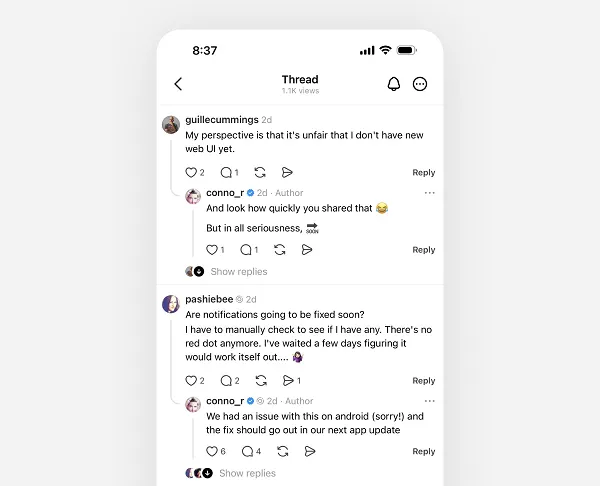
    Meta’s microblogging platform, Threads, has officially initiated the rollout of two significant updates designed to streamline navigation and improve the conversational flow for its growing global user base. The platform is introducing indented replies to help users better track complex discussions and is simultaneously overhauling its web interface to include long-awaited features such as a dedicated navigation sidebar and integrated direct messaging (DM) capabilities. These updates represent a strategic effort by Meta to bridge the functional gap between its mobile application and desktop experience, positioning Threads as a more robust competitor to X, formerly known as Twitter.

    The introduction of indented replies addresses one of the primary critiques regarding the platform’s readability since its launch in July 2023. Previously, Threads utilized a linear response format that often made it difficult for users to distinguish between direct responses to a primary post and secondary conversations occurring within a larger thread. Under the new system, responses are visually nested, creating a logical hierarchy that allows participants to follow specific branches of a conversation with greater ease. This UI enhancement is currently rolling out to all iOS users, with testing for Android devices underway and a wider release expected in the near future.

    Structural Overhaul of the Threads Web Experience

    Beyond the mobile interface, the Threads web application is undergoing a comprehensive redesign. For months, the desktop version of Threads has been criticized for being a simplified extension of the mobile app rather than a fully optimized desktop tool. The new UI introduces a layout that mirrors the traditional professional social media dashboard, featuring a main content feed on the right and a functional navigation bar on the left. This sidebar provides quick access to the home feed, search, notifications, and profile settings, significantly reducing the number of clicks required to navigate the site.

    Threads updates reply format and web UI

    A pivotal addition to the web interface is the integration of direct messaging. While Threads has historically lacked a standalone DM system—relying instead on Instagram’s infrastructure—the new web update brings messaging capabilities directly into the desktop browser. Users will soon be able to view and respond to messages without switching to their mobile devices or navigating to the Instagram website. According to Meta, while web-based messaging is not yet available for general public testing, it is slated to appear for users globally over the coming weeks.

    Chronology of Threads’ Rapid Evolution

    The development of these features marks the latest chapter in what has been an accelerated growth trajectory for Threads. Launched by Meta on July 5, 2023, the platform was positioned as a "sanitized" and more stable alternative to X, which was undergoing significant management and policy shifts at the time. The timeline of Threads’ evolution highlights Meta’s reactive and iterative development strategy:

    • July 2023: Threads launches as an invite-only extension of Instagram, reaching 100 million sign-ups in just five days, making it the fastest-growing consumer software application in history.
    • August 2023: Meta releases the first version of the Threads web app, allowing users to view and post from desktops, though it lacked many search and engagement features.
    • December 2023: The platform expands to the European Union after navigating complex regulatory requirements regarding data privacy and cross-platform integration.
    • Early 2024: Meta begins testing "Fediverse" integration, allowing Threads posts to be viewed on decentralized platforms like Mastodon via the ActivityPub protocol.
    • Mid-2024: The platform introduces "Trending Topics" and an improved search algorithm to facilitate real-time news discovery.
    • Late 2024: The current rollout of indented replies and the revamped web UI with DMs begins, focusing on power users and professional creators who utilize desktop environments.

    Supporting Data and Market Performance

    Meta’s commitment to refining the Threads UI is backed by strong performance metrics. In Meta’s Q2 2024 earnings call, CEO Mark Zuckerberg revealed that Threads had surpassed 175 million monthly active users. While this is still below X’s reported 550 million monthly active users, the growth rate suggests a steady migration of users looking for a different social experience.

    Data from third-party analytics firms indicates that while initial retention was a challenge following the record-breaking launch, engagement has stabilized. The introduction of desktop-specific features is particularly aimed at increasing "time spent on site" among journalists, marketers, and researchers—demographics that traditionally rely on desktop platforms for content curation and community management. Furthermore, internal Meta data suggests that users who engage in threaded conversations are 30% more likely to return to the app within 24 hours, justifying the technical investment in indented replies.

    Threads updates reply format and web UI

    Official Responses and Strategic Vision

    Adam Mosseri, the Head of Instagram and Threads, has been vocal about the platform’s philosophy regarding user feedback. In a recent post on the platform, Mosseri emphasized that the goal is to create a "productive and positive space for public conversation." He noted that the team is focused on "closing the feature gap" with competitors while maintaining a unique identity that prioritizes community safety and creator tools.

    Regarding the new web UI, Meta spokespeople have stated that the goal was to provide a "more familiar and efficient experience for those who use Threads for work or during their workday." The inclusion of DMs on the web is seen as a direct response to one of the most requested features from the community. By centralizing communication, Meta aims to make Threads a self-sustaining ecosystem that no longer feels like a secondary attachment to Instagram.

    Analysis of Implications for the Social Media Landscape

    The shift toward a more organized, desktop-friendly interface has several implications for the broader social media industry. First, it signals that Meta is no longer content with Threads being a "mobile-first" experiment. By adopting a UI that closely resembles the layout of X, Meta is making it easier for "power users" to switch platforms without having to relearn navigation habits.

    The introduction of indented replies is more than a visual tweak; it is a fundamental change in how information is consumed. In the "attention economy," the clarity of information determines how long a user stays engaged. Linear feeds often lead to "context collapse," where replies become untethered from their original meaning. Indentation preserves the context of the conversation, which is essential for healthy debate and nuanced discussion.

    Threads updates reply format and web UI

    Furthermore, the integration of DMs on the web is a tactical move to increase "stickiness." When a platform becomes a primary communication tool, user churn decreases significantly. If Threads can successfully transition from a place where people merely "post" to a place where they "talk," it will secure its position as a permanent fixture in the social media landscape.

    Future Outlook and Fediverse Integration

    As Threads continues to roll out these UI updates, the next major frontier for the platform is its integration with the Fediverse. Meta has already begun allowing users in certain regions to share their posts to other servers using the ActivityPub protocol. This decentralized approach is a departure from Meta’s historically "walled garden" strategy and suggests a long-term vision where Threads acts as a primary hub for a broader, interconnected internet.

    In the coming months, industry analysts expect Threads to focus on improving its "Live" capabilities and real-time data feeds. While the current updates improve the "look and feel" of the platform, the next challenge will be capturing the "breaking news" energy that still largely resides on X. The combination of a refined web UI, better conversation tracking through indentation, and the convenience of desktop DMs provides the necessary foundation for Threads to move beyond its "alternative" status and become a primary destination for digital discourse.

    With these updates, Meta is demonstrating a disciplined approach to product development—listening to user grievances, analyzing engagement data, and systematically deploying features that enhance the utility of the platform. For the 175 million active users, these changes represent a more mature, professional, and accessible version of Threads that is better equipped to handle the complexities of modern social interaction.

  • Google Ads Streamlines Conversion Tracking with Direct Google Tag Manager Integration

    Google Ads Streamlines Conversion Tracking with Direct Google Tag Manager Integration

    Digital advertisers are witnessing a significant evolution in campaign infrastructure as Google begins testing a streamlined "Set up in Google Tag Manager" option directly within the Google Ads conversion setup workflow. This development, initially identified by Google Ads Specialist Natasha Kaurra and subsequently reported by industry monitors such as PPC News Feed, marks a strategic move by the tech giant to eliminate one of the most persistent bottlenecks in digital marketing: the manual implementation of conversion tags. By creating a direct bridge between the Google Ads interface and Google Tag Manager (GTM), Google aims to reduce the high rate of human error associated with copying and pasting tracking IDs and conversion labels, ensuring that performance data is captured with greater precision and less technical friction.

    The Evolution of Conversion Tracking and the Manual Burden

    To understand the significance of this update, one must look at the historical trajectory of digital ad tracking. For over a decade, conversion tracking has been the bedrock of search engine marketing. It allows advertisers to see what happens after a customer interacts with an ad—whether they purchased a product, signed up for a newsletter, or downloaded an app. Historically, this required the manual placement of JavaScript snippets on specific "thank you" or "confirmation" pages.

    When Google Tag Manager launched in 2012, it revolutionized this process by providing a centralized container where marketers could manage various tracking codes without needing to constantly edit the website’s source code. However, even with GTM, the setup process remained bifurcated. An advertiser would generate a conversion action in Google Ads, obtain a unique Conversion ID and a Conversion Label, and then manually navigate to GTM to create a new tag, choose the Google Ads Conversion Tracking template, and paste those alphanumeric strings into the corresponding fields.

    While seemingly simple, this manual "hand-off" between platforms has been a frequent source of data discrepancies. Typographical errors, missing characters, or the accidental swap of IDs between different conversion actions often result in "broken" tracking, leading to under-reported ROI or, conversely, inflated conversion numbers that mislead machine-learning algorithms.

    Technical Breakdown: The Direct GTM Integration Workflow

    The new feature, currently in a testing phase for select accounts, introduces a "Set up in Google Tag Manager" button alongside existing methods such as "Install the tag yourself" or "Email the tag to your developer." Based on early screenshots and user reports, the integrated workflow follows a structured sequence designed to minimize user input while maximizing configuration accuracy.

    1. Platform Handshake: Upon selecting the GTM option, the user is prompted to select the specific Google Tag Manager account and container associated with the website they are tracking.
    2. Automated Configuration: Instead of requiring the user to copy-paste the Conversion ID and Label, Google Ads pushes this metadata directly into a pre-filled tag configuration window within the GTM interface.
    3. Simplified Tag Creation: The system automatically selects the "Google Ads Conversion Tracking" tag type. It pre-populates the required fields, including the Conversion ID, Conversion Label, and, where applicable, the Conversion Value, Transaction ID, and Currency Code variables.
    4. Triggering and Publishing: The user is then guided to select a trigger (the event that tells the tag when to fire, such as a page view or button click). Once the trigger is assigned, the user can publish the container, completing the setup without ever having to manually handle the underlying code.

    This integration represents a shift toward "low-code" or "no-code" solutions within the Google marketing stack, reflecting a broader industry trend of lowering technical barriers for small-to-medium-sized businesses while increasing the velocity of deployment for large-scale agencies.

    Google Ads tests direct Google Tag Manager integration for conversion setup

    Data Integrity and the Role of Machine Learning

    The move toward automated tag implementation is not merely a matter of convenience; it is a fundamental requirement for the modern era of "Smart Bidding." As Google Ads moves further toward AI-driven automation, the quality of the input data becomes the primary lever for campaign success.

    Google’s machine learning models—such as Target CPA (Cost Per Acquisition) and Target ROAS (Return on Ad Spend)—rely on a continuous stream of accurate conversion data to understand which users are most likely to convert. If a manual setup error causes a 10% under-reporting of conversions, the AI will incorrectly conclude that certain keywords or audiences are underperforming, leading to bid reductions and lost revenue. By automating the link between the ad platform and the tag manager, Google is effectively "protecting the signal," ensuring that its bidding algorithms receive the cleanest possible data.

    Furthermore, this update facilitates the adoption of "Enhanced Conversions," a feature that uses hashed first-party data to provide a more accurate view of conversions that might otherwise be lost due to browser privacy changes or cookie restrictions. A direct GTM integration makes it significantly easier to map the necessary user-provided data fields, which are often complex to configure manually.

    Strategic Implications for Digital Marketing Agencies

    For performance marketing agencies, the time spent on "tagging and tracking" is often a non-billable or low-margin overhead. Agency specialists frequently manage dozens of client containers, each with unique naming conventions and existing tag structures. The "Set up in GTM" feature offers several distinct advantages for these professionals:

    • Standardization: The automated push ensures that tags are named and configured according to Google’s best practices, creating a more uniform environment across multiple client accounts.
    • Reduced QA Cycles: Quality Assurance (QA) is a major component of any tracking implementation. Automated setups reduce the time spent debugging "missing ID" errors, allowing technical teams to focus on more complex custom event tracking and data layer architecture.
    • Faster Onboarding: When a new client is brought on board, the "time to market" for their first campaign is often dictated by how quickly tracking can be verified. This integration can shave hours or even days off the setup process, particularly when working with clients who have limited internal technical resources.

    The Broader Context: The Unified "Google Tag" Strategy

    This GTM integration is the latest step in a multi-year effort by Google to unify its measurement infrastructure. In 2022, Google introduced the "Google Tag" (gtag.js), a single tag that can be used for both Google Ads and Google Analytics 4 (GA4). The goal was to simplify the "tag bloat" on websites, where multiple redundant scripts were often slowing down page load speeds.

    By integrating the GTM setup directly into the Google Ads flow, Google is further consolidating its ecosystem. It encourages advertisers to use GTM as their primary deployment method, which in turn makes it easier for Google to roll out future updates—such as server-side tracking or advanced consent mode features—across a wider user base. Server-side tracking, in particular, is becoming a priority as traditional third-party cookies are phased out by browsers. GTM is the gateway to server-side implementation, and by funneling advertisers into GTM now, Google is preparing them for the more technical requirements of a cookieless future.

    Privacy, Consent, and Compliance

    In the current regulatory climate, dominated by the GDPR in Europe and various state-level privacy laws in the U.S., tracking is no longer just a technical hurdle; it is a legal one. Google Tag Manager plays a critical role in "Consent Mode," a feature that adjusts the behavior of Google tags based on the consent status of the user.

    Google Ads tests direct Google Tag Manager integration for conversion setup

    A direct integration between Ads and GTM allows for a more seamless implementation of Consent Mode. When the setup is automated, Google can more effectively prompt the user to ensure that their tags are "privacy-aware." This reduces the risk of advertisers inadvertently firing tracking pixels for users who have opted out of data collection, thereby helping brands maintain compliance with global privacy standards.

    Industry Reaction and Future Outlook

    While the feature is still in testing, the initial reaction from the PPC (Pay-Per-Click) community has been overwhelmingly positive. Experts note that while the change is a relatively small UI (User Interface) update, its impact on the daily workflow of digital marketers is substantial.

    "The friction between the ad interface and the tag manager has been a pain point for a decade," says one industry analyst. "Any move that reduces the ‘copy-paste’ nature of tracking is a win for data accuracy. It’s about making the technical foundation of a campaign as invisible as possible so that marketers can focus on strategy and creative."

    Looking ahead, it is likely that this integration will expand. We may soon see similar "push" functionalities for Google Analytics 4 event creation or automated "Data Layer" suggestions based on the type of conversion being tracked (e.g., e-commerce vs. lead generation). As Google continues to refine this flow, the distinction between "managing ads" and "managing data" will continue to blur, leading to a more cohesive and automated advertising experience.

    Conclusion

    The introduction of the "Set up in Google Tag Manager" option within Google Ads represents a significant milestone in the quest for "seamless measurement." By automating the connection between the intent (creating a conversion in Ads) and the execution (deploying a tag in GTM), Google is addressing a long-standing vulnerability in the digital marketing funnel. For advertisers, this means more reliable reporting, better-optimized campaigns, and a significant reduction in the technical debt associated with manual tracking. As the digital landscape becomes increasingly complex due to privacy regulations and the decline of cookies, such integrations are not just conveniences—they are essential tools for survival in a data-driven economy.

Grafex Media
Privacy Overview

This website uses cookies so that we can provide you with the best user experience possible. Cookie information is stored in your browser and performs functions such as recognising you when you return to our website and helping our team to understand which sections of the website you find most interesting and useful.