Tag: grammar

  • A Grammar of Typography: Classical Design in the Digital Age

    A Grammar of Typography: Classical Design in the Digital Age

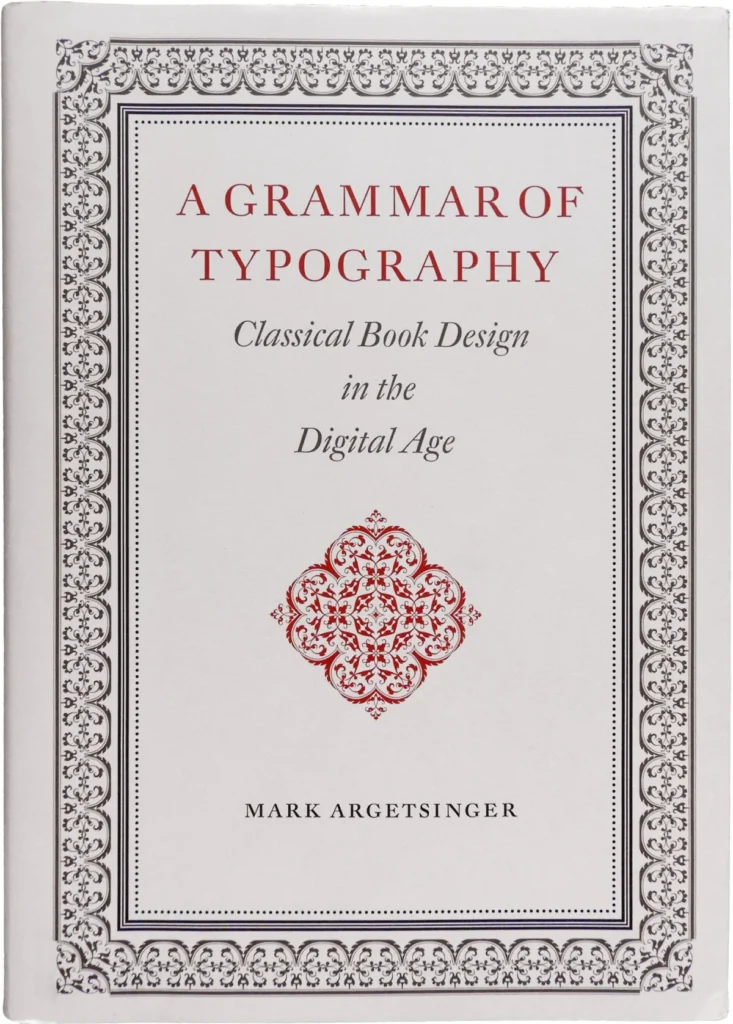
    In an era characterized by rapid technological advancement and the increasing digitalization of information, the enduring principles of traditional book design are facing unprecedented challenges. Mark Argetsinger’s comprehensive volume, A Grammar of Typography: Classical Design in the Digital Age, published by David R. Godine in 2020, emerges as a significant, albeit complex, contribution to the discourse surrounding the preservation and adaptation of classical typographic practices. This in-depth review, penned by Joshua Langman and originally published on January 6, 2022, delves into the strengths and weaknesses of Argetsinger’s treatise, examining its ambitious aim to equip a new generation of designers with the foundational knowledge required to produce meticulously crafted books in a world increasingly dominated by ephemeral digital content.

    The book’s genesis can be understood against a backdrop of profound shifts in the publishing industry. For centuries, the printed book has been a tangible artifact, shaped by a rich tradition of craft knowledge and trade practices. However, the advent of digital media has led to the abandonment of many of these long-standing disciplines. Publishers, both commercial and academic, appear to be systematically sidelining the very craftspeople—typographers—essential for preserving the printed book as a designed object and for fostering a deeper, more visceral engagement with reading. Typography, often relegated to a sub-discipline within graphic design, is in fact a distinct literary craft, historically intertwined with editing, printing, and publishing. The contemporary landscape of design literature frequently prioritizes ephemeral applications like web typography, e-books, and software interfaces, treating type as a transmedia construct rather than a tangible element. This pervasive trend, the review notes, risks devaluing the printed codex, a medium that has benefited from over five centuries of refinement. A Grammar of Typography therefore arrives as a timely intervention, advocating for the continued relevance of the traditional book as the preeminent medium for text presentation.

    Argetsinger’s work is positioned as a manual for designers seeking to uphold the standards of historical printers, navigating the complexities of digital tools such as text frames and swatch menus that have replaced the composing stick and ink stone. The book’s subtitle, Classical Book Design in the Digital Age, clearly articulates its core mission: to bridge the gap between historical typographic principles and contemporary digital workflows. Despite a vast contextualization of its subject matter, Argetsinger maintains a deliberately narrow focus, aiming to produce a guide for the creation of beautiful, meticulously crafted books in an era that often undervalues such endeavors. Langman observes that Argetsinger’s "quiet confidence in the simple superiority and timeless relevance of his craft is inspiring," presenting a "defiant affirmation of the necessity of bookmaking as a cultural endeavor." This assertion highlights the book’s potential to serve as a counter-narrative to the prevailing technological enthusiasm surrounding electronic publishing.

    A Deep Dive into the Content and Structure

    Despite the book’s laudable objectives and inspiring thesis, Langman’s review reveals a more nuanced picture when examining the finer details of its execution. The volume, comprising 514 pages and presented in a format reminiscent of historical folios, is substantial. Its physical presence, described as "at home on a stout wooden desk or a library lectern," underscores its dedication to a tangible, scholarly approach. The interior design successfully evokes the aesthetic sensibilities of neoclassical and baroque scholar-printers, a deliberate choice aimed at immersing the reader in the historical context of classical typography.

    However, the review points to a structural imbalance that potentially hinders its pedagogical effectiveness. Argetsinger dedicates a significant portion of the book—135 pages—to establishing the philosophical and historical groundwork for his typographic approach, leaving a comparatively smaller segment of 64 pages for practical instruction on working with type. For readers who are likely already familiar with the fundamentals of digital typesetting and are seeking advanced, nuanced technical skills, this extensive theoretical preamble may feel overwhelming. The book’s unique instructional value, which one might expect to lie in its ability to translate classical values into digital tools, is somewhat overshadowed by a reiteration of historical context that is readily available in other publications. While Argetsinger does offer valuable insights into paper selection and binding, the chapters dedicated to typography itself are criticized for their disproportionate focus on foundational concepts, akin to "Typography 101," and elementary software tutorials.

    Critiques of Execution and Typographical Choices

    The meticulous nature of book design invites scrutiny of its smallest details, and A Grammar of Typography is no exception. Langman identifies several points of contention regarding the book’s internal execution. While the typesetting is generally described as "impeccable," occasional lapses are noted. These include instances where numerals are not proportionally spaced, creating awkward gaps, and a stylistic choice to make running heads and folios larger than the main text. This latter decision is characterized as a "distinctly late-nineteenth-century American idiosyncrasy" that clashes with the book’s otherwise continental baroque and neoclassical aesthetic. Furthermore, the use of asterisks as section dividers is seen as a regression to a "typewriter-age" remnant, a practice that Argetsinger himself appears to caution against. The review contrasts the "restrained title page," which effectively uses scale, space, and color to convey meaning, with the "floriated dust jacket," which is deemed to indulge in "ecstatic ornamentation" that communicates little beyond a generalized baroque aesthetic.

    Beyond stylistic considerations, the book suffers from a notable quantity of typographical errors, averaging "about one every two pages." Names of individuals and typefaces are particularly susceptible to misspellings. Substantive factual errors also surfaced during the editorial process. For example, a specimen of Garamond Premier is misidentified as Adobe Garamond, and a demonstration intended to illustrate "kerning triumphant" with Zapfino is revealed to be a display of ligatures, where the entire word is a single, multi-character glyph. These errors, while perhaps minor in isolation, collectively detract from the authority and professionalism of a volume that purports to be a definitive guide to meticulous design.

    The Historical Scope and its Limitations

    A significant point of critique revolves around the book’s historical scope and its implications for contemporary design practice. The chapter on digital fonts, though brief at fourteen pages, is followed by a showcase of recommended typefaces, predominantly digital revivals of historically significant metal text faces. This selection, Langman argues, creates a "disconcerting impression that the history of typography ended sometime around the middle of the twentieth century." The review contends that this perspective represents "historically bound design" rather than merely "historically informed" design. The latter half of the twentieth century and the early twenty-first century saw the creation of numerous exceptional serifed text faces that employ distinct design idioms. By omitting these contemporary advancements, Argetsinger’s selection risks presenting an incomplete picture of typographic evolution.

    A Grammar of Typography: Classical Book Design in the Digital Age

    The omission extends to specific examples of significant digital revivals. The review questions the absence of Iberian revivals such as Mário Feliciano’s Rongel and Cristóbal Henestrosa’s Espinosa Nova. Additionally, several prominent modern revivals of Argetsinger’s preferred historical faces, including William Berkson’s Williams Caslon, Sergei Egorov’s Neacademia, Mark van Bronkhorst’s ATF Garamond, and František Štorm’s Jannon series, are inexplicably absent. This selective curation raises questions about the breadth of Argetsinger’s engagement with contemporary typographic scholarship and practice.

    The Definition of "Classical" and its Implications

    The term "classical" in the book’s subtitle, Langman clarifies, refers not to antiquity in the humanities sense, but to the neoclassical and baroque periods, analogous to the era of classical music. This definition, however, is not universally accepted as the zenith of typographic practice. Design historian Alan Bartram, for instance, views baroque design as an overcomplication of High Renaissance design, a period that might have served as a more intuitive exemplar of typographic purity. An alternative historical period that could have been explored as a high point in book design is the first half of the twentieth century, particularly in American commercial book design. The choice of the baroque era is thus characterized as "arbitrary" and "too aesthetically specific to be of much general use as a model of book design."

    The review posits a fundamental question: rather than imitating the forms of books designed by masters like Fournier, should designers not strive to identify the underlying structural logic of their work and extrapolate a more timeless and flexible approach? This leads to a broader discussion of Argetsinger’s design philosophy, which seems to equate the continued use of traditional materials and processes with an adherence to historical aesthetics. Langman argues for a distinction between medium and aesthetic, suggesting that it is possible to utilize "old tools in new ways." Argetsinger, conversely, appears committed to "using new tools in old ways." The book, the review notes, lacks discussion on how a design should emerge from or reflect the nature of the book itself, or practical advice on typeface selection beyond a curated list.

    A Contrast in Design Philosophies

    The review draws a contrast between Argetsinger’s approach and that of designers like Richard Eckersley. Eckersley, while capable of executing historically accurate designs, also possessed the ability to dissect, parody, and subvert historical conventions for postmodern texts. This suggests a capacity for creative reinvention, pushing the boundaries of established norms. The question arises whether a designer should subscribe exclusively to a single aesthetic philosophy. Some practitioners argue that a typographer should ideally possess no personal style, as any given style might be inappropriate for a particular project. A truly proficient typographer, the argument goes, should be conversant with the entire history of their craft, from antiquity to the present, enabling them to adapt to diverse aesthetic demands.

    The limitations of Argetsinger’s exclusive focus become apparent when considering texts that fall outside his defined aesthetic. Ancient texts, such as Robert Bringhurst’s translation of Parmenides, might be ill-suited to the "French fleurons and baroque filigree" that Argetsinger champions. Similarly, contemporary texts may challenge and transcend the traditional aesthetic of the book. The review questions how Argetsinger’s approach accommodates these diverse literary and historical contexts.

    The Role of Self-Consciousness and Experimentation

    While acknowledging Argetsinger’s sincerity and holistic approach, and distinguishing it from superficial pastiche, Langman observes that his philosophy leaves "no room for self-consciousness, irony, or aesthetic experimentation." Argetsinger is portrayed as a "traditional artisan in a postmodern world." The review suggests that while a yearning for a simpler era where visual beauty was an uncontroversial goal is understandable, contemporary designers must recognize the increased complexity of the field. The works of designers like Richard Eckersley and the manuals of Robert Bringhurst and Rich Hendel are presented as examples of a more pluralistic view, more adept at connecting the classical tradition with the fragmented philosophies of the postmodern age.

    The Enduring Importance of the Book

    Despite its frustrations, A Grammar of Typography is ultimately deemed an important work. In a period where books are increasingly trending towards "digital ethereality" and trade publishers are producing what are essentially photocopied pages presented as codices, a book that champions the "vitality of the codex as a manifestation of human thought and a product of human craft" is sorely needed. The review anticipates a potential cultural backlash against digital reading, positioning Argetsinger’s book as a timely catalyst. It has the potential to "pique the interest of young designers in search of materiality and authenticity" and contribute to a renaissance in bookmaking, not only as a fine art but also as a viable commercial craft.

    A Call for Broader Horizons

    Argetsinger’s contributions are multifaceted, ranging from his "passionate and erudite prose" to his "laudable and distinctly anti-commercial conviction" that designers should be involved in all aspects of book production. His devotion to typographic scholarship, his intricate arrangements of printer’s ornaments, and his profound belief in the significance of books are sources of inspiration. However, by narrowly defining "classical design," he risks excluding designers who aim not only to master historical practices but also to revitalize the tradition, reintroduce high-quality typography to new audiences, and, in doing so, help preserve the codex itself. The review concludes with a gentle suggestion: "A little more practical typographic instruction, a bit more editorial care, and a slight broadening of its underlying philosophy would help to make A Grammar of Typography into the spiritual and practical guide for contemporary typographers that it aspires to be."

    Joshua Langman, the reviewer, brings a wealth of experience to his critique. As a typographic designer, his background includes extensive study in letterpress printing, monotype casting, and book arts from institutions like Wells College Book Arts Institute, the Press and Letterfoundry of Michael and Winifred Bixler, and Sarah Lawrence College. His work on Babel, a polyglot literary journal, and his digitization of Hermann Zapf’s Orbis Typographicus demonstrate a deep engagement with typography and its historical dimensions. Langman’s expertise is further evidenced by his authorship of Standby: An Approach to Theatrical Design, underscoring his multidisciplinary perspective on design and communication. His qualifications lend significant weight to his assessment of Argetsinger’s A Grammar of Typography, positioning his review as a valuable contribution to the ongoing conversation about the future of book design.

Grafex Media
Privacy Overview

This website uses cookies so that we can provide you with the best user experience possible. Cookie information is stored in your browser and performs functions such as recognising you when you return to our website and helping our team to understand which sections of the website you find most interesting and useful.