The marketing technology landscape is undergoing a profound transformation as businesses increasingly pivot toward automated solutions to manage the complexity of the modern digital ecosystem. Marketing automation, once a specialized tool for enterprise-level corporations, has evolved into a foundational component of the marketing tech stack for organizations of all sizes. By leveraging software to automate repetitive tasks—ranging from email sequencing and social media scheduling to complex lead scoring and multi-channel campaign management—companies are realizing significant gains in operational efficiency and customer engagement. As of 2024, the industry is positioned at a critical juncture where artificial intelligence and machine learning are merging with traditional automation frameworks to redefine how brands interact with their audiences.
Market Revenue and Industry Growth Projections
The economic footprint of the marketing automation industry reflects its growing necessity within the global business framework. Market analysts and industry data indicate a consistent upward trajectory in worldwide revenue, signaling that investment in these technologies is not merely a trend but a long-term strategic shift. In 2021, the global marketing automation market was valued at approximately $4.79 billion. By 2022, this figure grew to $5.19 billion, followed by a jump to $5.86 billion in 2023.

Current projections for 2024 estimate the market size at $6.62 billion, representing a robust year-over-year growth rate. This momentum is expected to accelerate as businesses seek to integrate disparate data sources into unified platforms. By 2026, spending is anticipated to reach $8.44 billion, eventually crossing the $10 billion threshold by 2028. Long-term forecasts are even more aggressive, with the market expected to hit $17.2 billion by 2031 and reach a staggering $21.7 billion by 2032. This nearly five-fold increase from 2021 levels underscores the total digital transformation of the marketing sector, driven by the need for hyper-personalization at scale.
Evolution of Marketing Automation: A Brief Chronology
The journey to the current $6.6 billion market has been marked by several distinct eras of technological advancement. Understanding this timeline provides essential context for the current statistics:
- The Early Era (1990s – Early 2000s): The inception of the industry was characterized by basic email marketing tools and the birth of CRM (Customer Relationship Management) systems. These tools were primarily reactive and required significant manual oversight.
- The Integration Era (2010 – 2018): Platforms like HubSpot, Marketo, and Pardot began to consolidate features, allowing marketers to link social media, landing pages, and email into a single workflow. This era saw the rise of inbound marketing as a dominant strategy.
- The Intelligence Era (2019 – Present): The current phase is defined by the integration of Artificial Intelligence (AI). Modern platforms no longer just follow "if-then" rules; they use predictive analytics to determine the best time to send a message, the most effective subject lines, and the likelihood of a lead to convert.
Shifting Budgets and Marketer Sentiment
The financial commitment of marketing departments serves as a primary indicator of the technology’s perceived value. Data regarding budget allocations for 2024 reveals a strong consensus: marketing automation is a high-priority investment. Approximately 68% of marketers report that they are increasing their automation budgets. Specifically, 14% of respondents plan to increase spending significantly, while 54% anticipate moderate increases.

Conversely, only 11% of marketers expect to decrease their spending, with a mere 2% planning significant cuts. About 21% intend to keep their budgets stable. This widespread willingness to allocate more capital toward automation suggests that the Return on Investment (ROI) of these platforms has been proven across various sectors, even in a fluctuating global economy. Industry experts suggest that as labor costs rise, companies are looking to automation to maintain output without proportionally increasing their headcount.
Current Adoption Rates and Channel Usage
While the term "marketing automation" covers a broad spectrum of activities, adoption is not uniform across all channels. Email marketing remains the most dominant application, with 58% of marketers utilizing automation for their email campaigns. This is followed closely by social media management at 49%, where tools are used to schedule posts and monitor engagement across multiple platforms simultaneously.
Other significant areas of adoption include:

- Content Management: 33%
- Paid Advertisements: 32%
- SMS Marketing: 30%
- Campaign Tracking: 28%
- Landing Pages: 27%
Interestingly, there is a gap between current usage and planned adoption. For instance, while only 32% currently automate their paid ads, 29% of marketers plan to implement automation in this area in the near future. Similarly, social media management is a top priority for upcoming automation projects (29%). These figures indicate that while email is the "mature" segment of the market, the next wave of growth will come from paid media and mobile-first channels like SMS and push notifications.
Strategic Goals and the Quest for Data Quality
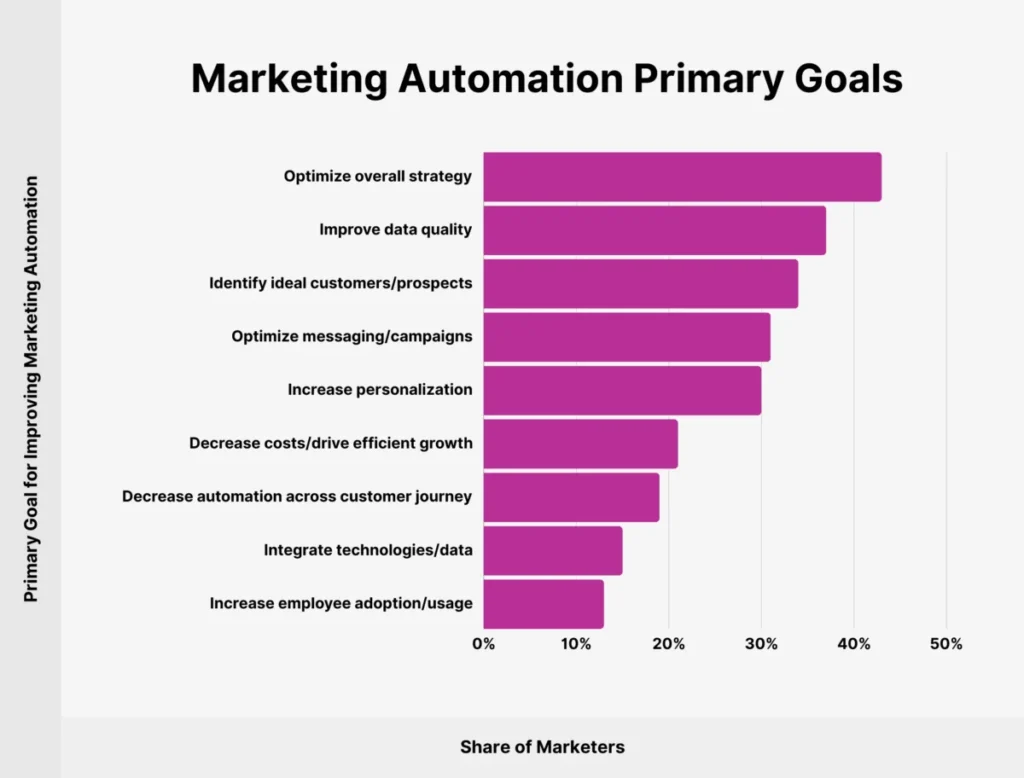
The primary motivation for implementing marketing automation has shifted from simple "time-saving" to more complex strategic objectives. According to recent surveys, the top goal for improving marketing automation is to optimize the overall marketing strategy, cited by 43% of professionals. This suggests that marketers are no longer looking for siloed tools but for platforms that can inform their broader business decisions.
The second most common goal is improving data quality (37%). In an era of strict privacy regulations like GDPR and CCPA, and the phasing out of third-party cookies, having high-quality, first-party data is essential. Automation platforms serve as the "source of truth" for customer interactions, helping to clean and organize data that would otherwise be fragmented. Other key goals include:

- Identifying Ideal Customers/Prospects: 34%
- Optimizing Messaging/Campaigns: 31%
- Increasing Personalization: 30%
- Driving Efficient Growth/Decreasing Costs: 21%
The Customer Journey and Automation Depth
A critical metric for the success of these platforms is how effectively they manage the customer journey. However, the data reveals that "full automation" is still a rarity. Only 9% of marketers describe their customer journey as "fully automated." The vast majority (59%) report being "partially automated," while 32% are "mostly automated."
Despite the lack of total automation, there is high satisfaction with the capabilities of modern platforms. 89% of marketers agree (30% strongly, 59% somewhat) that their marketing automation platform makes it easy to build effective customer journeys. The bottleneck appears not to be the software itself, but rather the complexity of designing multi-channel strategies that feel seamless to the end user. Only 5% of organizations have fully automated their multi-channel marketing strategies, while 22% have not automated them at all, highlighting a significant opportunity for growth in the mid-market and enterprise segments.
Procurement Drivers: What Influences the Purchase Decision?
When organizations enter the market for a new automation solution, their priorities are clear and pragmatic. Price remains the leading factor, influencing 58% of purchase decisions. However, "Ease of Use" is a very close second at 54%. This reflects a common pain point in the industry: sophisticated software is useless if the marketing team cannot navigate it without constant help from IT.

Other influential factors include:
- Customer Service: 27%
- Customization Options: 24%
- Integration Capabilities: 22%
- Breadth and Depth of Features: 21% and 19% respectively
- Data Visualization and Analytics: 13%
The emphasis on ease of use and customer service suggests that "human" factors remain vital in the software-as-a-service (SaaS) industry. Companies are looking for partners, not just vendors, to help them navigate the complexities of implementation and onboarding.
Quantifiable Benefits and Business Impact
The benefits of marketing automation extend beyond the marketing department and impact the entire organization’s bottom line. The most cited advantage is the improvement of the customer experience (43%). By delivering the right message at the right time, automation reduces friction in the buying process and fosters brand loyalty.

Efficiency gains are also a major driver, with 38% of marketers stating that automation enables better use of staff time. By removing manual data entry and repetitive tasks, employees can focus on high-level creative and strategic work. Furthermore, 35% of respondents noted that automation leads to better data and decision-making, while 34% saw improvements in lead generation and nurturing. From a fiscal perspective, 33% of marketers believe automation allows for better use of the overall marketing budget by identifying and doubling down on the most effective channels.
Broader Implications and Future Outlook
The data presented paints a picture of an industry that is both maturing and expanding. As marketing automation moves toward the $21 billion mark over the next decade, several key implications emerge. First, the divide between "automated" and "manual" businesses will likely widen, with the former enjoying a significant competitive advantage in terms of speed-to-market and personalization.
Second, the role of the marketer is evolving. The demand for "MarTech" specialists who can bridge the gap between creative strategy and technical execution is at an all-time high. Finally, the integration of AI will likely solve the current "partial automation" dilemma, allowing for more dynamic, self-optimizing customer journeys that require less manual configuration.

In conclusion, marketing automation has moved past the early adoption phase and is now a critical engine for business growth. With nearly 70% of marketers increasing their budgets and a clear roadmap toward multi-billion dollar revenues, the industry is set to remain a cornerstone of the global digital economy. Organizations that successfully navigate the challenges of data quality and ease of use will be best positioned to capitalize on these technological advancements, ultimately delivering a superior experience to their customers.