
For generations, mainstream historiography has characterized the period between the fall of the Western Roman Empire and the dawn of the Italian Renaissance as a stagnant epoch dominated by intellectual regression and socio-economic decline. Popularly referred to as the Dark Ages, this millennium-long span has frequently been dismissed as a prolonged intermission in human progress, a narrative that effectively sidelined the monumental advancements occurring outside Western Europe. However, a rigorous examination of the medieval Islamic Golden Age reveals a vastly different reality. While portions of Europe struggled with urbanization and infrastructure, thriving urban centers such as Baghdad, Cairo, Córdoba, and Isfahan operated sophisticated networks of universities, astronomical observatories, public hospitals, and extensive libraries. Within these thriving metropolitan hubs, scholars systematically preserved, translated, and expanded upon classical Greek, Persian, and Indian philosophies, laying the foundational framework for modern mathematics, astronomy, and engineering.
Among the most dynamic intersections of this intellectual renaissance was the Artuqid dynasty, a Turkoman principality that flourished during the twelfth century in the southeastern region of Anatolia. Centered in the ancient city of Amid—modern-day Diyarbakır, Turkey—the Artuqid court cultivated an environment of extraordinary cultural patronage and scientific inquiry. Operating against the backdrop of the protracted Crusades and the bustling trade networks of the Silk Road, the Artuqid rulers possessed both the financial capital and the aesthetic inclination to commission ambitious engineering projects. In this milieu, mechanical design transcended purely utilitarian functions, evolving into a sophisticated form of performance art designed to project sovereignty, impress foreign dignitaries, and explore the boundaries of applied physics.
It was within this intellectual ecosystem that Ismail al-Jazari, one of history’s most accomplished polymaths, was born in 1136 CE. Following a familial tradition of craftsmanship, al-Jazari immersed himself in the practical manipulation of materials, acquiring an empirical understanding of wood, brass, copper, and fluid dynamics long before these disciplines were formalized by modern scientific methods. By approximately 1174, his exceptional technical acumen earned him the prestigious appointment of Ra’is al-A’mal, or chief engineer, to the Artuqid court—a position he maintained for more than three decades until his death in 1206. Throughout his tenure, al-Jazari bridged the gap between theoretical mechanics and practical application, transforming court spectacles into milestones of scientific history.
Chronology of Innovation: Al-Jazari’s Life and Legacy
To contextualize the trajectory of medieval mechanical engineering, historians often examine the specific chronology of al-Jazari’s life and the dissemination of his seminal works:
- 1136 CE: Ismail al-Jazari is born in the region of Jazirat ibn Umar, situated along the upper Tigris River in the Artuqid territory.
- Circa 1174 CE: Al-Jazari assumes the role of chief engineer (Ra’is al-A’mal) for the Artuqid dynasty in Amid, initiating a thirty-year period of prolific invention.
- 1206 CE: Al-Jazari completes his masterwork, Al-Kitab fi ma’rifat al-hiyal al-handasiyya (The Book of Knowledge of Ingenious Mechanical Devices), coinciding with the final year of his life.
- Posthumous Era: Copies of al-Jazari’s manuscript circulate across the Islamic world, influencing subsequent generations of engineers in the Ottoman Empire, Persia, and Mughal India.
- Modern Era: Scholarly translations in the twentieth and twenty-first centuries reestablish al-Jazari’s historical standing as a precursor to modern automation, robotics, and software architecture.
The Magnum Opus: Documentation and Open-Source Principles
Al-Jazari’s crowning achievement was completed in the very year of his death: The Book of Knowledge of Ingenious Mechanical Devices. Comprising over a hundred distinct inventions—ranging from complex astronomical clocks and monumental water-raising pumps to intricate fountains and automated musical performers—the manuscript functioned as a comprehensive technical manual. Unlike many of his contemporaries who guarded trade secrets or relied solely on philosophical abstraction, al-Jazari provided exhaustive, step-by-step instructions, detailed dimensioned diagrams, and assembly guidelines for every device featured in the text.
This methodology mirrors contemporary open-source development models. By meticulously documenting gear ratios, valve dimensions, and hydraulic calibrations, al-Jazari ensured that his innovations were reproducible, scalable, and accessible to future generations of makers. Modern historians of technology frequently cite his work as an early manifestation of standardized technical documentation, where transparency of design takes precedence over intellectual monopolization.
Anatomy of the Castle Clock: Engineering Marvel of the Twelfth Century
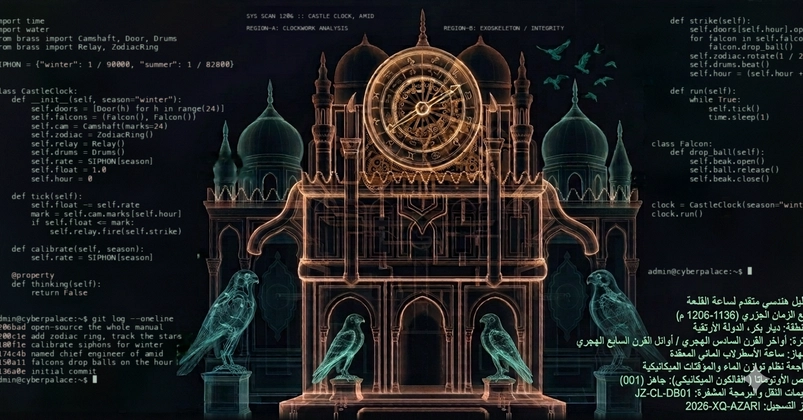
The pinnacle of al-Jazari’s engineering career was the Castle Clock, a monumental timekeeping device that stood approximately eleven feet tall in the Artuqid palace courtyard. Functioning simultaneously as a public chronometer, an astronomical display, and a theatrical performance, the structure combined wood, brass, and copper into an integrated system of mechanical automation.
The upper tier of the clock featured a slowly rotating zodiac ring and a crescent moon indicator, which tracked celestial movements to serve as a precise calendar. Below this astronomical display sat a horizontal row of automated doors, flanked by dynamic mechanical figures. At the base of the monument, a pair of brass falcons deployed metallic balls into resonant cups at pre-determined hourly intervals.
Beneath its ornate facade, the Castle Clock relied on an advanced continuous-flow hydraulic system. A meticulously calibrated water tank governed the descent of an internal float. As water drained from the reservoir through carefully regulated siphons, the float descended at a constant, mathematically predictable rate. This steady vertical movement acted as the primary operational cycle—effectively functioning as the mechanical heartbeat of the apparatus.
As the float descended, it pulled chains connected to a series of camshafts and mechanical relays. These physical switches, constructed from intricate arrangements of levers, strings, and pulleys, translated linear motion into rotational sequences. When specific thresholds were reached, the relays triggered secondary mechanisms, causing doors to swing open, falcons to drop balls, and percussion instruments to sound. This deterministic sequencing of physical instructions closely parallels the algorithmic execution found in modern computational hardware, demonstrating that complex programming concepts were successfully realized centuries before the invention of electronic computers.
Comparative Analysis and Modern Implications
The structural parallels between al-Jazari’s hydraulic automation and modern computing have attracted significant attention from contemporary engineers, computer scientists, and historians of science. While modern information technology relies on electrical voltages and binary logic gates, the underlying architectural philosophy remains fundamentally consistent: complex macro-behavior is achieved by stacking deterministic, lower-level abstractions on top of physical hardware.
Scholars analyzing al-Jazari’s contributions emphasize that his work challenges Eurocentric narratives of technological progress. By demonstrating that advanced automation, programmable machinery, and rigorous technical documentation flourished in twelfth-century Anatolia, historians are prompted to reevaluate the global diffusion of scientific knowledge. Furthermore, as artificial intelligence and complex physical-digital systems become increasingly central to modern society, recognizing historical antecedents like al-Jazari provides essential context for understanding humanity’s long-standing endeavor to imbue inanimate materials with functional intelligence.
Through his integration of rigorous mathematics, empirical material science, and transparent documentation, Ismail al-Jazari secured a permanent place in the annals of science, bridging the gap between classical mechanical craft and the dawn of automated computation.