
In the rapidly accelerating landscape of corporate digital transformation, an increasingly common paradox has emerged: artificial intelligence features designed to save time are inadvertently forcing employees to spend those reclaimed hours auditing the machine’s output. This phenomenon, which human-factors researchers characterize as a failure to reach a "break-even" point in user productivity, has prompted a shift in how enterprise product teams evaluate the implementation of generative AI. By conducting a rigorous, four-part audit of workflows before a single line of code is written, organizations are learning to distinguish between automation that creates value and automation that merely shifts the cognitive burden.
The Anatomy of an Implementation Failure
A recent case study involving a major health insurer provides a stark illustration of this friction. The insurance company tasked its product team with integrating generative AI into the benefits appeals process. The objective was straightforward: leverage large language models to draft full written determinations for specialists handling complex claims. On paper, the technology functioned precisely as specified, churning out coherent, grammatically correct reports in seconds.
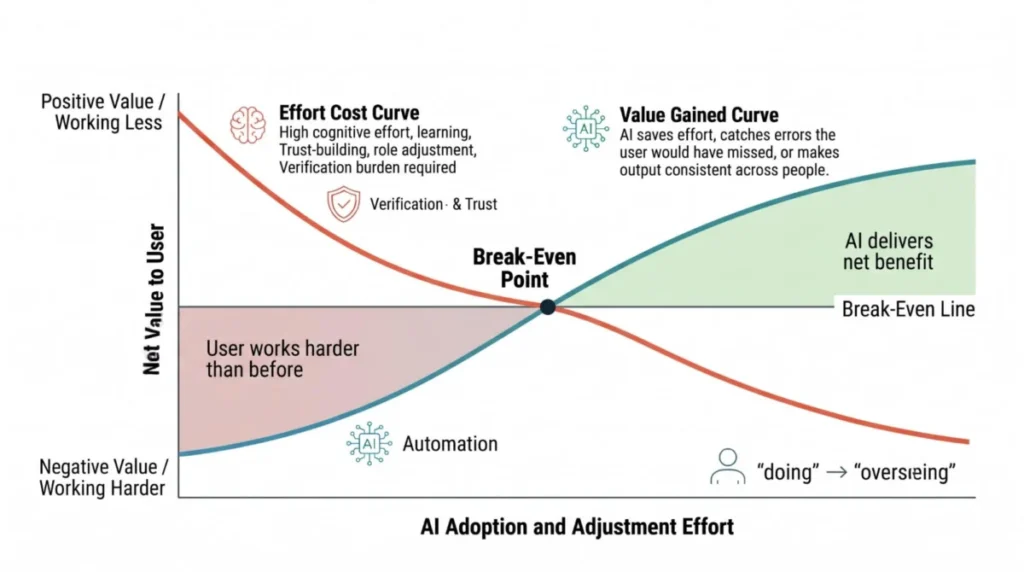
However, the field deployment yielded counterintuitive results. Instead of accelerating the appeals process, the AI integration caused a decline in productivity. Specialists who utilized the tool reported that the time required to meticulously review, fact-check, and edit the AI-generated text for subtle inaccuracies was equal to, or sometimes greater than, the time required to draft the determination from scratch. Furthermore, the specialists were forced to look for errors they were unlikely to have made themselves, turning a creative writing task into a tedious, high-vigilance verification exercise.
The insurer’s experience highlights a critical oversight in current AI development cycles: the failure to account for the cognitive cost of verification. When the AI assumes the "heavy lifting" of a task without being sufficiently accurate to remove the need for human oversight, the user is demoted to a passive checker, a role that often feels like a reduction in professional agency.
Establishing the Break-even Line
Every interface modification imposes a "cognitive tax" on the user. According to landmark research by cognitive psychologist Nelson Cowan, human working memory is limited to roughly four items at any given time. When an AI feature is introduced, the user must expend significant mental energy to understand how the new tool operates, determine where information is located, and calibrate their level of trust in the output. If the sum of these cognitive costs outweighs the efficiency gains, the feature falls below the "break-even line."
For enterprise software, this is not merely a matter of convenience. Professional identity is often tied to the mastery of specific tasks. When a physician or an analyst is asked to sign off on an AI-assisted decision, they are assuming legal and professional liability for the machine’s reasoning. A 2025 study by Sophia Ackerhans and her colleagues demonstrated that physicians who were required to validate AI-assisted decisions reported a significant threat to their professional identity, noting that even when the AI provided explanations for its reasoning, the resulting lack of transparency regarding the "why" behind the "what" actually heightened feelings of distrust.
The Four-Question Audit Framework
To avoid these pitfalls, product teams are increasingly adopting a standardized audit framework. This protocol requires a deep dive into four specific areas of user interaction before the design phase begins.
- Total Effort Reduction: The audit asks whether the total cognitive load—including thinking, clicking, and checking—is actually lower after the AI implementation. Simply reducing the number of clicks is insufficient if the "checking" phase is complex and prone to errors.
- Competitive Advantage over Manual Methods: The team must determine if the AI actually outperforms the existing manual workflow. In many cases, users have developed highly efficient, albeit informal, "workarounds" that are tailored to the specific nuances of their environment. AI should only be introduced if it provides superior speed, scale, or consistency that the human user cannot achieve.
- Error Visibility and Consequences: Product teams must map the "error surface" of the tool. If the AI is prone to errors that are difficult to detect (low visibility) but carry significant consequences, the feature requires built-in provenance—clear, traceable citations of data sources—or it should be scrapped entirely.
- Skill Maintenance: The audit evaluates whether the AI implementation will lead to the atrophy of critical human judgment skills. If, after a year of using the tool, a user would be unable to identify a machine error, the system is fundamentally flawed. Organizations are now implementing mechanisms like "blind review" periods or periodic manual tasks to ensure that human expertise remains sharp.
Data-Driven Decision Making and Professional Standards
The implications of this audit process extend beyond simple user interface design; they touch upon the core of professional accountability. Radiology research, such as the 2023 study by Thomas Dratsch, provides a cautionary tale. In this experiment, radiologists were shown mammograms alongside AI-generated suggestions. The results were alarming: even the most experienced radiologists saw their diagnostic accuracy drop significantly when they were presented with an incorrect AI-generated category. The experiment demonstrated that even experts are susceptible to "automation bias," where the presence of a "second opinion" from a computer can override a practitioner’s own seasoned judgment.
This data suggests that the "human-in-the-loop" model is not a panacea. If the human in the loop is not properly incentivized or equipped to challenge the machine, the entire system becomes a mechanism for amplifying errors rather than preventing them.

Shifting the Product Roadmap
For product managers, the goal of the audit is not to kill innovation, but to refine it. By identifying the specific segments of users who benefit from a tool and those who are hindered by it, teams can move away from "all-or-nothing" deployments.
In the case of the health insurer, a second version of the AI tool was released. Instead of drafting the entire determination, the AI was redesigned to surface only the most relevant policy provisions and prior case decisions. This kept the writing task—the part of the job the specialists were most proficient at—under human control, while eliminating the time-consuming search process. The result was a dramatic decrease in the time required to complete each case.
This approach aligns with the principles of "Human-Centered AI," a movement advocating that technology should augment human capability rather than replace it. By clearly defining the "design conditions"—the requirements that must be met before a feature is greenlit—teams can ensure that their developments contribute to organizational objectives rather than creating new sources of friction.
The Path Forward
As AI tools become ubiquitous in the workplace, the burden of proof for "efficiency" must rise. Pro-innovation bias—the tendency to assume that new technology is inherently better than old methods—often blinds organizations to the hidden costs of digital transformation.
The most successful teams are those that treat AI integration as a surgical intervention rather than a blanket upgrade. By conducting a 60-minute audit before the design phase, organizations can identify where the AI provides genuine value and where it introduces unnecessary complexity. Ultimately, the future of enterprise software does not lie in how much work the AI can do for the user, but in how effectively it can empower the user to perform their own tasks with greater insight and precision. As the industry matures, the ability to discern where the machine ends and the human begins will become the defining competency of successful product leadership.