
Creating a successful Instagram Reel is an exercise in balancing creative intuition with the cold, hard metrics of algorithmic distribution. As the platform continues to evolve, content creators and businesses are increasingly concerned with one specific variable: duration. While the technical capabilities of the Instagram application have expanded significantly, allowing for longer uploads, the relationship between video length and audience reach remains a complex landscape that requires a strategic approach.
To demystify this, an extensive study conducted by Buffer’s data science team examined 2,730,166 Instagram Reels published between January 1 and August 15, 2026. By analyzing the performance of these clips against each account’s individual baseline, researchers were able to identify clear patterns in how length dictates both the discovery of new content and the depth of audience engagement.
The Evolution of Instagram’s Video Constraints
The current technical landscape for Instagram video is more permissive than it has ever been. Users can now upload Reels up to 20 minutes in length, a significant shift from the platform’s origins as a short-form, mobile-first photo-sharing app. This change, which was rolled out gradually across the global user base throughout 2025 and 2026, was designed to compete with the long-form capabilities of platforms like YouTube and TikTok.
However, a fundamental distinction exists between what a user can upload and what the platform recommends. Instagram’s algorithm enforces a strict "discovery wall" at the three-minute mark. Any video exceeding 180 seconds is flagged by the system, effectively signaling that the content will not be pushed to non-followers via the Reels tab or the Explore page. This is a deliberate design choice by Meta to maintain the fast-paced, discovery-oriented nature of the Reels feed. Head of Instagram, Adam Mosseri, has frequently clarified that while the platform accommodates various content styles, it is not attempting to replicate the long-form ecosystem of traditional video-hosting sites.
Chronology of Platform Feature Adjustments
The shift toward longer video formats has been a multi-year transition for Meta. In 2022, the platform began unifying its video offerings, rebranding IGTV and standard video posts into the singular "Reels" format. By 2023, the standard limit was raised to 90 seconds, followed by a gradual increase to three minutes for general users. The recent expansion to 20 minutes represents the latest phase of this strategy, intended to capture creators who previously relied on separate platforms for tutorials, deep-dive commentary, and narrative storytelling.
This transition has created a clear dichotomy in user strategy: creators must now decide if they are producing content for viral discovery or for community retention.

Decoding the Data: Reach vs. Engagement
The most significant finding from the Buffer analysis is the clear divergence between reach and engagement metrics. When examining reach—defined as the number of unique accounts that view a video—the "sweet spot" is unequivocally between 90 seconds and three minutes. Reels falling into this duration window outperformed their account baselines by an average of 4% to 7.4%. This suggests that the algorithm favors content that is long enough to provide substantial value, yet short enough to maintain the high completion rates necessary for viral distribution.
Conversely, the data reveals a sharp decline in reach for videos exceeding the three-minute mark. These long-form clips saw a 49.3% reduction in reach compared to the account’s own baseline. This statistical drop-off serves as empirical evidence of the platform’s decision to throttle the distribution of long-form content to users who are not already subscribed to the creator.
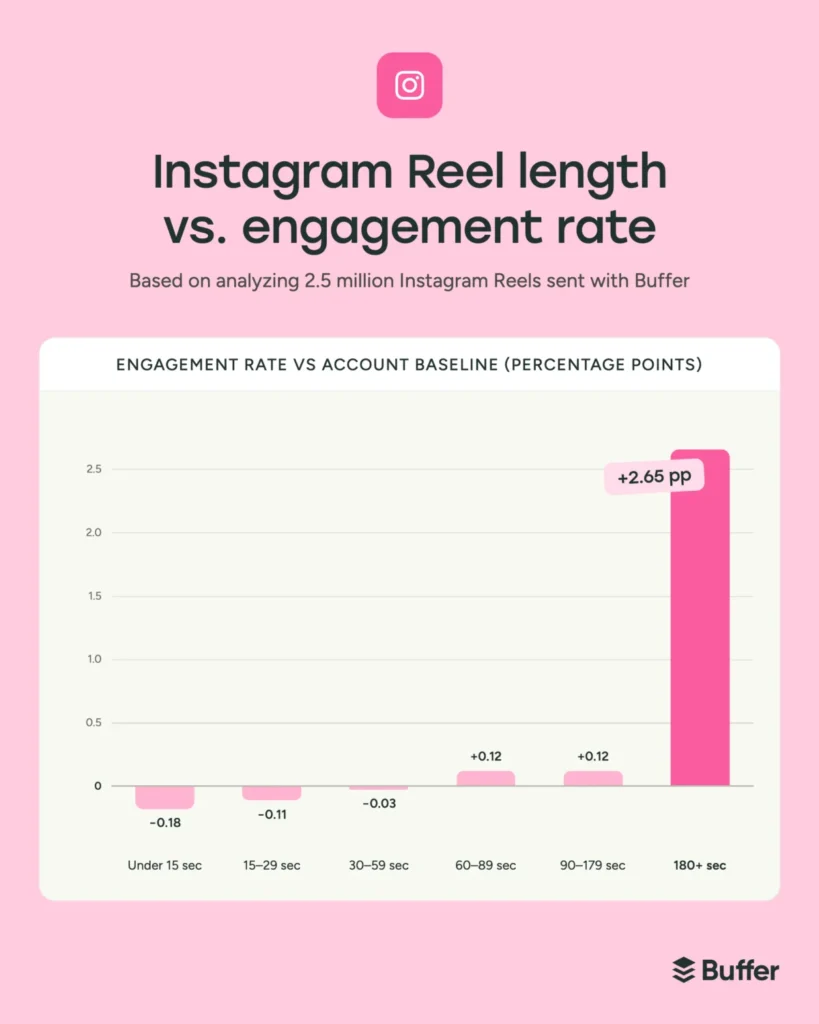
However, the narrative shifts when evaluating engagement rates—defined as likes, comments, saves, and shares. Reels that exceeded 180 seconds demonstrated an engagement rate 2.65 percentage points higher than the baseline. This indicates that while the total volume of viewers is lower, the quality of the audience is significantly higher. These viewers are not passive scrollers; they are invested participants who are more likely to interact with the content.
Comparative Analysis: Reels, TikTok, and YouTube Shorts
For social media managers and independent creators, understanding the competitive landscape is essential for efficient cross-platform distribution. As of late 2026, the industry standards are as follows:
- Instagram Reels: 20-minute maximum, but with a 3-minute limit for algorithmic recommendation to new audiences.
- TikTok: Supports up to 10 minutes for in-app recordings, with the capacity for up to 60-minute uploads via the desktop or mobile upload portal.
- YouTube Shorts: Maintains a strict 3-minute cap; any video exceeding this duration is automatically categorized as a standard long-form YouTube video, fundamentally changing its placement and performance metrics.
The uniformity of the three-minute threshold across major platforms suggests a consensus in the industry: three minutes is the psychological limit for "snackable" video consumption.
Methodological Rigor and Statistical Significance
To ensure the validity of these findings, the study employed a "self-comparison" methodology. Instead of comparing a small account to a massive influencer, the team evaluated how each individual account’s performance shifted as it changed its own video lengths. By isolating the variable of duration, researchers were able to account for the massive disparity in audience sizes.
Furthermore, both reach and view counts were log-transformed to prevent viral anomalies from skewing the averages. By capping engagement rates at the 99th percentile, the team removed statistical outliers—such as videos with extremely low view counts resulting in inflated percentage rates—that could otherwise lead to erroneous conclusions.

Strategic Implications for Creators
The evidence indicates that content length should be dictated by the primary objective of the specific post. If the goal is growth and audience expansion, creators should aim for the 90-second to 3-minute window. This length provides the necessary time to build a compelling narrative hook while remaining within the algorithm’s preferred parameters for discovery.
If the objective is to nurture an existing community—such as through educational tutorials, serialized storytelling, or detailed product explanations—the data supports going beyond three minutes. While reach will inevitably suffer, the increased engagement rate suggests that the content will resonate more deeply with the core audience, potentially leading to higher conversion rates and brand loyalty.
For creators uncertain about which length to employ, "trial reels" remain the most effective tool. By testing two versions of the same content—one under three minutes and one over—creators can gather actionable, account-specific data. This methodology allows for a data-driven approach to content strategy, moving away from guesswork and toward a refined, objective understanding of platform behavior.
The Role of Content Quality
It is important to note that for videos under 90 seconds, length proved to be a negligible factor. Whether a video was 15 seconds or 89 seconds long, the variance in performance was within a 3% margin of the account’s baseline. This indicates that for shorter content, the "hook," the production quality, and the intrinsic value of the topic matter significantly more than the specific timestamp.
In summary, while the platform provides the infrastructure to host longer videos, it does not incentivize them for general discovery. The most successful creators in 2026 are those who treat their video length as a strategic lever: using the 90-to-180-second window to cast a wide net for new followers, and using longer, high-engagement videos to solidify the loyalty of their established community. As the digital environment remains fluid, the integration of such quantitative insights into a broader creative strategy will continue to be the hallmark of effective social media management.