
The best enterprise rank-tracking software transcends simple keyword position checks, evolving into sophisticated platforms that monitor millions of data points across diverse devices, geographical locations, and ever-changing search features. This includes nascent elements like AI Overviews, established components such as featured snippets, and localized results within local packs. The resulting intelligence is then seamlessly integrated into comprehensive dashboards, streamlined CRM workflows, and executive reports, empowering large organizations to drive strategic action across their vast operational footprint. The digital marketing arena, characterized by its relentless evolution and escalating complexity, demands more than just basic visibility metrics; it requires a granular understanding of an enterprise’s organic presence and its direct correlation to business objectives.
For businesses operating at scale, the sheer volume of digital content and the intense competition necessitate tools that can not only track performance but also contextualize it within a broader strategic framework. Industry analysts consistently highlight the growing reliance on advanced analytics to decode consumer search behavior and anticipate algorithm shifts. Recent data indicates that organic search remains a primary driver of website traffic and revenue for many enterprises, underscoring the critical importance of maintaining and improving search engine visibility.
The Evolution of Enterprise Search Monitoring
The journey of search engine optimization (SEO) has been marked by continuous innovation, from rudimentary keyword stuffing in the early 2000s to today’s intricate dance with semantic search, user intent, and artificial intelligence. Enterprise rank tracking has mirrored this evolution, moving far beyond daily checks of a few hundred keywords. Historically, SEO was often a siloed function, focused on technical optimizations and basic ranking reports. However, as search engines became more intelligent and user behavior more nuanced, the scope of enterprise SEO expanded dramatically. The advent of mobile search, the proliferation of local businesses, and the emergence of rich SERP features (like carousels, answer boxes, and knowledge panels) each added new layers of complexity that traditional trackers could not adequately address.
The most recent and perhaps most significant shift has been the rise of generative AI in search. Google’s introduction of AI Overviews, alongside the growing influence of platforms like ChatGPT and Perplexity, has fundamentally altered how users discover information and how brands need to appear. This new frontier, often termed Answer Engine Optimization (AEO), demands tracking capabilities that monitor not just where a brand ranks, but how its narrative is constructed and cited within AI-generated responses. This chronological progression underscores that enterprise-grade tools are not merely enhanced versions of basic trackers; they are fundamentally different systems built for a distinct set of challenges.

Defining Enterprise-Grade Rank Tracking Software
Enterprise rank-tracking software is specifically engineered to monitor keyword positions at an unparalleled scale. Unlike tools designed for small websites with limited keyword portfolios, these platforms handle millions of data points, supporting complex requirements across multiple websites, sub-domains, languages, and geographic markets. The core differentiator lies in their ability to ingest, process, and make actionable vast quantities of data for large, cross-functional teams.
This distinction is crucial: basic trackers might check a few hundred keywords daily, but enterprise solutions are built for high data volumes, hyper-granular location targeting (down to city, zip code, or even coordinate level), real-time or near-real-time refresh rates, and robust integrations. These integrations are vital, pushing ranking data into broader organizational systems like Business Intelligence (BI) platforms, web analytics suites, and Customer Relationship Management (CRM) systems. On its own, ranking data provides visibility metrics. However, when paired with BI, it transforms into a narrative of opportunity and risk. Coupled with web analytics, it helps determine if visibility translates into traffic. And when connected to a CRM, it can draw a direct line between a keyword’s movement from position eight to position two and a measurable uptick in the sales pipeline, demonstrating tangible ROI.
Key Criteria for Evaluating Enterprise Rank Tracking Software
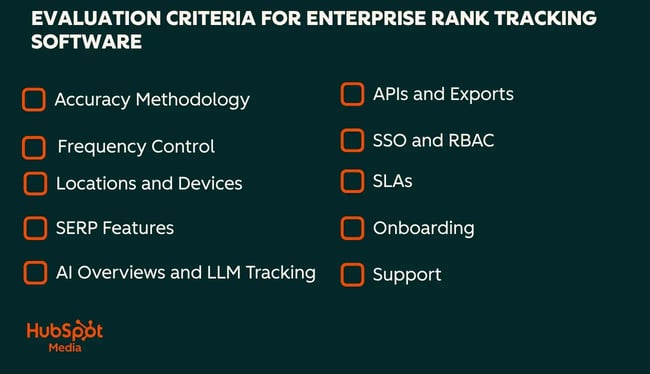
Choosing the correct platform is a critical strategic decision that begins with a deep understanding of a business’s unique needs and existing workflows. Enterprise teams require tools that integrate seamlessly to ensure rapid and widespread adoption. The following factors are paramount for consideration:
- Accuracy Methodology: A vendor’s data collection methods are foundational. Enterprises must inquire whether platforms use dedicated datacenter IPs, residential proxies, or a hybrid approach. Crucially, how do they account for personalization and localization to ensure results accurately reflect what actual users see? Requesting a detailed methodology document, rather than relying solely on marketing claims, is a non-negotiable step.
- Frequency Control: The ability to customize crawl schedules for specific keyword groups, campaigns, or markets is essential. While daily tracking is standard, high-stakes periods—such as major product launches, seasonal sale events, or fast-moving news cycles—demand hourly or on-demand refresh capabilities for SEO teams to react swiftly.
- Locations and Devices: Enterprise-level software must support multi-location and multi-device keyword tracking. For businesses with local or regional operations, confirming granularity at the city, zip code, or coordinate level is vital. Independent tracking for both desktop and mobile rankings is also critical, as positions often differ significantly between these environments.
- SERP Features: The traditional "ten blue links" no longer represent the full picture of search visibility. The chosen platform must track a comprehensive array of SERP features, including featured snippets, local packs, People Also Ask boxes, image carousels, video results, and shopping units. Confirming which features are tracked and whether alerts are triggered for position changes is crucial for optimizing overall search presence.
- AI Overviews and LLM Tracking: This capability is rapidly becoming indispensable. Enterprises must evaluate whether a platform monitors AI Overview appearances, tracks the specific URLs cited within them, and captures prompt-level data within generative search environments. Effective AI Overviews tracking necessitates robust prompt libraries and historical snapshots to provide meaningful insights over time.
- APIs and Exports: Enterprise teams often rely on their internal data infrastructure. The platform must offer a well-documented API with sufficient rate limits to handle high data volumes, alongside flexible export options (CSV, JSON) or direct connectors to data warehouses and existing business intelligence tools. This ensures data can flow into an organization’s central analytical ecosystem.
- SSO and RBAC: Security and governance are paramount for enterprises. Single Sign-On (SSO) integration with the organization’s identity provider and Role-Based Access Control (RBAC) are security essentials. Confirm that permissions can be scoped at the team, market, or campaign level, ensuring the right personnel access the appropriate data. Service Level Agreements (SLAs) should also be rigorously reviewed, detailing guaranteed uptime, data handling during crawl failures, and contractual commitments to data freshness.
- Onboarding and Support: Large keyword sets, complex site architectures, and multi-market configurations require significant setup. Vendors should provide a dedicated onboarding team, structured implementation support, and a realistic timeline for achieving full production use. Ongoing support quality is equally critical, necessitating a named account manager, defined response time commitments, and access to technical support for API and integration issues.
Leading Enterprise Rank Tracking Solutions
Several platforms have distinguished themselves in their ability to meet the stringent demands of enterprise-grade rank tracking and reporting.
HubSpot’s Marketing Hub (SEO Marketing Software)
As part of HubSpot’s unified customer platform, the SEO Marketing Software offers enterprise teams a centralized environment to manage and enhance organic search performance. It provides keyword recommendations prioritized by impact, aiding teams with extensive content libraries in focusing on the most effective optimizations. The content strategy tool facilitates the discovery and ranking for relevant topics, with suggestions based on relevance, competition, and popularity.
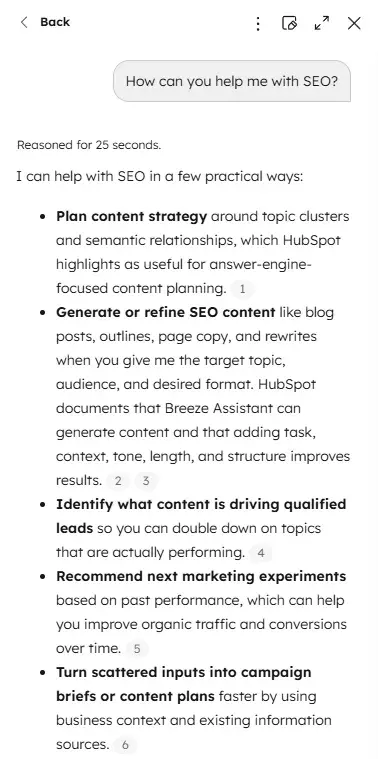
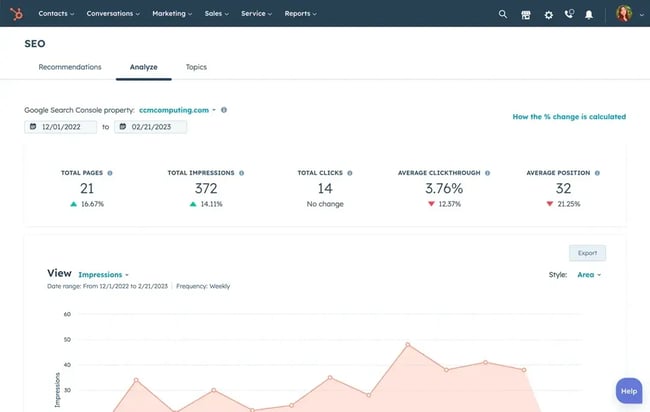
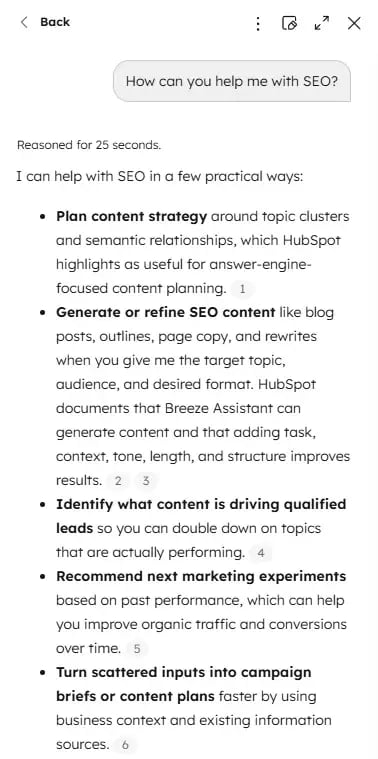
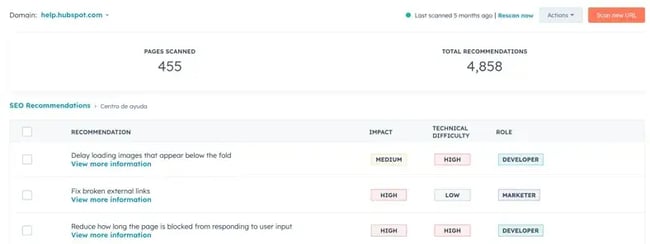
The primary advantage for enterprises is deep integration. Keyword data, content performance, and lead attribution reside within the same ecosystem as CRM, campaign tools, and analytics. This eliminates manual data bridging, a common pain point at scale. The software also integrates with Google Search Console and HubSpot’s CMS, enhancing inbound marketing. Its capabilities extend to AEO, helping structure content for AI-driven search results and featured snippets, a growing visibility layer. Breeze Assistant, an AI assistant, further empowers marketing teams with SEO support. The SEO Recommendations tool scans all live pages, including those hosted outside HubSpot, for optimization suggestions, organizing them by priority. This is invaluable for managing thousands of URLs. Content readability metrics, meta tags, internal linking, and content length are also analyzed. The SEO Analyze tab tracks core search performance directly from Google Search Console, offering data on indexed pages, impressions, clicks, CTR, and average position, with side-by-side comparisons and export options.
HubSpot’s Content Hub
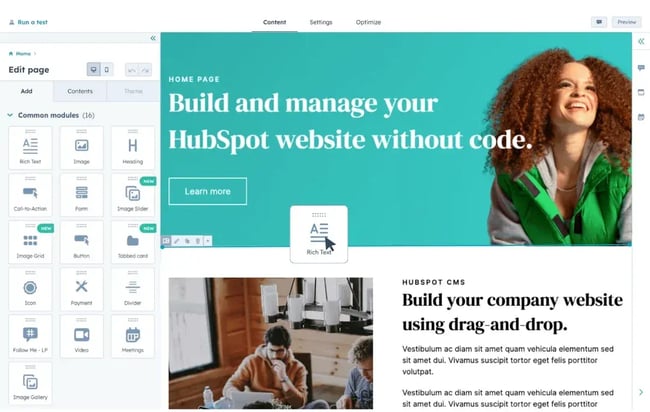
Content Hub is a CMS built for publishing content at scale while maintaining SEO discipline and structural consistency. It embeds SEO guidance directly into the authoring workflow, providing recommendations on internal linking and page structure during content creation. This proactive approach minimizes post-publication audits, crucial for large content libraries and multiple contributors. Its robust schema capabilities, supporting HTML, HubL, HubDB, and custom modules, enable systematized schema implementation across templates or specific content types. Tools like Content Remix transform content into various formats, while Brand Voice ensures consistent tone for AI-generated content, mitigating brand drift. The AI Content Writer further streamlines content creation directly within the CMS.
HubSpot AEO Grader
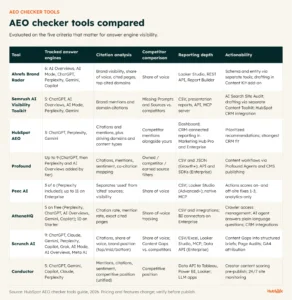
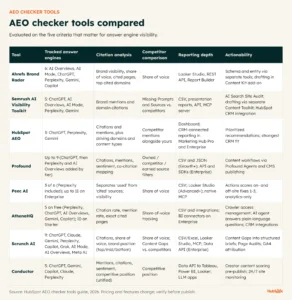
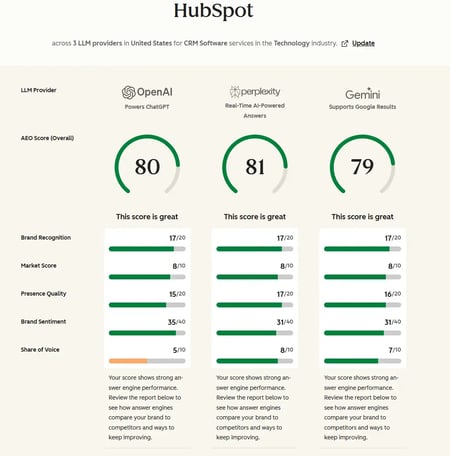
Addressing the shift towards AI-generated answers, HubSpot AEO Grader is a free tool designed to measure a brand’s appearance in AI responses from platforms like ChatGPT, Perplexity, and Gemini. It scores performance across five dimensions: recognition, accuracy, sentiment, context, and prominence. This tool helps enterprises understand if their brand is poorly represented or absent in AI-generated responses, even if it ranks well in traditional search. Its competitive intelligence feature allows direct benchmarking against competitors, revealing how AI platforms characterize rivals. While manual, consistent use provides a credible baseline for understanding AI search visibility and identifying content/schema improvements.
Semrush One
Semrush is a long-standing leader in SEO software, now offering an AI Visibility Toolkit within its Semrush One subscription. This integrates traditional keyword rank tracking (research, position tracking, technical audits, on-page optimization) with GEO and prompt tracking. Semrush One helps brands maintain visibility across both traditional search and AI platforms. Its competitive intelligence features are robust, tracking competitor rankings, share of voice, and overall domain health. The platform’s consistent investment in data quality and keyword coverage makes its transition into AI visibility tracking a natural extension of its mature data infrastructure.
Profound
Profound is an enterprise-grade AI visibility platform purpose-built to understand and improve brand appearance across generative AI engines. Unlike other platforms that add AI tracking as an add-on, Profound was designed specifically for managing how a brand’s narrative is shaped across the entire AI ecosystem. It tracks narrative, sentiment, brand mentions, and competitor comparisons across various AI engines, providing deep insights into market trends and the overall "AI share of voice." Its key features include AI-native prompt tracking, sentiment analysis, competitive benchmarking, and AI content optimization tools, making it ideal for large marketing and brand teams.
Strategic Considerations for Enterprise Software Selection
The process of selecting an enterprise rank tracking platform is rarely simple. An incorrect choice can lead to significant delays, data silos, reporting gaps, and adoption issues that take months to rectify.

- Integration Fit Over Feature Count: A platform with fewer features but clean integration with an existing technology stack will often outperform a more feature-rich but isolated solution. Rank data becomes truly useful only when it flows into the systems where decisions are made (BI platforms, data warehouses, CRMs, executive dashboards). Manual exports to bridge data gaps lead to deprioritization. Enterprise rank tracking software must integrate with these systems, which should be a non-negotiable requirement.
- Early Stakeholder Engagement: A common and costly mistake is to run the evaluation process without involving all key stakeholders early on. The SEO team’s recommendations must be discussed with IT, legal, finance, sales, and any other department impacted by the new technology. Initiating these conversations at the shortlisting stage, rather than at the contract stage, prevents delays and ensures broader organizational buy-in.
- Pricing Tiers and Scalability: Enterprise rank tracking pricing models vary widely, and the initial cost rarely reflects long-term expenditure. Platforms may charge per keyword, user, domain, or location. A platform affordable at 10,000 keywords and two markets can become prohibitively expensive at 500,000 keywords across 15 markets. It is crucial to map anticipated growth over a two-to-three-year horizon against each vendor’s pricing model, identifying realistic tiers and upgrade triggers. Features like API access, historical data, or advanced user permissions are often gated behind higher enterprise plans.
Advanced Competitive Ranking Strategies at Enterprise Scale
At the enterprise level, competitor rank tracking extends far beyond simply monitoring a rival’s keyword positions. It encompasses comprehensive share of voice and pixel position analysis, SERP feature ownership, and meticulous brand variant tracking across affiliates, resellers, and partner sites.
- Share of Voice Tracking: This measures how frequently a domain appears in search results relative to competitors for a defined keyword set. At scale, this involves tracking share of voice across topic clusters, segmented by product line, market, or buyer stage. Monitoring these trends over time provides invaluable insights into who is gaining or losing ground.
- Pixel Position Analysis: Ranking in position one does not guarantee top-of-page visibility. Paid ads, AI Overviews, local packs, and shopping units can push organic results significantly down the page. Pixel position tracking measures the actual vertical distance from the top of the page to the first organic result, offering a more accurate picture of true visibility. For high-value commercial keywords, tracking pixel position alongside rank position is crucial.
- SERP Feature Ownership: SERP features represent significant visibility opportunities not captured by rank position alone. Tracking feature ownership over time helps identify when competitors gain or lose snippets, signaling opportunities to review and update content.
- Brand Variant and Affiliate Tracking: Large enterprises often operate with multiple brand variants, sub-brands, regional domains, and affiliate or reseller partners. Tracking these entities as part of competitive monitoring provides a holistic view of the brand family’s search presence, identifying potential cannibalization of organic traffic or competitive appearances for branded terms.
- Automation and Alerting: Manual competitive monitoring is unsustainable at enterprise scale. Automated alerts for significant position changes (both gains and losses) across the competitor set, with thresholds to distinguish meaningful shifts, are essential. Integrating competitive rank data into regular reporting ensures changes are visible to teams responsible for content, product, and go-to-market decisions.
Frequently Asked Questions About Enterprise Rank Tracking Software
How do we validate rank accuracy across thousands of locations?
Validation at scale requires a multi-layered approach. Enterprises should define representative keyword-location cohorts, conduct scheduled spot checks, and compare results against control datasets. Maintaining comprehensive audit logs to track discrepancies and ensure data consistency over time is also vital for robust validation.
How should we track AI Overviews when prompts change frequently?
To effectively track AI Overviews despite prompt variability, enterprises should build structured prompt libraries aligned with key topics and product lines. Capturing regular snapshots of AI-generated responses, meticulously logging cited sources, and reviewing performance on a defined cadence (e.g., weekly or monthly) are critical for tracking trends and adapting content strategies.
What is the best way to migrate from a legacy rank tracker?
A successful migration typically involves running both the legacy and new platforms in parallel during a carefully planned transition period. This allows for thorough validation of data consistency and the mapping of key metrics and integrations upfront. Prioritizing API connections and reporting workflows before fully decommissioning the legacy system helps ensure a seamless transition with minimal disruption.
When should you track hourly versus daily rankings?
Hourly tracking is best reserved for high-volatility periods, such as major product launches, critical sales events, or rapidly evolving news cycles, where immediate insights are crucial. For steady-state performance monitoring and general trend analysis, daily tracking is typically sufficient and more cost-efficient, balancing data granularity with operational overhead.
Rank tracking software is a non-negotiable for enterprise businesses.
Enterprise rank tracking has evolved into a strategic imperative, encompassing a comprehensive understanding and ownership of the full search presence across traditional rankings, diverse SERP features, and increasingly, AI-generated results. The right enterprise tracking platform must deliver accurate, scalable data and seamlessly integrate with the wider organizational tech stack. This ensures that enhanced visibility directly translates into actionable insights, informed decisions, and ultimately, measurable revenue growth. Whether leveraging integrated SEO and CRM workflows through platforms like HubSpot, utilizing AI visibility benchmarking tools such as HubSpot AEO Grader, or streamlining content operations via HubSpot Content Hub, the chosen tools must accurately reflect the complex and ever-changing dynamics of modern search.