
TikTok has officially released two comprehensive strategic guides designed to help marketers navigate the lucrative post-holiday period spanning from Christmas Day to New Year’s Eve, a timeframe increasingly recognized within the digital advertising industry as "Q5." The newly published playbooks focus heavily on optimizing app installations and gaming promotions, offering actionable insights into consumer behavior, cost efficiencies, and technical campaign execution during a window when user engagement traditionally peaks.
The introduction of these guides comes at a crucial time for digital advertisers. While many traditional brands wind down their marketing expenditures immediately following Christmas, data suggests that consumers remain exceptionally active online, searching for entertainment, redeeming holiday gift cards, and taking advantage of year-end retail sales. By releasing these resources, TikTok aims to position its platform as the primary destination for developers and publishers looking to capture this lingering holiday momentum and convert high user activity into long-term app engagement and revenue.
Understanding the Phenomenon of Q5 Marketing
The concept of Q5 refers to the trailing week of the calendar year—the days bridging Christmas and the start of January. Historically, this period has presented a unique psychological and economic window for consumers and brands alike. Consumers find themselves with newfound disposable income, holiday gift cards, and considerable free time resulting from end-of-year holidays and school breaks. Consequently, screen time across mobile devices spikes significantly as users explore new devices, download freshly gifted applications, and seek out immersive entertainment.
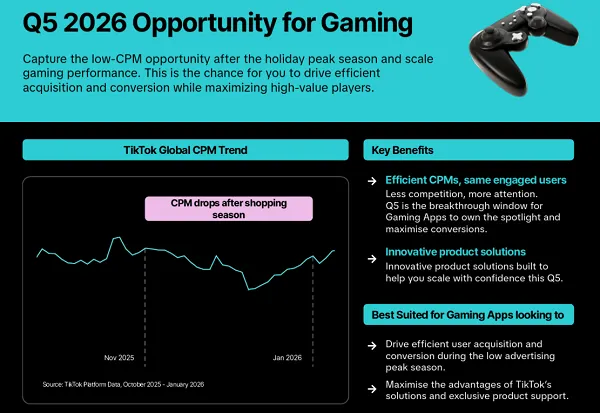
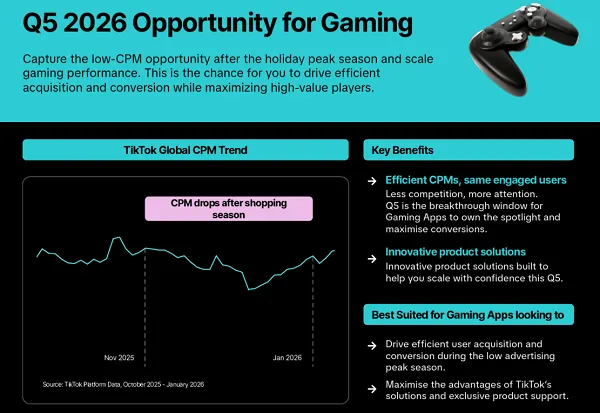
For years, digital marketers treated Q5 as an operational dead zone, pulling back ad spend to reset budgets for the upcoming fiscal year. However, platform data and modern consumer analytics have radically shifted this perspective. Rather than a period of low intent, Q5 is now viewed as an opportune landscape characterized by heightened consumer receptivity and, crucially, reduced advertising competition. Because many enterprise brands step back from bidding during this week, cost-per-click (CPC) and cost-per-install (CPI) metrics frequently drop, allowing savvy advertisers to secure high-value impressions and conversions at a fraction of peak fourth-quarter pricing.
TikTok’s Strategic Insights and Consumer Metrics
According to internal statistics highlighted in TikTok’s newly published documentation, consumer shopping and browsing habits remain robust well after traditional holiday shopping winds down. Data compiled by the platform indicates that an overwhelming 70 percent of consumers actively plan to shop during the week immediately following December 25. This behavior is largely driven by the desire to capitalize on end-of-year clearance sales and to redeem gift cards received during the holidays.
The engagement translates directly onto social commerce and discovery platforms. TikTok reports that 75 percent of its global user base maintains the same level of app usage or increases it during Q5 compared to earlier in the holiday season. Furthermore, user intent shifts toward personal gratification: approximately 63 percent of surveyed users report shopping specifically for themselves during this post-holiday window, rather than purchasing gifts for others. This self-gifting mindset creates an ideal environment for mobile application developers and gaming companies seeking to promote in-app purchases, subscription renewals, and digital goods.
Tailored Playbooks for Gaming and Mobile App Verticals
TikTok’s newly released literature is divided into two distinct, highly focused documents: a four-page guide tailored specifically to the gaming industry and a parallel handbook dedicated to general mobile application marketing. Both resources are structured to provide both high-level strategic direction and granular, technical advice for media buyers.
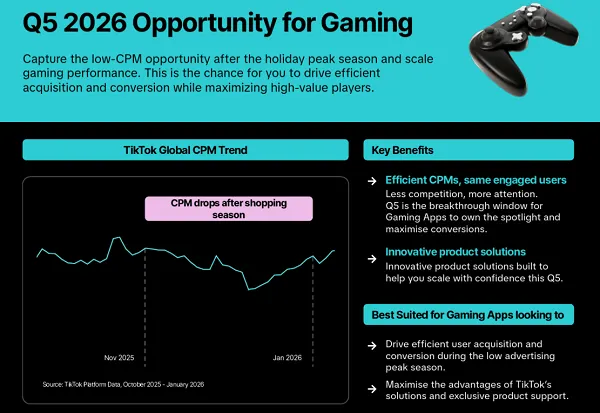
The gaming playbook centers heavily on the economic advantages of advertising during late December. Because mainstream retail and consumer packaged goods (CPG) brands drastically reduce their bidding activity during this week, TikTok’s gaming guide notes a measurable dip in the cost per ad. For mobile game developers operating on tight customer acquisition budgets, this reduction in ad auction competition represents a rare opportunity to scale user acquisition campaigns efficiently. The guide walks developers through audience targeting methodologies, creative best practices designed to showcase actual gameplay rather than cinematic trailers, and strategies for re-engaging lapsed players who suddenly find themselves with free time over the holiday break.
Simultaneously, the mobile app marketing guide expands these principles beyond the gaming sector, addressing utility, fintech, entertainment, and e-commerce applications. In addition to creative strategies, this handbook provides rigorous technical guidance regarding tracking infrastructure. Proper attribution setup remains a critical hurdle for mobile marketers, particularly in an era characterized by stringent privacy frameworks and post-IDFA measurement challenges. TikTok’s documentation outlines best practices for configuring tracking pixels, Software Development Kits (SDKs), and event optimization to ensure that campaigns launched during Q5 accurately attribute conversions and measure return on ad spend (ROAS).
Chronology of Platform Evolution Toward Year-End Commerce
The release of the Q5 marketing playbooks reflects a multi-year evolution in how TikTok approaches commercial seasonality. Over the past several years, the platform has steadily expanded its monetization infrastructure, shifting from a pure entertainment app into a dominant ecosystem for discovery-driven commerce.
In the nascent stages of TikTok’s advertising business, year-end guidance was generalized, lumped into broader fourth-quarter holiday checklists that primarily emphasized Black Friday and Cyber Monday. However, as advanced attribution models and first-party data collection revealed sustained post-Christmas engagement, advertisers began demanding specialized insights. By 2024 and 2025, industry discussions surrounding Q5 transformed from niche marketing lore into mainstream digital strategy. The formalization of these insights into standalone guides for 2026 marks a maturation of TikTok’s enterprise business solutions, providing brands with formalized frameworks rather than ad-hoc recommendations.
Implications for App Developers and Digital Advertisers
The publication of these playbooks carries significant implications for the broader digital advertising ecosystem. As competition on traditional search and social channels intensifies during the peak weeks of November and early December, profit margins for app developers acquiring users via paid media are frequently squeezed to their limits. Q5 offers a strategic pressure-release valve.
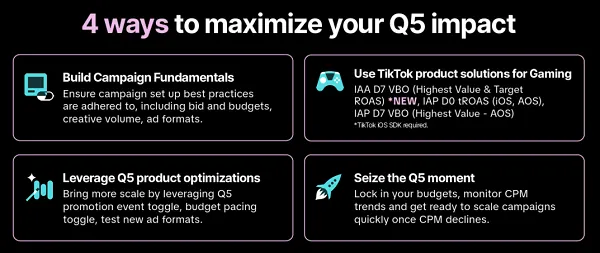
By leveraging lower ad auction costs alongside high consumer leisure time, smaller and mid-sized app publishers can compete more effectively against enterprise giants whose year-end budgets may be temporarily exhausted. Furthermore, because users are actively browsing for new digital experiences to occupy their time, conversion rates for app installs often exhibit high intent. When combined with TikTok’s focus on full-funnel tracking setup and creative diversification, these resources empower developers to optimize campaigns with greater precision.
Industry Reaction and Future Outlook
While direct statements from external brand executives regarding these specific guides are still emerging, early reactions from digital marketing agencies and user acquisition specialists have been largely positive. Media buyers have long recognized the untapped potential of the post-Christmas landscape, yet many corporate stakeholders historically resisted allocating budget outside established fiscal quarters. The validation of Q5 by a major platform like TikTok provides marketing teams with the institutional backing necessary to convince finance departments and executive boards to maintain active campaigns through the end of the calendar year.
Looking forward, the success of these playbooks will likely depend on how effectively brands execute their creative strategies. As TikTok continues to emphasize authentic, community-driven content over polished corporate advertisements, developers utilizing the Q5 guides will need to pair technical tracking precision with native, engaging video formats. Ultimately, the integration of these technical handbooks signals that Q5 is no longer an overlooked afterthought in digital marketing, but a systematically optimized season capable of driving substantial annual revenue for mobile apps and games alike.