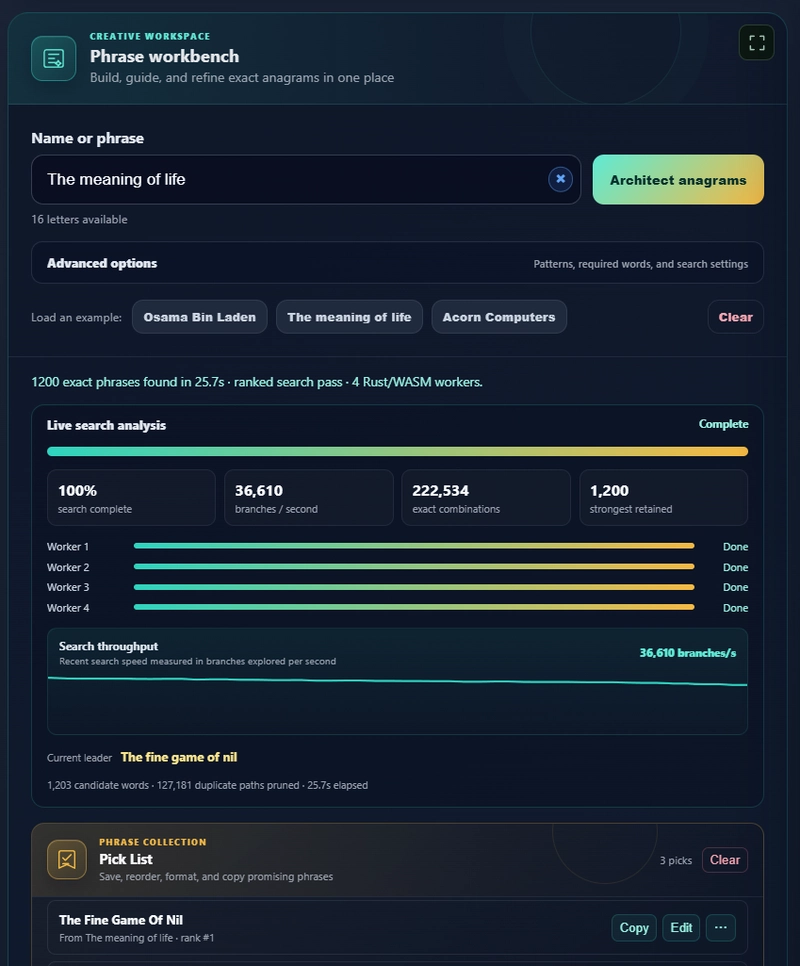

The intersection of computational linguistics and combinatorial mathematics has yielded a novel browser-based tool that redefines how word puzzles are generated. When developer and software architect behind the project typed the phrase “The meaning of life” into a web browser, a specialized application evaluated more than 222,000 exact combinations in less than 26 seconds. The resulting top-ranked anagram—“The fine game of nil”—offered a surprisingly poetic mathematical solution, demonstrating how modern web technologies can execute heavy computational tasks directly on consumer hardware without relying on cloud-based servers.
This experiment ultimately materialized as Anagram Architect, a sophisticated phrase-anagram generator built using Rust, WebAssembly (WASM), and JavaScript. By shifting the computational burden away from remote application programming interfaces (APIs) and onto the user’s local device, the platform addresses long-standing challenges in performance, data privacy, and linguistic intelligence.
Main Facts and Technological Foundation
Generating a simple, single-word anagram is a trivial programming task, but producing a multi-word phrase that reads naturally in English presents a formidable combinatorial challenge. Anagram Architect approaches this by treating letter-shuffling as a high-performance search problem.
The core engine is written in Rust—a systems programming language renowned for memory safety and raw execution speed—and compiled into WebAssembly. This allows complex algorithms to run at near-native speeds inside standard web browsers. When a user inputs a source phrase, the application breaks it down into a compact 26-letter frequency signature. It then systematically queries a localized dictionary, subtracting character counts with each chosen word:
Remaining Letters = Source Letters – Chosen Word Letters
If any character count drops below zero, the processing branch is immediately discarded. However, raw mathematical correctness does not guarantee grammatical or semantic validity. While a computer can easily prove that a combination uses the exact same letters, it cannot inherently determine whether the resulting sentence sounds humorous, profound, or even coherent.
To bridge this gap, the application incorporates a dedicated ranking layer. This system evaluates generated phrases using multiple linguistic signals, estimating how natural or memorable a sequence sounds before presenting it to the user.
Chronology of Development and Architecture
The creation of Anagram Architect followed a deliberate trajectory focused on browser performance and user experience.
Initially, the developer encountered the classic bottleneck of recursive searches: deep computational trees can easily freeze a browser tab, rendering the user interface unresponsive. To resolve this, the architecture was divided into parallel processing pipelines utilizing Web Workers.

- Shard Division: The candidate space is segmented into manageable shards and distributed across multiple Web Workers operating concurrently.
- Local Execution: Each worker loads the WASM engine, explores its assigned computational branch, and periodically reports its progress.
- Main Thread Integration: The primary JavaScript thread aggregates these candidates into a stable, ranked list while continuously updating progress metrics and maintaining interface responsiveness.
This mechanism powers the real-time throughput graph visible in the user interface. Rather than serving as a purely decorative animation, the graph displays live telemetry indicating how many thousands of branches per second the local engine is processing.
Supporting Data and Performance Metrics
Performance metrics gathered during testing underscore the efficiency of client-side WASM execution. During the initial benchmark run with the phrase “The meaning of life,” the browser evaluated precisely 222,534 exact combinations over a duration of 25.7 seconds. Across four active worker threads, the system successfully explored approximately 36,000 branches per second entirely within the client environment.
To ensure that ranking improvements do not inadvertently degrade overall output quality, the development process relies on a comprehensive benchmark set of classic anagrams. If a code adjustment alters the scoring algorithm in a way that buries established, high-quality results, the regression is immediately caught and corrected.
Furthermore, the application provides advanced interactive controls that allow users to guide the search process. By defining grammar templates—such as [Noun] of [Noun], [Verb] the [Noun], or [Adjective] [Noun]—or by explicitly requiring, preferring, or excluding specific words, users can steer the combinatorial engine toward more desirable linguistic outcomes. Once a base phrase is established, an integrated "Pick List" functions as a localized workshop, enabling users to reorder words, lock specific terms in place, substitute synonyms sharing identical letter counts, and apply final punctuation.
Privacy Implications and Zero-API Architecture
In an era where digital privacy concerns routinely dominate technological discourse, Anagram Architect adopts a strict zero-API data handling model for input phrases.
Because names, unpublished book titles, and private or sensitive jokes often serve as source material for anagram enthusiasts, privacy is a paramount consideration. While the application downloads static assets—including dictionaries, language data, JavaScript bundles, and the WASM binary—upon initial page load, no user-entered text or generated candidate phrases are transmitted to an external search endpoint or cloud server. All processing remains strictly contained within the user’s local hardware environment.
This local-first paradigm represents a growing trend in modern web development, where powerful client-side runtimes reduce infrastructure costs for developers while offering absolute confidentiality for end users.
Broader Impact and Industry Implications
The deployment of tools like Anagram Architect highlights the expanding capabilities of WebAssembly in fields traditionally dominated by desktop software or cloud-based microservices. By harnessing Rust for intensive numerical and logical computations, web developers can now execute complex artificial intelligence, cryptography, and linguistic algorithms directly within standard web browsers.
Industry analysts note that client-side computation minimizes latency, eliminates server maintenance overhead, and safeguards user data. However, it also places higher demands on consumer hardware, requiring developers to implement sophisticated multithreading techniques, such as Web Workers, to prevent interface lockups.
As web standards continue to evolve, projects combining Rust, WASM, and JavaScript serve as a blueprint for high-performance browser applications. Whether applied to recreational linguistics, data analysis, or creative writing assistants, the methodology demonstrates that exhaustive computational power, when paired with thoughtful heuristic ranking and human oversight, can successfully transform raw mathematical correctness into meaningful, creative art.