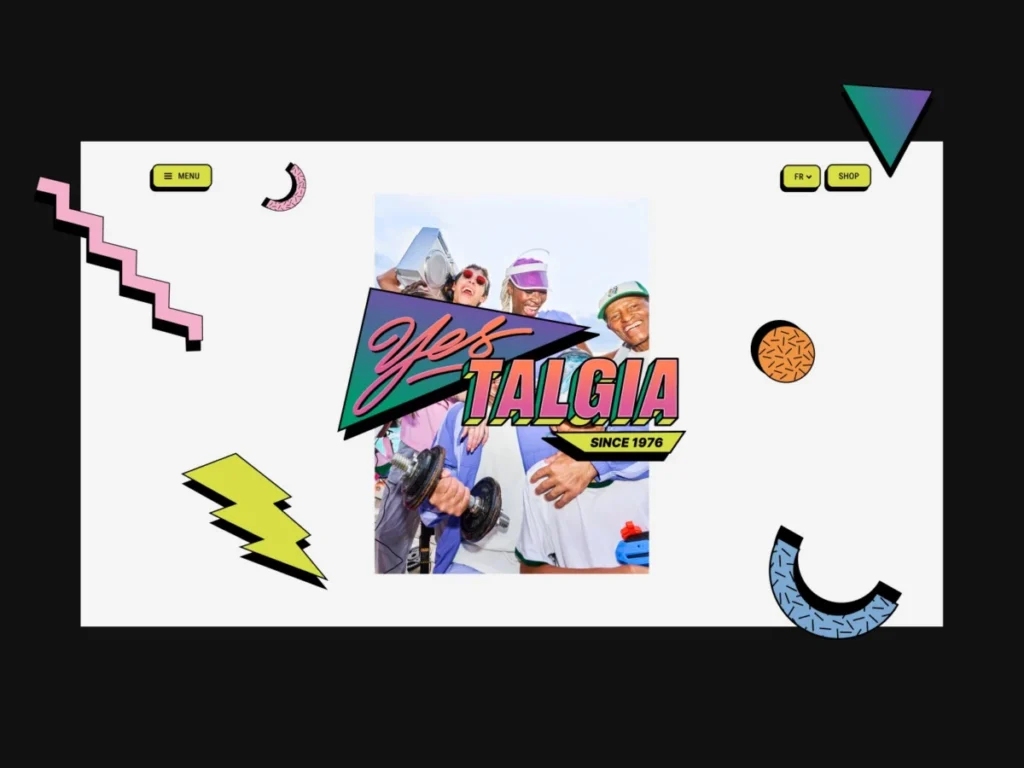

Decathlon, the global sports equipment and apparel titan, has officially launched its highly anticipated exclusive capsule collection, Yestalgia. Designed to capture the vibrant, optimistic energy of the 1990s, the collection breathes new life into historical archival pieces through a modern lens. To support the global rollout of this vintage-inspired line across seven languages, the development and design teams crafted an immersive, high-performance digital experience that marries nostalgic pop-culture aesthetics with cutting-edge web engineering.
The creation of the Yestalgia web platform required a delicate balance between heavyweight creative direction and high-speed performance. Built on a fully custom WordPress theme utilizing Timber and Blockstudio, the site serves as both an e-commerce gateway and an interactive digital museum. The visual identity, forged in close collaboration with renowned illustrator Dalkhafine, features expressive typography, dynamic vector animations, and bold color palettes that pay homage to outdoor heritage from three decades ago.

Background Context and Strategic Intent
The 1990s have experienced a significant cultural renaissance across the fashion and retail industries. Consumers increasingly gravitate toward retro aesthetics, seeking comfort, color, and emotional connection in a fast-paced digital era. For Decathlon, the Yestalgia capsule represents more than a mere exercise in nostalgia; it is a strategic repositioning of the brand’s heritage assets. By reinterpreting iconic outdoor gear from the 90s, Decathlon aims to engage both older demographics who remember the original designs and younger consumers who view the era through a lens of retro-futuristic cool.
Translating this ethos into a web environment presented distinct technical and creative challenges. Standard e-commerce templates would not suffice for a campaign rooted in high-end art direction. The development team needed to construct a platform that felt less like a traditional digital catalog and more like an interactive editorial magazine, ensuring that product discovery felt effortless and visually arresting.
Innovative Design and Editorial Approach
The architecture of the Yestalgia website relies heavily on an editorial, product-first layout. Large-scale imagery, generous spatial compositions, and minimal interface elements allow visitors to inspect each garment instantly. Rather than burying products beneath layers of filters and navigation menus, the site delivers a curated storytelling experience.

To bridge the gap between product displays and campaign branding, the designers introduced graphic interludes throughout the user journey. Typography, geometric shapes, and motion elements function as active components of the site’s visual language rather than passive decoration. This establishes a constant dialogue between the merchandise, the typography, and the user’s interactions.
One of the platform’s standout features is its novel approach to navigation. Inspired by classic analog technology, the site menu is conceptualized as a physical Walkman. Users browse through a selection of virtual cassette tapes, each representing a distinct destination within the platform. Selecting a cassette triggers a tactile physical simulation where the tape snaps into the deck before transitioning the user to the chosen section. This clever nod to 90s hardware transforms a mundane functional element into an engaging micro-interaction, complete with customized background color shifts and subtle haptic feedback on mobile devices.
Advanced Front-End Engineering and Animation
Beneath the playful surface lies a sophisticated technical stack designed to handle complex animations without sacrificing loading speeds or accessibility. The front-end operates on piecesjs, a lightweight framework built on native web components. Each "Piece" functions autonomously, lazy-importing its own JavaScript and CSS only when required. Scroll-driven interactions are centralized via a custom Scroll Piece that integrates Lenis with GSAP ScrollTrigger, mapping interactivity directly to HTML data attributes.

Tackling Performance and Client Usability
A primary hurdle in developing heavily art-directed digital campaigns is ensuring that the client can update content independently without breaking the design integrity. The Yestalgia platform resolves this tension through Blockstudio. Every section of the site is structured as a Blockstudio block comprising a JSON schema and a Twig template. This enables Decathlon’s internal teams to reorder, recompose, and update copy and imagery seamlessly across all seven localized languages without altering the underlying codebase.
Animation performance was meticulously optimized across all devices. For instance, vector animations powered by Rive are strictly gated using Intersection Observers. Graphics only execute when they enter the viewport and pause instantly upon leaving, preventing unnecessary GPU consumption on off-screen elements. Furthermore, the site features robust support for reduced-motion preferences, ensuring that users with motion sensitivities receive an accessible experience without visual degradation.
The platform also utilizes innovative markup-driven motion primitives. Decorative elements, such as rotating satellite graphics, subscribe to Tempus—a single shared animation loop normalized against delta time to guarantee consistent performance across 60Hz and 120Hz displays. Meanwhile, large title reveals employ a clever 2.5D visual trick: characters and words are duplicated with distinct opacity, stagger, and delay offsets to simulate embossed depth without rendering actual 3D geometries, thereby safeguarding mobile performance.

Chronology and Development Milestones
The Yestalgia digital project evolved through iterative collaboration between motion designers and front-end developers.
- Concept Phase (Early Development): Initial wireframes established the 90s aesthetic, outlining the Walkman menu concept and editorial layout grids.
- Prototyping and Motion Refinement: Developers built initial functional versions of the cassette navigation. Motion designers subsequently refined the easing curves, timing, and physics-based bounces to ensure the interaction mimicked real-world hardware.
- Architecture and Localization: The custom WordPress theme was integrated with Timber and Blockstudio, and Polylang was implemented to support the seven-language rollout.
- Optimization and Deployment: Performance audits led to the implementation of viewport-gated Rive animations, CSS-driven timeline components, and mobile-specific performance fallbacks, culminating in a smooth global launch.
Broader Implications and Industry Impact
The successful deployment of the Yestalgia digital experience underscores a broader evolution in digital retail and marketing campaigns. As brands increasingly compete for consumer attention in saturated digital landscapes, standard template-driven e-commerce sites are frequently proving insufficient for high-impact product drops.
By combining deep emotional storytelling, tactile retro interfaces, and robust, maintainable content management architectures, Decathlon and its development partners have established a new benchmark for promotional campaign sites. The project demonstrates that heavy art direction and rigorous performance optimization are not mutually exclusive. As digital agencies look toward the future, the methods deployed in the Yestalgia project—such as markup-declared GSAP timelines, modular web components, and client-friendly block structures—offer a viable roadmap for executing complex, narrative-driven brand activations at a global scale.