
The digital landscape is defined by a paradox of quality: a website is almost always at its absolute peak on the day it launches. Following the final merge of code and the subsequent public release, the project represents a synchronized effort of design, content, and engineering. Yet, from that moment forward, the asset enters a state of inevitable decay. This decline is rarely the result of technical failure; rather, it is a consequence of market evolution, shifting brand messaging, and the simple reality that human teams rarely possess the bandwidth to keep pace with the hyper-accelerated cycle of the modern web.
Industry analysts observe that websites effectively become "period pieces" within 12 to 18 months of deployment. While the underlying infrastructure remains functional, the messaging begins to mismatch the reality of the business, leading to a silent erosion of user trust and conversion rates. Pierre Burgy, co-founder of the autonomous web platform Fimo, suggests that this stagnation is not a law of nature but a failure of current operational models. The solution, he posits, lies in autonomous web systems—agents designed to continuously optimize digital properties long after the initial launch team has moved on to other projects.
The Evolution of Web Maintenance and the Autonomous Shift
The concept of the "set it and forget it" website has been the standard since the early 2000s. However, the rise of large language models (LLMs) and specialized AI agents has created a new category of software: the autonomous web. Unlike traditional Content Management Systems (CMS) that rely on human inputs to trigger updates, autonomous websites utilize agents that actively scan for issues, monitor performance metrics, and perform iterative optimizations.
In the early stages of this technology, developers assumed that total autonomy—granting AI full control over publishing, editing, and architectural changes—was the ultimate goal. However, early testing revealed a psychological and professional barrier: stakeholders are inherently uncomfortable relinquishing total control over their brand identity. Data gathered during the development of Fimo indicates that while users are eager to delegate tedious maintenance tasks, they remain highly protective of creative and strategic decision-making.
Categorizing the Maintenance Load
To make autonomous web management viable, developers have begun to categorize tasks based on the level of human judgment required. This taxonomy is essential for integrating agents into enterprise workflows.
-
Rule-Bound Chores (The 80%): The vast majority of website maintenance consists of repetitive, non-creative tasks. This includes ensuring accessibility compliance (WCAG standards), propagating design system updates, fixing broken metadata, compressing assets, and correcting redirect loops. These tasks are governed by rigid rules rather than subjective taste. Industry reports estimate that this "maintenance debt" consumes up to 80% of a developer’s time on long-term projects, yet it contributes nothing to the strategic value of the brand.
-
Strategic Judgment (The 20%): At the opposite end of the spectrum is the work that defines a brand’s soul. Decisions regarding visual aesthetics, tone of voice, and high-level marketing strategy require human intuition. No AI agent currently possesses the contextual depth to determine if a design choice is "on brand" in a subjective sense. Consequently, this remains the domain of human designers and product managers.
-
The Subjective Boundary: The most complex area of web operations exists in the middle, where tasks can be perceived as either a chore or a strategic decision depending on the individual. For example, a developer might view a system-wide shift to "dark mode" as a simple configuration update. Conversely, a lead designer might view that same change as a fundamental shift in brand positioning. This variability proves that there is no "one-size-fits-all" setting for autonomy.
Implications for Modern Development Teams
The integration of autonomous agents is poised to shift the role of the front-end developer and the content strategist. Rather than acting as "gatekeepers" who manually approve every minor change, these professionals are increasingly becoming "curators" of the agents themselves. By defining the parameters under which an agent operates, a team can delegate the tedious 80% of site health while retaining absolute authority over the high-level strategic direction.
This shift has profound implications for corporate productivity. A company that utilizes autonomous agents to monitor accessibility and performance can reallocate its engineering resources from "maintenance mode" to "innovation mode." In an economic environment where technical talent is expensive and highly sought after, this reallocation represents a significant competitive advantage.
Establishing Trust: The Chronology of Autonomy
The path toward a fully optimized, autonomous site typically follows a specific lifecycle, according to industry experts:
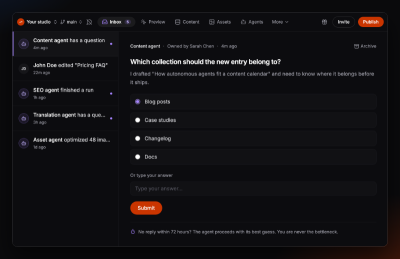
- Phase 1: Observation. The agent is deployed in a "read-only" mode, where it identifies potential improvements and reports them to the team without executing changes. This allows the team to verify the agent’s logic against their own standards.
- Phase 2: Assisted Implementation. The agent is permitted to make changes but requires human verification via a dashboard. This stage builds confidence as the agent demonstrates its ability to follow brand guidelines and technical constraints.
- Phase 3: Managed Autonomy. The agent is granted permission to perform specific, low-risk tasks (e.g., image optimization, link repair) without human intervention, while higher-level decisions remain gated.
- Phase 4: Continuous Optimization. The agent continuously scans the site, implementing improvements as they are required, with the team only intervening to update the agent’s core directives.
This iterative process is designed to mitigate the risk of "runaway" AI changes. By keeping a clear audit trail of every modification, teams can revert changes instantly, ensuring that the agency of the human designer is never truly lost.
Fact-Based Analysis of the "Frozen Site" Risk
The most significant risk in the current web landscape is not that an AI might make an unauthorized change, but that a site remains "frozen" for too long. A website that does not evolve is effectively a liability. Search engines prioritize fresh, high-quality content and current technical standards. A site that falls behind on accessibility, performance metrics, or mobile responsiveness will inevitably experience a decline in search engine rankings (SEO) and user engagement.
From an institutional perspective, the "frozen site" creates a disconnect between the company’s internal growth and its external representation. If a company launches a new product or shifts its core service, but its website remains stuck in the design language of two years ago, the conversion funnel is disrupted. Autonomous agents serve as a continuous heartbeat for these digital assets, ensuring that the site evolves in tandem with the organization it represents.
Future Outlook and Conclusion
The goal of web autonomy is not to remove humans from the creative process, but to remove the decay that naturally sets in after a product launch. By treating website maintenance as a programmable, automated layer of the business, organizations can ensure that their digital footprint is always in a state of peak performance.
As this technology matures, the definition of a "web developer" will likely expand to include "agent architect." The future of the web will not be defined by static codebases that require manual intervention, but by living, breathing ecosystems that grow, adapt, and optimize in real-time. The organizations that embrace this transition will be those that view autonomy not as a replacement for human creativity, but as the essential tool that enables humans to focus on the work that actually matters. The challenge, ultimately, is not technical, but cultural: learning to draw the line where human value begins, and letting the agents handle the rest.