
Parent company Alphabet has released its financial results for the third quarter of 2026, revealing a nuanced picture for its flagship video-sharing platform, YouTube. While advertising revenue growth experienced a slight deceleration compared to earlier quarters, the platform offset this through robust momentum in subscription services, connected television (CTV) viewership, e-commerce integrations, and artificial intelligence-driven creative tools.
For Q3 2026, YouTube advertising revenue reached $11.2 billion, representing a 9% increase year-over-year. Although this figure demonstrates continued financial scale, it marks a modest slowdown from the 13% growth rate recorded in the second quarter of the same year. Despite the tempered ad intake, Alphabet’s overarching financial health was bolstered by substantial gains in non-advertising sectors, most notably through subscriptions and strategic enterprise tools.
Subscription Growth and the Rise of Connected TV
A primary driver of YouTube’s diversified revenue stream is its subscription ecosystem. Alphabet reported an 11% increase in Google’s overall subscription, platform, and device revenues, a surge heavily propelled by YouTube Music and YouTube Premium. The combined subscriber base for these premium services has officially climbed to 150 million globally.
This milestone represents a significant acceleration in user adoption. YouTube first crossed the 100 million subscriber threshold for its music and premium tiers in early 2024. Reaching 150 million subscribers highlights a sustained upward trajectory, driven in large part by shifting consumer entertainment habits away from traditional linear television and toward streaming environments.
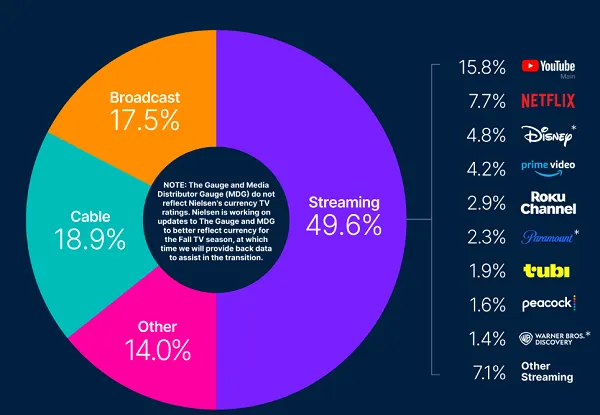
During Alphabet’s Q2 earnings call in July, executives noted that YouTube experienced a notable spike in Premium sign-ups specifically among connected TV (CTV) viewers. This trend aligns with broader media consumption data. According to Nielsen’s "The Gauge" report published in August 2026, YouTube cemented its position as the top streaming platform in the United States, capturing the highest share of TV viewing time among all major streaming services.
Expanding upon this dominance, Google Chief Business Officer Philipp Schindler emphasized during the Q3 earnings call that the platform’s "Living Room" experience—referring to YouTube consumed via connected TVs—has evolved far beyond a secondary viewing format. Living Room engagement now accounts for more than one-third of total YouTube advertising revenue, transforming how brands reach audiences and positioning the platform as a direct competitor to traditional broadcast and cable networks.
Chronology of Growth and Strategic Milestones
To understand YouTube’s current market standing, it is helpful to examine the timeline of key developments leading up to the third quarter of 2026:
- Early 2024: YouTube surpasses 100 million global subscribers for its combined YouTube Music and YouTube Premium tiers.
- March 2026: YouTube introduces an AI-powered "reimagine" option for Shorts, allowing viewers to generate alternative video concepts based on existing creator content.
- July 2026: During the Q2 earnings call, Alphabet highlights a surge in connected TV subscriptions as users increasingly substitute traditional TV with YouTube.
- August 2026: Nielsen’s The Gauge report ranks YouTube as the number-one streaming platform in the U.S.
- Late 2026: YouTube tests and rolls out advanced creator tools, including an "Extend with AI" feature for Shorts, and announces a landmark affiliate partnership with retail giant Amazon.
- October/November 2026: Alphabet reports Q3 2026 earnings, revealing $11.2 billion in advertising revenue and an expanded creator base exceeding 3 million participants.
Monetization, Small Businesses, and E-Commerce Partnerships
Beyond consumer subscriptions, YouTube continues to expand monetization avenues for its creator ecosystem and enterprise advertisers. Alphabet reported that small and medium-sized businesses (SMBs) are adopting Google’s Demand Gen advertising products at an accelerated rate, providing a stable foundation for ad intake despite the moderation in core ad growth.

Concurrently, the YouTube Partner Program (YPP) has expanded to include more than three million creators worldwide. To enhance earning potential for these content producers, YouTube has leaned heavily into social commerce. More than 1.3 million channels are currently enrolled in YouTube’s shopping program, facilitating direct product sales through video content.
In a move set to reshape creator commerce in the United States, YouTube recently finalized a major affiliate partnership with Amazon. This integration allows U.S.-based creators to tag Amazon products directly within their long-form videos, YouTube Shorts, and livestreams. By bridging content creation with direct e-commerce fulfillment, YouTube aims to increase average revenue per user and provide creators with resilient income streams independent of ad-rate fluctuations.
Integration of Generative Artificial Intelligence
Artificial intelligence remains a central pillar of Alphabet’s strategy to stimulate user engagement, improve ad targeting, and lower barriers to content production. With over 20 million videos uploaded to the platform daily, scaling creative output efficiently is a primary operational focus.
During the Q3 earnings presentation, Philipp Schindler underscored the impact of newly deployed AI infrastructure. "Every day, more than 20 million videos are being uploaded," Schindler stated. "We’re making creation easier with new generative AI tools in YouTube Studio, plus a conversational editing assistant in Shorts and YouTube Create."
Over the course of 2026, YouTube rolled out several distinct AI-driven features designed to empower creators. In March, the platform launched an AI-powered reimagine tool for Shorts, enabling users to generate derivative video clips. This was followed by testing of an "Extend with AI" feature, which allows creators to seamlessly generate alternative endings for their short-form content.
Data released by YouTube prior to the Q3 earnings report indicates that these technological integrations are meeting with enthusiastic user adoption. According to a platform survey, 61% of individuals who published videos on the app over the preceding 12 months expressed keen interest in using generative AI tools to insert themselves into video content or alter their visual media.
Implications and Industry Outlook
The financial disclosures and operational updates from Alphabet’s Q3 2026 report signal a mature phase for the world’s leading video platform. While the deceleration in direct advertising growth from 13% in Q2 to 9% in Q3 suggests that the digital advertising market is facing normalization, the simultaneous surge in high-margin subscription revenue offers a powerful financial cushion.
Furthermore, YouTube’s dominance in the living room through connected TVs fundamentally alters its value proposition to advertisers. By capturing prime television viewing real estate, YouTube bridges the gap between digital video flexibility and traditional television reach. Coupled with aggressive push into social commerce via the Amazon partnership and the widespread adoption of AI productivity tools, YouTube appears well-positioned to sustain its market leadership.
However, industry analysts note that scaling generative AI tools introduces ongoing challenges regarding content moderation and the proliferation of low-quality or repetitive media—often referred to as "AI slop." As user-generated AI content accelerates, YouTube’s ability to successfully curate high-value material while filtering out derivative noise will likely dictate long-term creator retention and viewer satisfaction. For now, the platform’s multi-pronged approach of subscriptions, CTV expansion, and commerce integration has successfully diversified its revenue base against the cyclical nature of digital advertising.