
Jim Parkinson, a celebrated lettering artist, type designer, and painter whose distinctive hand-drawn letterforms graced countless logos, publications, and brands for over five decades, passed away on June 26, 2025, at his home in Oakland, California. He was 83. Parkinson had been battling Alzheimer’s disease for several years. He is survived by his wife, the book artist Dorothy A. Yule, who served as his devoted life partner and caregiver.
Born in Oakland on October 23, 1941, Parkinson’s early fascination with the art of lettering was sparked by his neighbor, Abraham Lincoln Paulsen, a renowned penman who could reportedly write the Gettysburg Address upside down and backward using only the numeral "2." This early exposure ignited a lifelong passion, leading Parkinson to meticulously study lettering manuals and correspondence courses, often delving into historical styles and reinterpreting them with his unique artistic vision—a hallmark of his distinguished career.
Parkinson pursued his artistic education at the California College of Arts and Crafts, graduating in 1963. His professional journey began at Hallmark Cards in Kansas City, Missouri. Initially tasked with illustrating greeting card characters, his innate talent for lettering soon became apparent, leading to a pivotal reassignment to the company’s lettering department. It was here that Parkinson not only found a professional calling but also solidified his understanding that lettering was his true vocation. His exceptional ability to render any letterform by hand with precision and flair would become the foundation of his extensive freelance career, spanning more than fifty years after his return to Oakland.
A Prolific Career Shaping Visual Identity
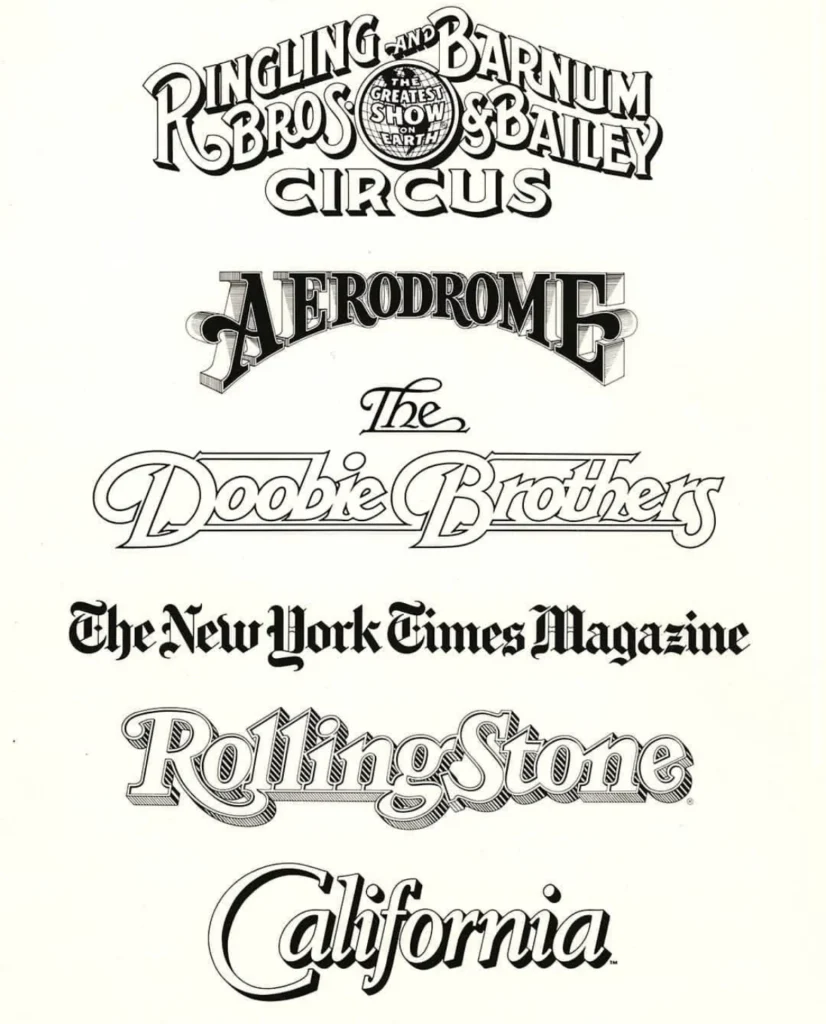
Parkinson’s mastery of lettering allowed him to tackle a vast array of projects, from intricate logos to complete typeface families. His career was a testament to his versatility and prolific output, with his distinctive letterforms appearing across a wide spectrum of media. He designed headlines for advertising campaigns, created iconic logos for renowned musical acts like The Doobie Brothers and legendary circuses such as Ringling Bros. and Barnum & Bailey. His contributions extended to the development of dozens of custom and retail typefaces, as well as numerous nameplates for prominent magazines, including Rolling Stone, and newspapers like the Los Angeles Times.
The sheer volume and ubiquity of Parkinson’s work made him an indispensable figure in the design industry. Art directors frequently sought his expertise to refresh and revitalize publication identities, with Parkinson often redrawing mastheads multiple times over the years, demonstrating his enduring relevance and adaptability. A casual visit to any newsstand in the United States, and even some abroad, would likely reveal his handiwork on multiple covers, a testament to his pervasive influence on visual communication. His website, established in the early days of the internet, showcased an enviable collection of his projects, reflecting his early adoption of digital platforms to display his craft.

Beyond Typography: A Painter of Nostalgic Americana
In his later years, when not engaged in logo design or font creation, Parkinson dedicated himself to a unique artistic pursuit: painting vintage neon signage. These were not mere reproductions but rather fine art interpretations of the fading glow of roadside Americana. Drawing inspiration from his road trips across the American West, his extensive collection of photographs provided the source material for numerous large-scale paintings. These works meticulously captured the worn textures and broken glass of weathered signs, imbuing them with a poignant realism that often surpassed the original photographs. These paintings adorned the walls of his home, creating a personal gallery of his lifelong aesthetic interests.
A Welcoming Mentor and Keeper of Ephemera
For the past two decades, Stephen Coles, author of this tribute and a prominent figure in the typographic community, had the privilege of knowing Parkinson. Upon Coles’ arrival in Oakland in 2004, Parkinson was among the first to extend a welcoming hand, inviting him and other designers to his home to explore his personal archive. This collection comprised a treasure trove of ephemera, rare type books, and Parkinson’s own extensive body of work. These visits were cherished opportunities for Coles and his friends to witness firsthand the depth and breadth of Parkinson’s artistic legacy, often revealed as flat files were opened to expose original artwork.
Parkinson was a consistent and joyful presence at semiregular community picnics, radiating a warmth and wisdom that endeared him to all. Despite his immense talent and professional success, he maintained a humble demeanor, embodying Margot Fonteyn’s adage: "Take your work seriously, but never yourself." This spirit of levity and self-awareness was evident in his online presence and in a 2010 video interview conducted by Coles, which offers a glimpse into his personality and creative process.
A Legacy Preserved: Memoir and Charitable Contributions
Parkinson’s ability to craft compelling narratives was as remarkable as his skill with letters. The Letterform Archive is slated to publish his memoir in 2026, a significant undertaking that will allow future generations to connect with his life and work through his own words. This posthumous publication ensures that those who did not have the opportunity to meet him can still gain insight into his remarkable journey and unique perspective. Readers are encouraged to sign up for notifications from the Letterform Archive to stay informed about the memoir’s release.
A memorial service for Jim Parkinson is planned for the fall. In lieu of flowers, the family requests that donations be made to the Alzheimer’s Association, a cause deeply personal to them given Parkinson’s long struggle with the disease. The organization’s mission to end Alzheimer’s and all other dementia through the care, support, and research it provides remains critical in the ongoing fight against these debilitating conditions.
Parkinson’s passing represents a significant loss to the fields of typography, design, and art. His legacy, however, endures through the indelible marks he left on the visual landscape and the inspiration he provided to countless designers and artists. His work serves as a timeless reminder of the power and beauty of handcrafted letterforms in an increasingly digital world.

Broader Impact and Implications
The death of Jim Parkinson marks the end of an era for hand-lettering and custom type design. In an age where digital fonts are ubiquitous and often algorithmically generated, Parkinson’s commitment to the nuanced, tactile art of drawing letters by hand stood as a powerful counterpoint. His work demonstrated that even in the digital age, the human touch, artistic sensibility, and historical awareness could elevate design to a profound level of craft and communication.
Parkinson’s prolific output and consistent quality influenced generations of designers. His ability to adapt historical styles while imbuing them with his own distinct voice set a benchmark for custom lettering. This approach not only ensured the longevity of his designs but also contributed to the rich tapestry of visual culture. The fact that his work appeared on so many high-profile publications and brands underscores the critical role of skilled lettering artists in shaping brand identity and public perception.
The impending publication of his memoir by the Letterform Archive is a significant event for the design community. It promises to offer invaluable insights into the creative process, the challenges and triumphs of a freelance career, and the personal journey of a master craftsman. Such autobiographical accounts are crucial for preserving the history of design and for educating future practitioners about the foundations of their discipline.
The call for donations to the Alzheimer’s Association highlights the pervasive impact of neurodegenerative diseases. Parkinson’s prolonged struggle and his wife’s dedicated care underscore the personal toll of Alzheimer’s. The increased awareness generated by his passing and the subsequent tribute serves to further the ongoing efforts to find treatments and ultimately a cure for this devastating illness. The design community’s response, marked by tributes and a commitment to preserving his legacy, reflects the deep respect and admiration held for Jim Parkinson, a true titan of his craft.