
Jim Parkinson, a towering figure in the world of lettering art, type design, and painting, passed away peacefully at his home in Oakland, California, on June 26, 2025. He was 83 years old and had been engaged in a long and courageous battle with Alzheimer’s disease. His devoted wife, the accomplished book artist Dorothy A. Yule, was not only his life partner since 2010 but also his steadfast caregiver throughout his years of declining health, a testament to their profound bond.
Parkinson’s extraordinary journey with the art of the letter began in his childhood in Oakland, where his early fascination was sparked by his neighbor, Abraham Lincoln Paulsen. Known as the "Wizard Penman," Paulsen possessed the remarkable ability to pen the Gettysburg Address upside down and backward, using only the numeral "2." This extraordinary demonstration was Parkinson’s first encounter with the transformative power of lettering, igniting a passion that would define his illustrious career. He diligently absorbed knowledge from vintage lettering manuals and correspondence courses, meticulously studying historical styles. This early immersion in the past would become a hallmark of his approach, enabling him to not only understand but also reimagine and infuse historical letterforms with his unique contemporary sensibility.
Born on October 23, 1941, Parkinson’s artistic education formally began at the California College of Arts and Crafts, where he pursued studies in design and painting. Upon graduating in 1963, he embarked on his professional career, joining the esteemed staff artists at Hallmark Cards in Kansas City, Missouri. While initially finding his niche elsewhere, his innate talent for rendering letters by hand quickly became apparent. Hallmark recognized his gift, reassigning him to their lettering department, where he discovered his true calling. It was here that Parkinson understood that specialization in lettering was not merely a career path but a profound life’s purpose. His exceptional ability to meticulously craft any letter style by hand became the cornerstone of his freelance career, which spanned over five decades.
A Prolific Career Shaping Visual Identity

Parkinson’s mastery of lettering allowed him to tackle an astonishing breadth of projects, from intricate logos to complete typeface families. His career was akin to a series of distinct yet interconnected professional lives, each marked by exceptional skill and creative vision. Over his fifty-plus years as a freelance artist, his distinctive hand-lettered work graced countless logos, headlines, and publications that became deeply ingrained in the cultural landscape.
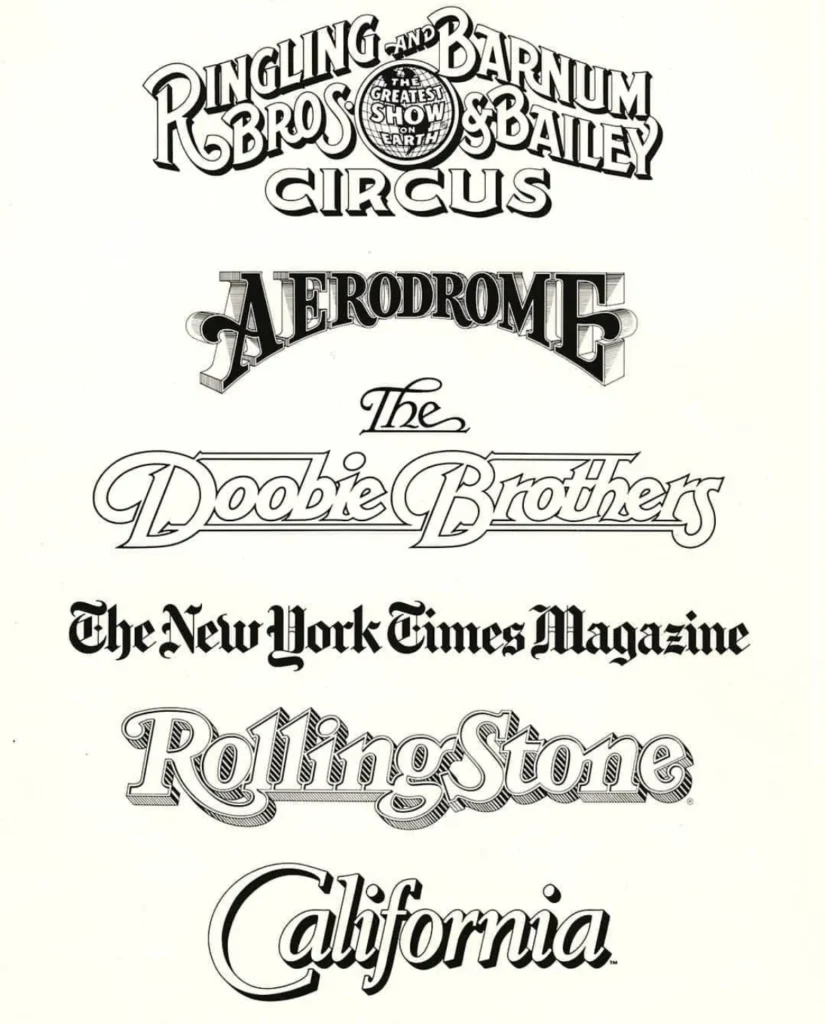
His contributions to the music industry are notably exemplified by his iconic lettering for the Doobie Brothers. In the realm of entertainment, he lent his distinctive touch to the legendary Ringling Bros. and Barnum & Bailey Circus logo, a mark that evoked wonder and excitement for generations. Beyond these prominent examples, Parkinson designed dozens of bespoke and retail typefaces, each imbued with his characteristic warmth and meticulous craftsmanship. His work also extended to the visual identity of numerous publications, including the instantly recognizable nameplates for Rolling Stone magazine and the Los Angeles Times. The sheer volume of his output was staggering; a visit to any newsstand in the United States, and even many internationally, would reveal Parkinson’s hand on multiple covers, often for publications seeking to refresh their visual appeal. His ability to redraw and revitalize titles multiple times over the years underscored his enduring relevance and adaptability.
The significance of Parkinson’s contributions can be further appreciated by considering the evolution of graphic design and branding. In an era increasingly dominated by digital tools, his dedication to the art of hand-lettering provided a vital counterpoint, emphasizing the unique human touch and artisanal quality that digital methods often struggle to replicate. His work served as a constant reminder of the power of thoughtful, handcrafted typography to convey emotion, personality, and prestige.
A Passion for Vintage Signage and Artistic Expression
Beyond his commercial successes, Parkinson cultivated a profound personal passion for painting vintage neon signage. This was not a mere hobby but a serious artistic pursuit that allowed him to explore his fascination with Americana and the ephemeral beauty of roadside art. Drawing inspiration from extensive road trips across the American West, his photo albums became a rich source for dozens of large-scale paintings. These artworks meticulously captured the weathered surfaces, broken glass tubes, and faded glory of vintage signs, often imbuing them with an even greater sense of reality and poignancy than their photographic counterparts. His paintings, which filled the walls of his Oakland home, are a testament to his keen observational skills and his ability to transform the mundane into compelling fine art.

Community and Legacy
For the past two decades, Jim Parkinson was a cherished mentor and friend to many in the design community. Stephen Coles, the author of this tribute and a prominent figure in typography, recounts his own experience of Parkinson’s generosity. Upon moving to Oakland in 2004, Coles was among the first to be welcomed into Parkinson’s home, where he discovered an extraordinary personal collection of ephemera, type books, and Parkinson’s own extensive archive of work. Coles often brought friends to visit, delighting in their reactions as Parkinson unfurled flat files brimming with original artwork.
Parkinson was a regular and beloved presence at semiregular design picnics, where he consistently radiated joy, wisdom, and a disarming sense of humor. His casual silliness, a stark contrast to his immense talent, kept him grounded and approachable, embodying the admirable mantra of Margot Fonteyn: "Take your work seriously, but never yourself." This wry levity is evident throughout his website, a domain he wisely secured in the early days of the internet, and in a compelling video interview conducted in 2010.
The depth of Parkinson’s storytelling abilities was as profound as his artistic talent. It is with great anticipation that the Letterform Archive will publish his memoir in 2026. This posthumous publication offers a vital opportunity for those who did not have the privilege of meeting Parkinson to connect with him through his own words, gaining insight into his life, his work, and his unique perspective on the world. Those interested in being notified of the memoir’s release are encouraged to sign up for updates from the Letterform Archive.
A memorial service to celebrate Jim Parkinson’s life will be held in the fall. In lieu of flowers, the family requests that donations be made to the Alzheimer’s Association, supporting research and care for those affected by this devastating disease. The outpouring of tributes from colleagues, friends, and admirers underscores the profound impact Jim Parkinson had on the fields of lettering, typography, and art, leaving behind a legacy that will continue to inspire for generations to come. His work serves as a powerful reminder of the enduring beauty and importance of handcrafted artistry in a rapidly evolving visual landscape.