
Alphabet Inc. has announced a significant shift in the landscape of digital advertising, revealing that its newly graduated AI Max platform is successfully monetizing "billions" of search queries that were previously considered unreachable for traditional advertising models. During Alphabet’s Q2 2026 earnings call, senior executives detailed how the integration of advanced generative AI into the core Search product is not merely refining existing ad placements but is actively expanding the total addressable market for search advertising. By leveraging the Gemini large language model, Google is now able to interpret complex, conversational, and often ambiguous user queries, matching them with relevant commercial content in ways that the industry’s legacy keyword-based systems could not achieve.
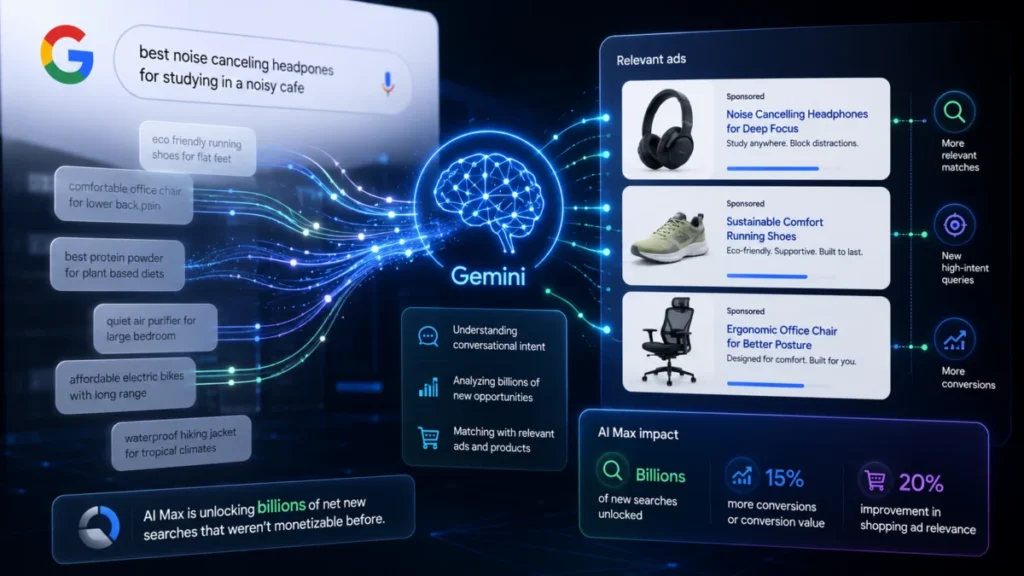
Philipp Schindler, Google’s Senior Vice President and Chief Business Officer, informed investors and analysts that AI Max has officially moved out of its beta testing phase. The platform has seen rapid adoption, with over 500,000 advertisers already integrating the tool into their marketing stacks. The primary value proposition of AI Max lies in its ability to bridge the gap between human intent and product availability. In the past, search queries that were too long or lacked specific high-volume keywords often went unmonetized because the system could not confidently predict what the user wanted to buy. AI Max changes this dynamic by analyzing the semantic meaning of a query rather than just the individual words within it.
The Evolution of Search: From Keywords to Intent
For over two decades, the backbone of Google’s revenue was the keyword. Advertisers bid on specific terms, and Google’s algorithms matched those terms to user input. However, as user behavior evolved toward more natural language—driven by mobile voice search and conversational AI interfaces—the limitations of keyword matching became apparent. Users frequently input "long-tail" queries, such as "what is the best eco-friendly hiking boot for someone with wide feet who also needs ankle support?" Traditional systems might struggle to find a perfect keyword match for such a specific string, often resulting in generic ads or no ads at all.
The introduction of AI Max represents the culmination of a multi-year transition toward "intent-based" marketing. According to Schindler, AI Max allows Google to look at these complex strings and understand the underlying commercial intent. By doing so, the company is effectively "opening up" billions of searches that previously resided in a non-commercial or "unmonetized" bucket. This expansion is critical for Alphabet as it seeks to maintain its dominant position in a market where competitors like Microsoft’s Bing and various specialized AI search engines are vying for user attention.
Gemini Integration and the Performance Surge
A central component of this technological leap is the integration of Gemini, Google’s most capable multimodal AI model. Alphabet reported that Gemini has directly improved the relevance of Shopping ads for complex queries by approximately 20%. This improvement is not just a marginal gain; it represents a fundamental shift in how the engine perceives product catalogs. Gemini can "read" product descriptions, "view" product images, and "understand" user reviews to determine if a product truly matches a nuanced user request.
The data provided during the Q2 2026 call highlights the tangible benefits for the advertiser. Google noted that businesses utilizing AI Max, often in conjunction with Performance Max (PMax), are experiencing an average 15% lift in conversions or conversion value. Crucially, this lift is being achieved at a similar return on ad spend (ROAS) to previous campaigns. This suggests that the AI is not simply spending more money to get more results, but is instead finding more efficient pathways to the consumer.
Chronology of AI Development at Google Search
The journey to AI Max has been marked by several key milestones over the last few years:
- The Launch of BERT (2019): Google introduced Bidirectional Encoder Representations from Transformers to better understand the context of words in search queries.
- MUM Implementation (2021): The Multitask Unified Model allowed the search engine to handle more complex tasks and understand information across different media types.
- The Rise of Performance Max (2021-2023): Google began pushing advertisers toward automated, goal-based campaign types that utilized machine learning to allocate budgets across Search, YouTube, Display, and Discover.
- The Gemini Era (2024-2025): The integration of generative AI into the search results page (SGE/AI Overviews) changed the visual and functional nature of search.
- AI Max Beta (2025): A select group of 100,000 advertisers began testing the next generation of AI-driven targeting.
- Full Release (Q2 2026): AI Max becomes the standard for complex query monetization, reaching 500,000+ advertisers.
Strategic Implications for the Advertising Industry
The move toward AI Max carries profound implications for digital marketers and agencies. Historically, search engine marketing (SEM) was a labor-intensive process involving extensive keyword research, manual bidding, and the crafting of hundreds of specific ad variations. With AI Max, the "signals" required by Google have shifted.

Instead of focusing on a list of 5,000 keywords, advertisers are now being encouraged to focus on the quality of their "inputs." This includes high-resolution creative assets, detailed and accurate product feeds, and landing pages that are optimized for clarity and user experience. The AI takes these assets and dynamically assembles the most effective ad for each individual user in real-time.
However, this shift has not been without controversy. Industry analysts have pointed out that as Google’s AI takes more control over ad placement, advertisers lose "granularity." Traditional visibility into which specific queries triggered an ad is being reduced in favor of aggregate performance data. This "black box" approach requires a high degree of trust in Google’s algorithms. While the 15% lift in conversion value is a compelling argument for adoption, some veteran marketers remain cautious about the lack of transparency regarding where their budgets are being deployed.
AI Mode Ads and New Revenue Streams
Beyond traditional search results, Google provided a glimpse into the future of "AI Mode" ads. As more users interact with Search through a conversational interface—essentially chatting with the search engine to refine their needs—Google is developing ad formats that feel native to that experience.
These "AI Mode" ads are designed to be assistive rather than disruptive. For example, if a user is using the AI to plan a ten-day itinerary for a trip to Japan, the AI might suggest specific travel insurance providers or boutique hotels as part of the conversation, rather than as a separate sidebar of links. This represents a move toward "contextual commerce," where the line between information and transaction becomes increasingly blurred.
Market Reaction and Financial Outlook
Financial analysts have responded positively to the Q2 2026 earnings report, noting that Alphabet’s ability to monetize the "long tail" of search is a powerful counter-narrative to fears that generative AI would cannibalize search revenue. By turning previously unmonetized queries into revenue-generating opportunities, Google is effectively growing the pie rather than just fighting for a larger slice of the existing one.
Alphabet’s stock saw a modest uptick following the call, as investors were reassured that the company’s massive capital expenditures on AI infrastructure—including the development of custom TPU (Tensor Processing Unit) chips—are beginning to yield measurable returns in the advertising business. The company’s focus on "intent" over "keywords" is seen as a future-proofing strategy against the rise of specialized AI assistants.
The Bottom Line for Businesses
For the half-million advertisers already using AI Max, the message from Google is clear: the future of search is conversational, and the future of advertising is automated. To succeed in this new environment, brands must ensure their digital presence is "AI-ready." This means moving away from the rigid structures of the 2010s and toward a more fluid, asset-based approach to marketing.
As AI Max continues to roll out globally, it is expected to become the primary engine for Google’s Search revenue. The "billions" of searches now being monetized represent a new frontier for digital commerce, one where the complexity of human language is no longer a barrier to finding the right product, but a bridge to it. The challenge for Google moving forward will be balancing the undeniable efficiency of these AI systems with the transparency and control that advertisers have come to expect over the last two decades. For now, however, the numbers suggest that the AI-driven expansion of the search market is well underway, providing a clear path for Alphabet’s continued growth in the mid-2020s.