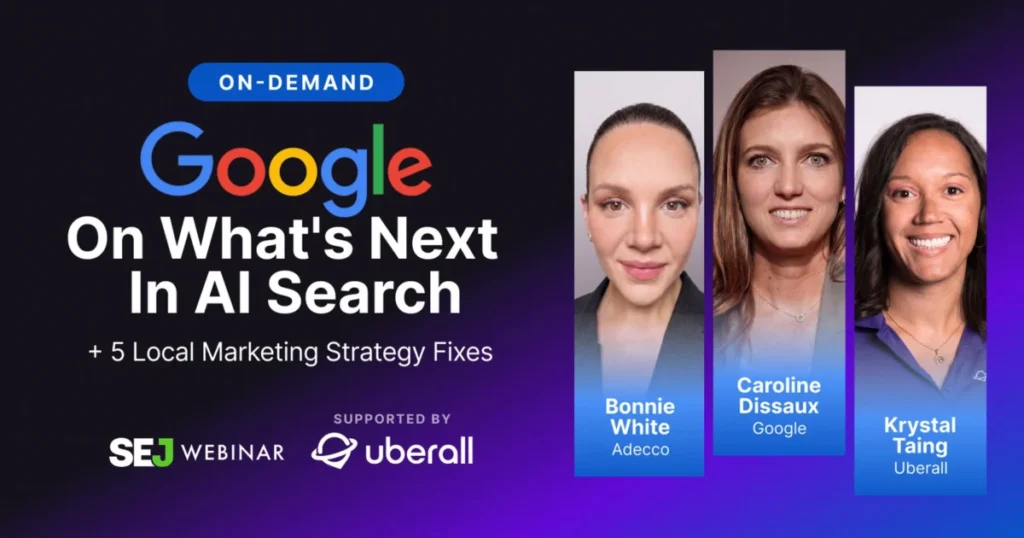

The landscape of local discovery is undergoing a profound structural transformation, driven by the rapid evolution of artificial intelligence in search engines. No longer satisfied with broad geographic queries, modern consumers increasingly rely on conversational, highly specific AI-driven prompts that demand granular, real-time answers. During a recent industry webinar titled Google On What’s Next In AI Search + 5 Local Marketing Strategy Fixes, digital marketing leaders gathered to dissect these emerging paradigms. Featuring insights from Google’s Caroline Dissaux, Adecco’s Bonnie White, and Uberall’s Krystal Taing, the September 24 event illuminated a critical reality for multi-location enterprises: traditional listing strategies, which often rely on little more than a business name, address, and operating hours, are rapidly losing efficacy in the age of large language models (LLMs).
Background Context of the AI Search Shift
For decades, local search optimization revolved around basic directory consistency, foundational keyword targeting, and accumulating reviews. Search engines processed queries like "plumber near me" or "Italian restaurant downtown" and returned a static list of options based primarily on proximity, prominence, and keyword relevance. However, the integration of generative AI into mainstream search engines—exemplified by Google’s Search Generative Experience (SGE), AI Overviews, and conversational AI assistants—has fundamentally altered consumer behavior.
Today’s users are increasingly comfortable posing complex, multi-layered queries to search interfaces. A consumer might now ask an AI engine to find a family-friendly restaurant that offers gluten-free menu options, has an open patio table for this Saturday evening, and is located within a ten-minute drive of a specific transit station. AI search engines respond by synthesizing data from across the web, breaking down these convoluted requests into discrete parameters, and parsing digital footprints to identify businesses that can fulfill every specified condition.
Consequently, a business listing that lacks specific operational details is effectively invisible to these algorithms. If an enterprise fails to explicitly state its amenities, service menus, real-time inventory, or specific appointment availability, LLMs will bypass it in favor of competitors with more comprehensive data architectures. This structural shift moves local search optimization from a simple visibility exercise to a complex data-integrity challenge.
The Scaling Challenge for Multi-Location Enterprises
During the webinar, Krystal Taing of Uberall emphasized that while the foundational principles of local optimization remain familiar, the modern challenge lies entirely in scale and complexity. Maintaining accurate data across a single storefront is manageable; ensuring absolute synchronization across hundreds or thousands of franchise locations, corporate branches, or international subsidiaries is a monumental operational undertaking.
"Most of us really have been talking about these things for years," Taing noted during the session. "What’s different is the scale, the complexity, and the importance of getting these right across every location and what it means to LLMs and generative AI."
For large enterprises, this realization exposes vulnerabilities in traditional organizational structures. Marketing departments frequently operate under the assumption that a robust national brand presence or a standardized corporate website is sufficient to drive local traffic. However, generative AI evaluates visibility at the hyper-local level. If an individual branch office fails to update its specific service offerings or operational hours, the overarching brand will be excluded from hyper-specific local AI recommendations.
This dynamic necessitates a rigorous, location-by-location data audit. Enterprises can no longer rely on top-down assumptions that a single national profile accurately represents the operational reality of every regional storefront. Instead, multi-location brands must implement decentralized data governance frameworks supported by centralized quality control.
Optimizing Google Business Profiles for Generative Engines
To bridge the gap between traditional listings and AI readiness, Google’s Caroline Dissaux and Adecco’s Bonnie White outlined actionable strategies for maximizing the utility of Google Business Profiles (GBPs). While the speakers clarified that populating specific profile fields does not serve as a guaranteed shortcut to top-tier AI visibility, it fundamentally equips search algorithms with the contextual data required to match a business with complex consumer queries.
Key optimization priorities include:
- Comprehensive Service Categories: Moving beyond primary industry classifications to include granular sub-categories that reflect niche offerings.
- Detailed Attributes: Explicitly detailing amenities, accessibility features, payment methods, and specialized operational capabilities.
- Real-Time Inventory and Menus: Integrating live inventory feeds and dynamic menu structures directly into listing ecosystems.
- Dynamic Availability: Ensuring that appointment booking links, operational hours for holidays, and temporary schedule adjustments are meticulously maintained.
Crucially, the panel stressed that consistency across digital surfaces does not imply rigid uniformity. While core brand facts must remain identical, regional nuances—such as location-specific services or unique local operating hours—must be accurately reflected to prevent consumer confusion and algorithmic penalties. Conflicting information across directories, social platforms, and official websites severely damages the trust signals that LLMs rely upon when synthesizing recommendations.
Navigating Measurement and Analytics in the Age of AI
As marketing budgets increasingly pivot toward AI readiness, attribution and measurement have emerged as significant pain points for digital strategists. During the webinar’s Q&A session, attendees frequently inquired about how to accurately measure the return on investment of local optimization efforts specifically within AI-driven search environments.
Krystal Taing addressed these concerns by examining current metrics, such as Google Business Profile post views and clicks. While she acknowledged that these figures are valuable for evaluating the performance of individual promotional posts, she cautioned that they do not definitively establish direct causality between a specific post and visibility within AI Overviews or advanced AI search modes.
Instead of searching for a single silver-bullet metric, Taing recommended a qualitative and analytical approach: comparing historical post topics and content themes against the actual query patterns and AI-generated answers observed in local markets. Caroline Dissaux reinforced this perspective, noting that direct, clear-cut attribution models linking local posts explicitly to AI visibility remain challenging to establish due to the complex, multi-source nature of generative algorithms.
When discussing promotional content across multi-location networks, the speakers advised that while automated distribution tools can efficiently syndicate corporate messaging, adding localized context significantly increases engagement. A generic national promotion is far less compelling to a consumer evaluating physical storefront options than a localized offer tailored to regional preferences or events. Furthermore, the panel cautioned against publishing variable pricing figures unless the enterprise possesses the operational agility to maintain absolute price accuracy across every branch, recommending instead that complex or fluctuating services be described clearly without misleading numerical figures.
The Human-AI Partnership in Local Marketing Operations
Managing the sheer volume of data required to maintain hundreds of localized profiles inevitably leads organizations to explore automation and artificial intelligence solutions. However, the panel was unanimous in emphasizing that technology should augment human oversight, not replace it entirely.
Krystal Taing argued that while automated models and algorithmic tools are essential for handling data scale, human strategists must remain firmly at the helm to define operational standards, brand voice, and compliance guardrails.
"It doesn’t mean that a human needs to manually review every single thing," Taing explained. "You know, you can have models, you can have these elements, but it does mean that humans should be the ones establishing the strategy, the standards, the guardrails."
Translating this philosophy into everyday operations requires a structured division of labor. Centralized marketing teams should establish clear governance frameworks, compliance policies, and automated auditing tools, while local store managers or regional coordinators act as the final arbiters of local truth. This collaborative model ensures that data remains agile and accurate without overwhelming corporate resources.
Practical Implementation: Five Essential Fixes for Multi-Location Brands
To help organizations operationalize the insights shared during the September 24 webinar, industry experts recommend a sequential five-step framework designed to systematically eliminate data gaps and enhance AI search readiness:
- Conduct a Comprehensive Local Data Audit: Systematically review every digital listing across major search engines, maps platforms, and social directories to identify discrepancies in names, addresses, phone numbers, and operational hours.
- Expand Granular Service Attributes: Move beyond basic business categories by populating all relevant secondary attributes, specialized service listings, and amenity details that align with conversational consumer queries.
- Establish a Single Source of Truth: Implement centralized database management software or localized content management systems that allow regional updates to syndicate seamlessly while maintaining strict corporate oversight.
- Delegate Local Ownership with Guardrails: Assign specific operational accountability to regional managers or store leads for maintaining real-time local data, backed by centralized automated monitoring to catch inaccuracies early.
- Align Content Strategy with AI Query Patterns: Analyze emerging conversational search trends and incorporate long-tail, descriptive phrasing into local landing pages and business profile posts to match the way LLMs interpret user intent.
Looking Ahead: The Future of AI Citations and Local Discovery
As search engines continue their rapid transition toward generative, conversational interfaces, the rules governing local search optimization will only grow more rigorous. Businesses that cling to legacy optimization tactics risk becoming invisible as AI-driven algorithms prioritize depth of context, data integrity, and real-time operational availability over keyword density and basic directory listings.
For multi-location enterprises, the path forward requires a cultural and structural pivot. By treating local data as a dynamic, high-value asset rather than a static administrative chore, organizations can position themselves to capture high-intent traffic in an increasingly automated digital ecosystem.
Building upon these foundational strategies, industry discourse continues to evolve. In upcoming educational initiatives, such as Search Engine Journal’s subsequent webinar featuring Lisa Salvatore and Brian Barranger of CallTrackingMetrics, experts will further explore how brands can extract actionable audience insights, FAQ content, and real customer phrasing from existing communication channels to sharpen targeting and integration across product and marketing teams. Ultimately, mastering the intersection of local data integrity and generative search will define the market leaders of the next decade, ensuring that when consumers ask complex, hyper-specific questions, local businesses are fully equipped with the answers.