
Jim Parkinson, a celebrated lettering artist, type designer, and painter whose distinctive hand-crafted typography graced countless logos, publications, and advertisements for over five decades, passed away on June 26, 2025, at his home in Oakland, California. He was 83 years old. Parkinson had been battling Alzheimer’s disease for an extended period, with his wife, the book artist Dorothy A. Yule, providing devoted care throughout his years of dementia.
Born in Oakland on October 23, 1941, Parkinson’s early fascination with the art of lettering was ignited by his neighbor, Abraham Lincoln Paulsen, a self-proclaimed "Wizard Penman." Paulsen’s extraordinary ability to pen the Gettysburg Address upside down and backward using only the numeral "2" captivated young Jim, sparking a lifelong passion. Parkinson’s initial education in lettering was largely self-directed, relying on vintage lettering manuals and correspondence-school textbooks. This early immersion in historical styles laid the foundation for his career, as he developed a unique talent for not only mastering but also reinterpreting and revitalizing classic lettering forms.
Parkinson pursued his formal design education at the California College of Arts and Crafts, graduating in 1963. His early professional career began at Hallmark Cards in Kansas City, Missouri. Initially assigned to drawing cartoon characters, Parkinson soon found his true calling when the company recognized his exceptional aptitude for lettering and transferred him to that department. This pivotal move solidified his understanding that lettering was not just a professional pursuit but a profound life’s calling. His innate ability to render any letterform by hand with precision and artistry became the cornerstone of his subsequent freelance career, which spanned more than fifty years.
A Prolific Career Shaping Visual Landscapes
Upon returning to Oakland to establish his independent practice, Parkinson’s versatility and mastery of lettering allowed him to undertake a remarkably diverse range of projects. His talent extended from crafting iconic logos to developing complete typeface families. Over five decades, Parkinson’s hand-drawn letters became an integral part of the visual fabric of American culture and beyond. His work appeared on advertisements, album covers for renowned musicians like the Doobie Brothers, and the grand typography for the Ringling Brothers and Barnum & Bailey Circus. He was instrumental in the creation of numerous custom and retail typefaces, as well as countless distinctive nameplates for prominent magazines, including Rolling Stone and The Los Angeles Times.

The sheer volume and ubiquity of Parkinson’s output underscore his significant impact. A casual visit to any newsstand in the United States, and indeed many internationally, would likely reveal multiple publications featuring his hand-lettered titles. Art directors frequently sought his expertise to refresh the visual identity of their publications, leading Parkinson to redesign some titles multiple times over the years, a testament to his enduring relevance and artistic evolution.
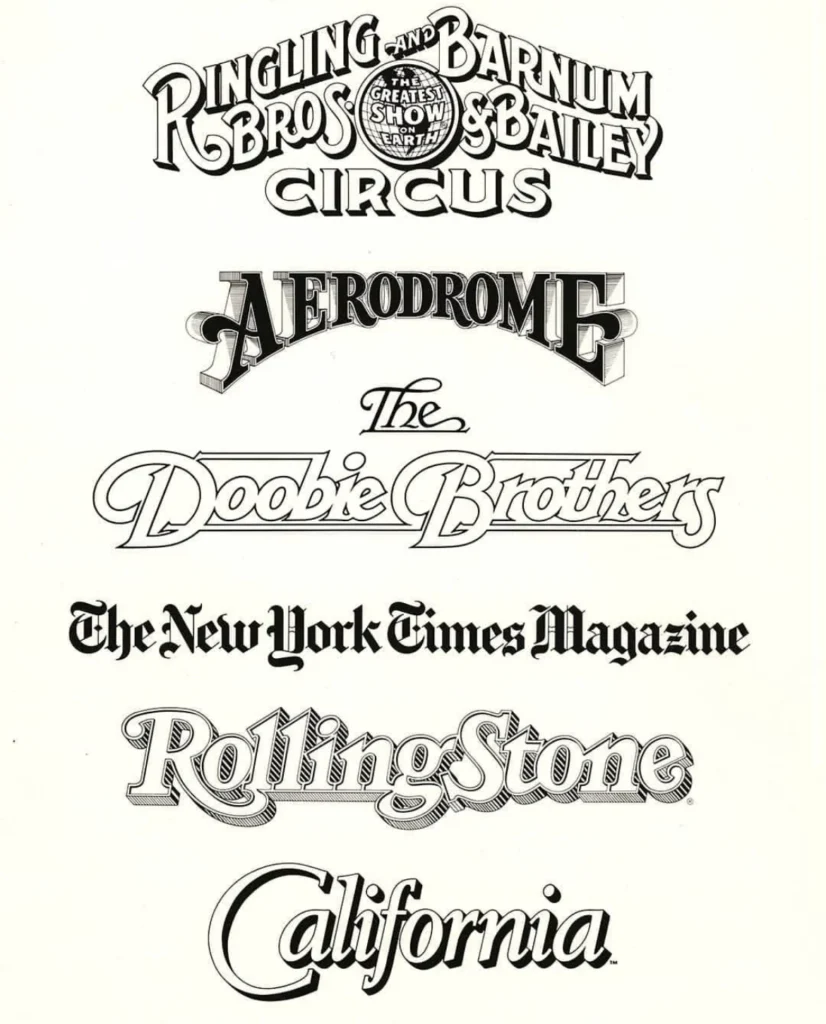
A detailed promotional poster, compiled from his extensive portfolio, showcases the breadth of his typographic achievements. This collection, now part of the Letterform Archive, includes logos for legendary entities such as Ringling Bros. and Barnum & Bailey Circus, Aerodrome, The Doobie Brothers, The New York Times Magazine, Rolling Stone, and California magazine. The poster itself serves as a visual testament to his prolific career and his ability to imbue each project with a unique character and artistic flair.
Beyond Typography: A Painter of Neon Dreams
In his later years, Parkinson channeled his artistic sensibilities into a unique passion: painting vintage neon signage as fine art. This hobby evolved into a significant body of work, inspired by his road trips across the American West. His extensive collection of photographs from these journeys provided the source material for dozens of large-scale paintings. These artworks meticulously captured the intricate details of peeling paint, broken glass tubes, and the atmospheric glow of defunct neon signs, often rendering them with a vividness that surpassed even the original photographs. His paintings of these iconic, often overlooked, elements of roadside Americana offered a poignant and artistic commentary on nostalgia, obsolescence, and the beauty of decay.
A Welcoming Mentor and Generous Spirit
For those fortunate enough to know Jim Parkinson, his generosity of spirit and his passion for sharing his knowledge were as remarkable as his artistic talent. Stephen Coles, who writes for Typographica and was a close friend of Parkinson’s, shared his personal reflections: "I was lucky to know Jim over the past twenty years. When I moved to Oakland in 2004, he was one of the first people to connect with me. He welcomed anyone to his home to visit his personal collection of ephemera, type books, and archive of his own work." Coles fondly recalled introducing friends to Parkinson’s studio, witnessing their awe as Parkinson unveiled flat files filled with original artwork.
Parkinson was a regular and beloved presence at semiregular picnics organized by the local design community, where he consistently radiated joy and wisdom. His approach to life and work was characterized by a "casual silliness" that, despite his immense talent, kept him grounded and approachable. He embodied the philosophy of Dame Margot Fonteyn: "Take your work seriously, but never yourself." This wry levity was evident in his early acquisition of a highly sought-after domain name for his website and in a video interview conducted in 2010, which offered a glimpse into his personality and artistic process.

Preserving a Legacy: Memoir and Memorial
Parkinson’s ability to craft compelling narratives was as profound as his skill in shaping letters. The Letterform Archive is slated to publish his memoir in 2026, a project that will allow individuals who did not have the opportunity to meet him to gain insight into his life and career through his own words. This posthumous publication promises to be an invaluable resource for understanding the man behind the iconic typography.
A memorial service for Jim Parkinson will be held in the fall. In lieu of flowers, the family requests that donations be made to the Alzheimer’s Association, a cause that directly impacted Parkinson’s final years.
The passing of Jim Parkinson marks the end of an era in the world of typography and graphic design. His legacy, however, will continue to inspire and inform future generations of designers, artists, and anyone who appreciates the power and beauty of meticulously crafted letters. His work remains a permanent fixture in our visual culture, a testament to a life dedicated to the art of the letter.
A Timeline of Jim Parkinson’s Life and Career
- October 23, 1941: James "Jim" Parkinson is born in Oakland, California.
- Early Childhood: Becomes fascinated with lettering through neighbor Abraham Lincoln Paulsen, the "Wizard Penman."
- Teenage Years: Self-studies lettering techniques using historical manuals and textbooks.
- 1959-1963: Studies design and painting at the California College of Arts and Crafts.
- 1963: Graduates from the California College of Arts and Crafts.
- 1963-1964: Joins Hallmark Cards as a staff artist in Kansas City, Missouri. Transferred to the lettering department.
- Circa 1964: Returns to Oakland to begin a freelance career in lettering and type design.
- 1970s-2000s: Creates numerous logos for bands (e.g., The Doobie Brothers), circuses (e.g., Ringling Brothers and Barnum & Bailey), and publications (e.g., Rolling Stone, Los Angeles Times). Develops custom and retail typefaces.
- 2004: Stephen Coles moves to Oakland and connects with Parkinson, beginning a lasting friendship.
- 2010: Participates in a video interview for FontCast, discussing his work and career.
- 2010: Marries Dorothy A. Yule.
- Circa 2010s-2020s: Develops a passion for painting vintage neon signage as fine art.
- Undated (Late Career): Begins compiling material for his memoir.
- Circa 2015-2025: Begins experiencing symptoms of Alzheimer’s disease, with Dorothy A. Yule providing care.
- June 26, 2025: Jim Parkinson passes away at his home in Oakland, California.
- 2026 (Scheduled): Letterform Archive plans to publish Jim Parkinson’s memoir.
Impact and Analysis
Jim Parkinson’s passing leaves a significant void in the design community. His dedication to hand-lettering in an increasingly digital age served as a vital reminder of the artistry and craft inherent in typography. His work demonstrated that even in the face of mass production, bespoke, hand-rendered elements could imbue brands and publications with a unique personality and a timeless quality. The proliferation of his designs across various media platforms highlights the profound influence he had on visual communication standards. His ability to adapt historical styles and infuse them with contemporary relevance ensured his work remained fresh and impactful for decades. The forthcoming publication of his memoir by the Letterform Archive will undoubtedly provide invaluable insights into his creative process and the evolution of his remarkable career, further solidifying his place in the history of design. The continued relevance of his work in contemporary design discourse, coupled with the planned memoir, ensures that Jim Parkinson’s legacy will endure and continue to inspire.