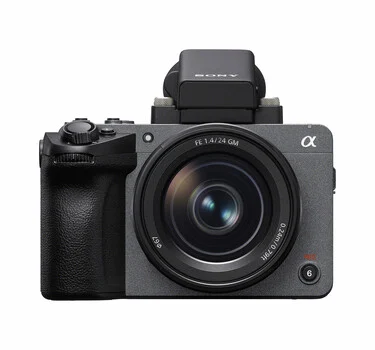

Sony has officially unveiled the FX5, a groundbreaking addition to its prestigious Cinema Line that introduces several high-end features previously reserved for the flagship Venice series. By integrating a newly developed full-frame image sensor with internal raw recording and Open Gate capabilities, Sony is positioning the FX5 as a pivotal bridge between compact mirrorless-style cinema cameras and high-end production systems. This move signals a strategic shift in the professional imaging market, addressing the growing demand for "guerrilla-style" filmmaking tools that do not compromise on technical specifications or post-production flexibility.
The Core Technology: Sensor and Processing Architecture
At the heart of the Sony FX5 lies a newly developed, fully stacked Exmor RS CMOS full-frame sensor. This architecture is paired with the BIONZ XR2 image processing engine and a dedicated AI processing unit, a combination designed to handle the massive data throughput required for high-resolution raw recording. Sony rates this sensor at 15+ stops of dynamic range when shooting in S-Log3, placing it on par with industry-leading cinema cameras in terms of latitude and highlight retention.
The camera features a sophisticated triple-base ISO system, offering native settings at ISO 800, 4,000, and 12,800. This triple-gain architecture allows cinematographers to maintain a high signal-to-noise ratio across vastly different lighting environments. For professional workflows, manual base ISO selection is available in Cine EI and Flexible ISO modes. In the Cine EI Quick mode, the camera automates the selection of the optimal base ISO based on the user’s Exposure Index setting, streamlining the workflow for operators who need to move quickly between varying light levels.
A significant addition to the FX series is the Dual Gain Shooting function. This technology extracts additional data from the sensor to produce smoother gradations and wider latitude while simultaneously suppressing noise in shadow regions. While this mode is limited to a gain equivalent of 18 dB and is subject to specific shooting constraints, it represents a major step forward in sensor-level image optimization for the compact cinema segment.
Revolutionary Recording: Open Gate and X-OCN
The FX5 marks a milestone as the first FX-series camera to support 3:2 full-pixel readout across the entire sensor, commonly referred to as "Open Gate" shooting. This feature is highly sought after by modern creators because it captures the maximum possible image area, providing immense flexibility in post-production. Editors can extract 16:9, 17:9, or even 9:16 vertical crops for social media from a single take without the loss of resolution associated with upscaling.
In addition to Open Gate, the FX5 introduces internal recording in X-OCN (eXtended tonal range Original Camera Negative), Sony’s proprietary 16-bit scene-linear raw format. Previously, recording raw on compact Sony cameras required expensive external recorders and cumbersome HDMI or SDI cabling. By bringing X-OCN internal, Sony has eliminated a common point of failure and reduced the overall weight of the camera rig. To manage the high data rates of raw video, Sony has introduced two new codecs: X-OCN C1 and X-OCN C2. These codecs are designed to compress data more efficiently, facilitating faster file transfers and reducing the storage burden on production houses.
At launch, the camera supports impressive frame rates, including 5K at up to 60 fps, 4K at up to 120 fps, and Full HD (FHD) at up to 240 fps. These specifications ensure the FX5 is capable of high-quality slow-motion capture across all standard production resolutions.
AI-Driven Autofocus and Color Science
The inclusion of a dedicated AI processing unit enables advanced human pose estimation. This system can recognize and track a subject’s eyes, head, and body with high precision, even when the subject is turned away or partially obscured. Sony claims this technology maintains robust autofocus performance in low-light scenes where traditional contrast or phase-detection systems might struggle.
Complementing the autofocus is the new Auto Tracing White Balance (ATW) system. This technology combines data from a visible-light sensor and an infrared sensor with deep-learning algorithms to estimate light sources. The result is a more stable and natural white balance in challenging environments, such as heavily shaded areas or interiors with mixed lighting. Notably, this enhanced stability is currently optimized for X-OCN recording, ensuring that the highest quality files benefit from the most accurate color data.
For filmmakers using anamorphic glass, the FX5 includes a built-in de-squeeze function. It supports a wide range of squeeze factors, including 1.3x, 1.5x, 1.6x, 1.8x, and 2.0x, allowing operators to monitor their widescreen compositions accurately in real-time.
Ergonomics and Physical Design
The FX5 body is designed for both durability and versatility. It features 5-axis optical in-body image stabilization (IBIS) with a new stabilization unit that Sony claims doubles the roll correction range of the FX3. For handheld work, the camera offers "Active Mode" and a new "Dynamic Active Mode." The latter provides even more aggressive stabilization, though it involves a tighter crop and is limited to 60 fps.
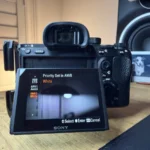
The camera’s monitoring system has seen a significant upgrade with a 3.5-inch touch-panel LCD boasting 2.76 million dots. The screen is mounted on a 4-axis multi-angle arm, providing extensive tilt and swivel range. Sony has also implemented the "BIG6" home screen interface, a layout derived from its high-end CineAlta cameras. This interface places critical settings like frame rate, shutter angle, and LUTs on the periphery of the screen, ensuring the image remains unobstructed.
In terms of build, the FX5 is designed to be "cage-free." The body is peppered with multiple 1/4-20 threaded mounting points, allowing users to attach monitors, microphones, and wireless transmitters directly to the camera chassis. A high-efficiency cooling fan and optimized internal heat sinks are included to prevent thermal throttling during long takes in demanding climates.
Power and Connectivity
The FX5 introduces the NP-SA100 battery, a new high-capacity power source with 2,670 mAh. This offers roughly 1.3 times the runtime of the standard NP-FZ100 batteries used in previous models. For studio and multicamera environments, the camera includes a wired LAN terminal and two USB Type-C ports. These ports support USB Power Delivery (PD) and can accept timecode input via an optional adapter cable, the VMC-BNCU1.
Sony’s integration with the "Monitor & Control" application allows for wireless monitoring and remote operation via smartphones or tablets. This is particularly useful for gimbal operators or when the camera is mounted in inaccessible locations.
Industry Reactions and Professional Use Cases
The announcement has garnered significant attention from industry veterans. Yang Cheng, Vice President of Imaging Solutions at Sony Electronics, emphasized that the FX5 was born from user feedback. "We wanted to build on the FX3, taking it one step further with the inclusion of some VENICE 2 features, like internal RAW recording and Open Gate," Cheng stated.
Oscar-winning cinematographer Claudio Miranda, ASC, who tested the camera, praised its balance of quality and mobility. "I felt that FX5 is a camera that combines high-quality image expression and mobility in a compact body," Miranda noted, suggesting its utility in diverse shooting environments.
Director Gareth Edwards, known for "The Creator" and "Rogue One," utilized the FX5 for a project filmed across Southeast Asia. Edwards highlighted the camera’s suitability for "guerrilla filmmaking," calling it "the run-and-gun cinema camera to beat." His endorsement underscores the FX5’s appeal to high-end directors who require a small footprint without sacrificing cinematic texture.
Chronology and Future Roadmap
Sony has outlined a clear timeline for the FX5’s release and subsequent software support:
- Mid-August 2024: The ILME-FX5 (with XLR handle) and ILME-FX5B (body only) begin shipping.
- July 2026: Scheduled release of Monitor & Control version 3.0, enabling enhanced wired and wireless control.
- August 2026: Release of Catalyst Prepare version 3.0, merging stabilization and color editing into a single suite.
- 2027: Firmware Version 2.0 update. This major update is slated to unlock 240 fps in X-OCN, 3:2 Open Gate in XAVC S-I, and a vertical shooting interface.
Market Impact and Strategic Analysis
The FX5 enters the market at a suggested retail price of $4,899.99 for the body and $5,499.99 with the XLR handle unit. This pricing strategy places it in direct competition with the Canon EOS C70 and the Blackmagic Design Pyxis 6K. However, Sony’s inclusion of internal 16-bit raw and the robust E-mount ecosystem gives it a distinct advantage for users already invested in Sony glass.
The decision to delay some of the camera’s most advanced features—such as 240 fps X-OCN—until 2027 suggests that Sony is pushing the hardware to its absolute limits, requiring extensive software refinement. While some early adopters may be frustrated by the wait, the roadmap provides a sense of longevity for the platform, ensuring the camera remains relevant for several years.
For independent filmmakers and small production houses, the FX5 represents the democratization of the "Venice look." By stripping away the need for external recorders and heavy rigs, Sony has made high-end cinema capture more accessible than ever. The focus on sustainability, with 30% recycled plastic and 100% renewable energy used in production, also aligns the product with modern corporate responsibility standards.
As the industry moves toward more agile production workflows, the Sony FX5 stands as a testament to the convergence of compact design and uncompromising professional specifications. It is a tool designed not just for the way movies are made today, but for the increasingly multi-platform, high-speed future of digital cinematography.