
Jim Parkinson, a celebrated lettering artist, type designer, and painter whose distinctive hand graced countless logos, publications, and artistic endeavors, passed away on June 26, 2025, at his home in Oakland, California. He was 83. His death followed a prolonged battle with Alzheimer’s disease, a condition his wife, book artist Dorothy A. Yule, diligently managed as his dedicated nurse in recent years.
Born in Oakland on October 23, 1941, Parkinson’s formative years were shaped by the serendipitous proximity to Abraham Lincoln Paulsen, a local calligrapher renowned as the "Wizard Penman." Paulsen’s extraordinary ability to pen the Gettysburg Address upside down and backward using only the numeral "2" served as Parkinson’s initial, and profound, introduction to the art of lettering. This early fascination with the precise and expressive potential of letterforms ignited a lifelong passion. Parkinson’s autodidactic approach to learning, meticulously collecting and studying decades-old lettering manuals and correspondence-school textbooks, foreshadowed a career distinguished by his ability to masterfully interpret and modernize historical styles, a hallmark of his extensive body of work.
A Career Forged in Craft and Calling
Parkinson pursued formal design and painting studies at the California College of Arts and Crafts, graduating in 1963. His early professional steps led him to Hallmark Cards in Kansas City, Missouri. While initially assigned to draw cartoon animals, Parkinson’s inherent talent for lettering quickly became apparent. The company recognized his aptitude, relocating him to their lettering department, where he flourished. It was here that Parkinson solidified his understanding that lettering was not merely a professional specialization but a profound life calling. His innate ability to render any letter style by hand with exceptional skill became the bedrock of a freelance career that spanned over five decades, primarily based in his native Oakland.
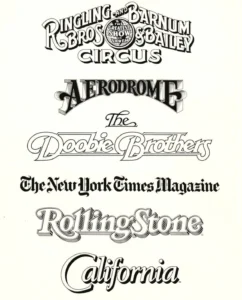
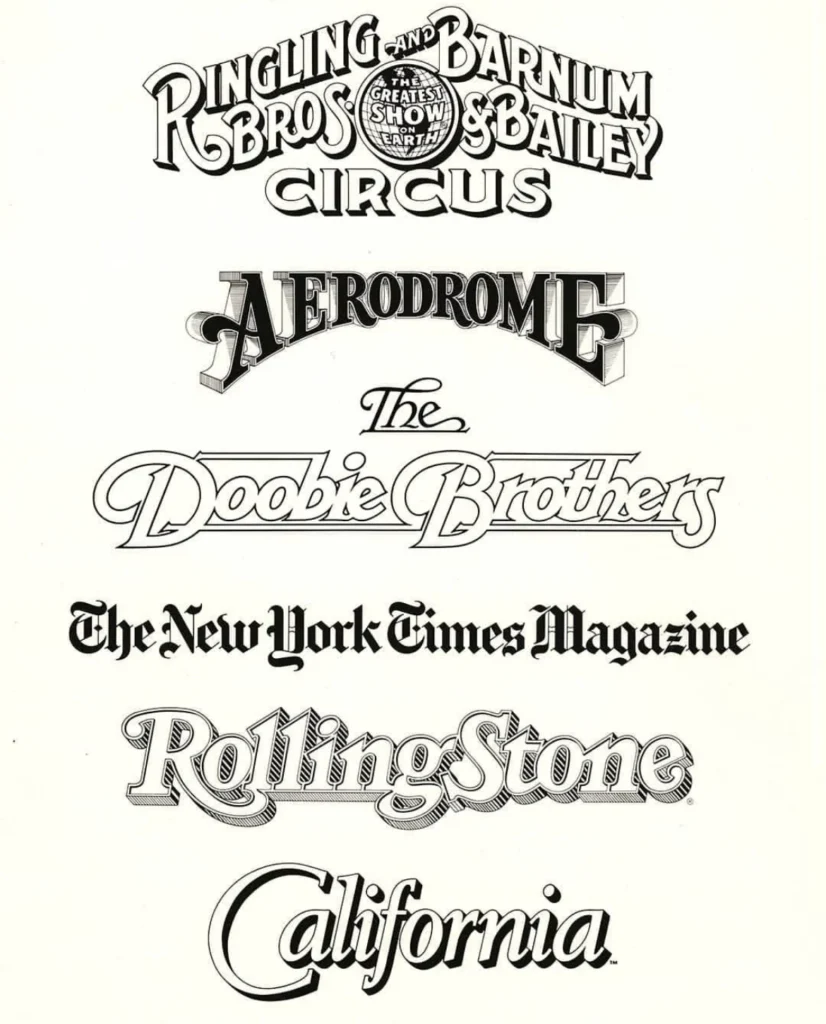
His versatility was such that he could adeptly handle an extensive range of lettering projects, from intricate logos to complete typeface families. Parkinson’s career can be viewed as a series of distinct yet interconnected professional chapters, each marked by his meticulous craftsmanship. His lettering appeared ubiquitously, a testament to his prolific output and the high regard in which he was held by art directors and clients alike. He designed headlines for advertisements, iconic logos for musical groups such as The Doobie Brothers, and renowned circus brands like Ringling Brothers and Barnum & Bailey. His contributions extended to dozens of custom and retail typefaces, and a vast array of nameplates for prominent magazines, including Rolling Stone, and newspapers, notably the Los Angeles Times. The sheer volume of his work meant that a visit to any newsstand in the United States, and even some internationally, would likely reveal his handiwork on multiple covers, often updated or refreshed by Parkinson himself over the years.

Artistic Evolution: From Letterforms to Neon Dreams
Beyond his commercial successes, Parkinson also cultivated a unique artistic practice. In his later years, when not engaged in logo design or font creation, he dedicated himself to painting. His artistic focus was on vintage neon signage, rendered as fine art. Drawing inspiration from extensive photo albums documenting his road trips across the American West, Parkinson created dozens of large-scale paintings. These works meticulously captured the atmospheric decay of neon signs, depicting peeling paint, broken glass tubes, and the ethereal glow of the illuminated letters with a fidelity that often surpassed the original photographs, imbuing them with an almost hyperreal quality. His paintings filled his home, transforming it into a gallery of nostalgic, luminous Americana.
A Generous Mentor and Keeper of Ephemera
For the past twenty years, Parkinson was a significant figure in the graphic design and typography community, particularly in the Bay Area. Stephen Coles, the author of the original commentary and a close friend, recalls Parkinson as one of the first individuals to welcome him upon his arrival in Oakland in 2004. Parkinson was known for his open-door policy, enthusiastically sharing his personal collection of ephemera, type books, and his own extensive archive of original artwork with visiting friends and colleagues. These visits, often described as revelatory, allowed individuals to witness firsthand the depth and breadth of Parkinson’s talent as he unfurled flat files filled with original artwork.
He was a consistent and joyful presence at semiregular community picnics, where his radiated warmth, wisdom, and a characteristic "casual silliness" made him approachable and grounded, despite his immense talent. Parkinson embodied the philosophy of taking one’s work seriously but never oneself, a mantra often attributed to Margot Fonteyn. This ethos was palpable in his accessible website, a domain he had secured in the nascent days of the internet, and in a video interview conducted in 2010, which offered a glimpse into his creative process and personality.
A Lasting Literary Legacy

Parkinson’s gift for storytelling was as profound as his skill with lettering. It is with great anticipation that the Letterform Archive will publish his memoir in 2026. This forthcoming publication promises to offer a comprehensive narrative of his life and career, allowing those who did not have the privilege of knowing him personally to connect with his experiences and insights through his own words. Individuals interested in being notified of the memoir’s release can sign up for updates via the Letterform Archive’s mailing list.
A Community Mourns and Remembers
A memorial service for Jim Parkinson is planned for the fall. In lieu of flowers, the family requests that donations be made to the Alzheimer’s Association, a cause deeply connected to Parkinson’s final years. The community is invited to share their memories and tributes in the comments section of the original publication, fostering a collective remembrance of his significant contributions and the personal impact he had on so many.
The passing of Jim Parkinson marks the end of an era in the world of lettering and design. His unique ability to imbue letterforms with personality and meaning, coupled with his artistic vision and generous spirit, leaves an indelible mark on the visual landscape. His legacy will continue to inspire and inform designers, artists, and enthusiasts for generations to come. The extensive body of work he leaves behind, from iconic logos to his evocative paintings, serves as a powerful testament to a life dedicated to the beauty and craft of the letter.