
Parkinson’s journey into the world of letters began in his native Oakland, where, as a child, he lived across the street from Abraham Lincoln Paulsen, a lettering artist renowned as the "Wizard Penman." Paulsen’s extraordinary ability to pen the Gettysburg Address upside down and backward using only the numeral "2" captivated young Jim. This early encounter ignited a lifelong passion for lettering, a craft he would meticulously hone throughout his career. His initial forays into learning involved the diligent study of vintage lettering manuals and correspondence-school textbooks. These historical resources, often decades old, provided the foundation for what would become Parkinson’s signature approach: deeply referencing historical styles while imbuing them with his unique contemporary sensibility. This ability to synthesize the past and present, to breathe new life into established forms, would define his artistic legacy.
A Foundation in Art and the Birth of a Calling
Born on October 23, 1941, Parkinson’s formal artistic education began at the California College of Arts and Crafts, where he studied design and painting. Upon graduating in 1963, he moved to Kansas City, Missouri, to join the staff artists at Hallmark Cards. While initially tasked with illustrating the company’s iconic characters, Parkinson soon discovered that his true aptitude lay not in drawing anthropomorphic animals but in the nuanced art of lettering. Hallmark recognized his burgeoning talent and transferred him to their lettering department, a move that proved pivotal. It was here that Parkinson not only found a professional niche but also solidified his life’s calling. His innate ability to render any letterform by hand with precision and flair became his hallmark. This mastery of manual dexterity served him exceptionally well when he returned to Oakland to embark on a freelance career that would span an impressive fifty years.
A Prolific Career Shaping Visual Culture
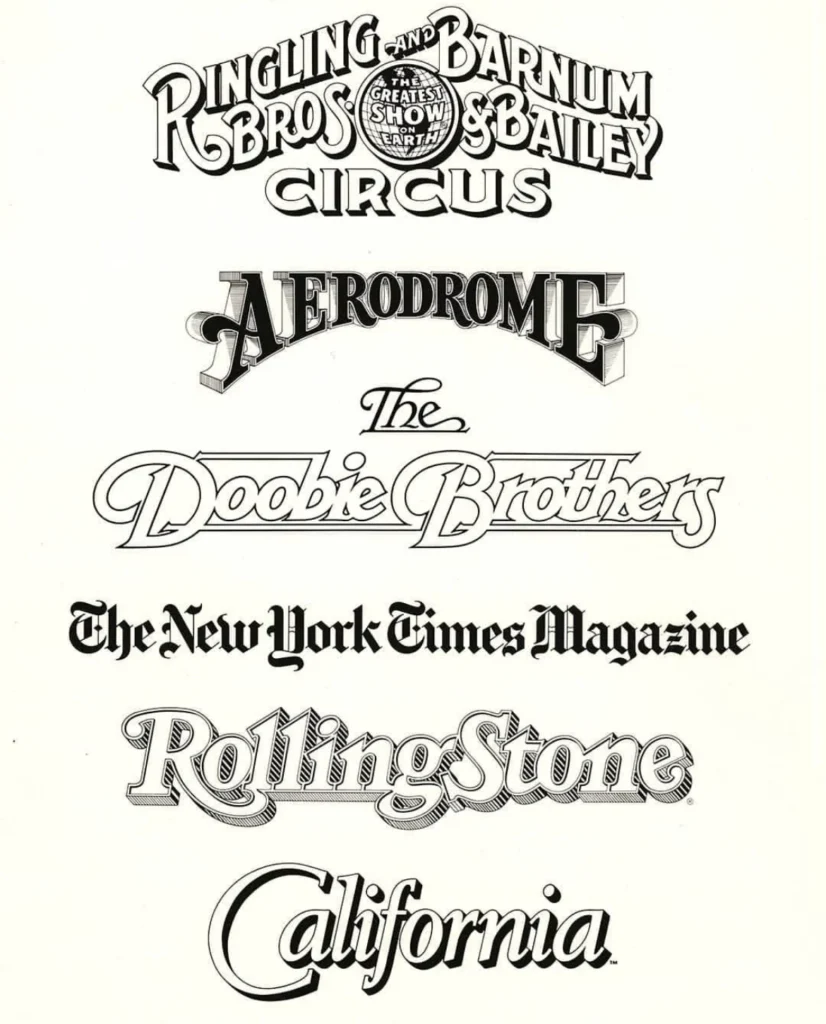
Parkinson’s dedication to the art of lettering was unwavering, yet his versatility within this specialized field was extraordinary. He possessed the rare ability to tackle an immense spectrum of projects, from crafting iconic logos to designing complete, nuanced alphabets. His career trajectory was, in essence, a series of distinct yet interconnected professional lives. Over five decades, his lettering graced an astonishing array of visual communications. He designed headlines for advertising campaigns, memorable logos for musical acts such as The Doobie Brothers, and the iconic branding for Ringling Bros. and Barnum & Bailey Circus. His expertise extended to the creation of dozens of custom and retail typefaces, as well as countless nameplates for prominent magazines, including the instantly recognizable logos for Rolling Stone and The Los Angeles Times.

The sheer volume of his output makes a comprehensive enumeration nearly impossible. A casual perusal of any newsstand in the United States, and indeed many abroad, would likely reveal Parkinson’s handiwork on multiple covers. He became an indispensable resource for art directors seeking to revitalize their publication’s visual identity, often being called upon to redraw established titles multiple times over the years, demonstrating his enduring relevance and artistic adaptability. His contributions were not merely decorative; they were integral to the visual language of popular culture, shaping brand recognition and reader engagement.
A Passion for Neon and the Art of Observation
Beyond his commercial work, Parkinson cultivated a profound personal artistic practice later in his life. When not engaged in logo design or font creation, he dedicated himself to painting vintage neon signage. This was not a mere hobby but a serious artistic pursuit. His passion led him to document his travels through the American West, meticulously photographing roadside attractions and their luminous, often decaying, neon signs. These photographs served as the direct inspiration for dozens of large-scale paintings. Parkinson’s canvases captured the weathered surfaces, the flickering tubes, and the inherent nostalgia of these iconic structures with a fidelity that often surpassed the original photographs. His paintings imbued these ephemeral elements of Americana with a timeless quality, transforming them into fine art that resonated with viewers on a deep emotional level. These works, which adorned the walls of his home, are a testament to his keen eye for detail and his ability to find beauty in the overlooked.
A Welcoming Spirit and a Legacy of Generosity
The author of this tribute, Stephen Coles, recounts a personal connection with Parkinson spanning two decades, beginning in 2004 when Coles relocated to Oakland. Parkinson was among the first to extend a warm welcome, opening his home and his extensive personal collection of ephemera, type books, and his own artistic archives to visitors. Coles fondly recalls the delight of introducing friends to Parkinson, witnessing their awe as he revealed flat files filled with original artwork. Parkinson was a consistent and joyful presence at semiregular industry picnics, exuding an infectious blend of warmth, wisdom, and a disarming casualness. This humility, a stark contrast to his immense talent, prevented him from ever adopting an airs of superiority. He embodied the principle articulated by Margot Fonteyn: "Take your work seriously, but never yourself." This wry levity is evident in his website, a testament to his early adoption of the internet, and in a video interview conducted in 2010, which offers a glimpse into his personality and creative process.
A Voice Preserved: Memoir and Memorial
Parkinson’s gift for storytelling was as potent as his skill in crafting letters. It is with great anticipation that the Letterform Archive will publish his memoir in 2026. This posthumous release promises to offer a comprehensive and intimate portrait of his life and career, allowing those who did not have the privilege of knowing him personally to connect with his unique spirit and profound contributions to the design world. Readers are encouraged to sign up for notifications from the Letterform Archive to ensure they are among the first to access this significant work.

A memorial service will be held for Jim Parkinson by his family and friends in the autumn. The community is invited to share their memories and tributes in the comments section of the original article. In lieu of flowers, the family requests that donations be made to the Alzheimer’s Association, a cause that directly impacted Parkinson’s final years.
The passing of Jim Parkinson leaves a void in the landscape of contemporary design. His legacy, however, is etched in the visual fabric of our culture, a testament to a life dedicated to the beauty and power of the letterform, a life lived with profound artistry, generosity, and an unwavering commitment to his craft. His work will continue to inspire and inform designers for generations to come.