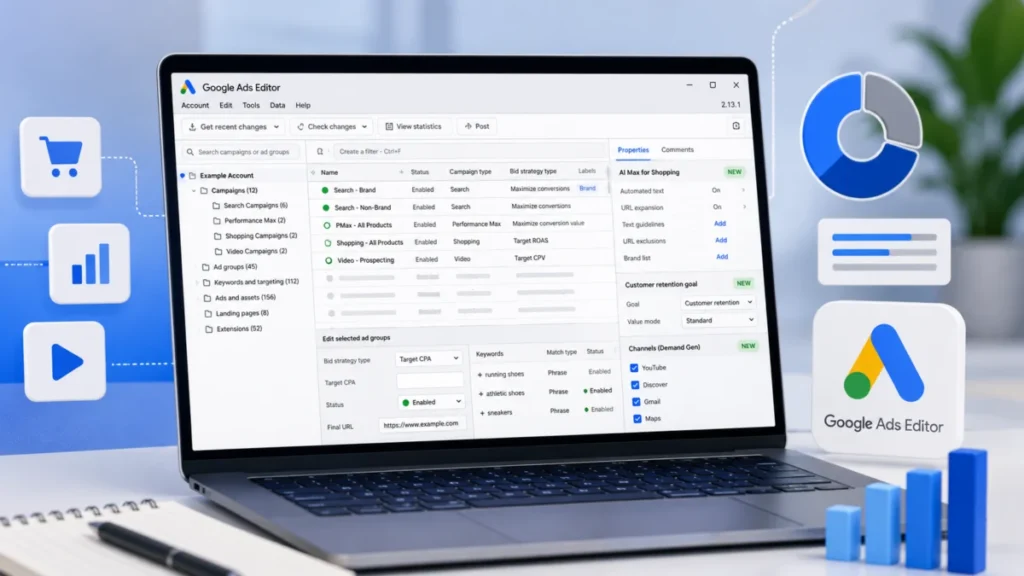

Google has commenced the rollout of Google Ads Editor 2.13, a substantial update poised to redefine offline campaign management for advertisers worldwide. This latest iteration introduces critical support for AI Max in Shopping campaigns, alongside new Performance Max retention goals and expanded features for Demand Gen campaigns. Designed to bridge the gap between Google’s rapidly evolving AI-powered web interface and the robust offline editing environment, Editor 2.13 also brings a suite of workflow improvements, enhanced reporting capabilities, and essential AI compliance tools. Concurrently, the update signals a strategic pivot by Google, officially retiring support for the creation of new Video Action campaigns, directing advertisers towards more integrated, AI-driven solutions like Demand Gen.
The release of Google Ads Editor 2.13 represents more than just a routine update; it underscores Google’s accelerating commitment to infusing artificial intelligence across its entire advertising ecosystem. For professional marketers, agencies, and large-scale advertisers who rely on the Editor for managing complex, multi-faceted campaigns efficiently, this update ensures feature parity with the online platform, minimizing the need to constantly switch interfaces. This strategic alignment facilitates a smoother, more integrated workflow, crucial in an environment where speed and precision are paramount.
Deep Dive into AI Max for Shopping Campaigns
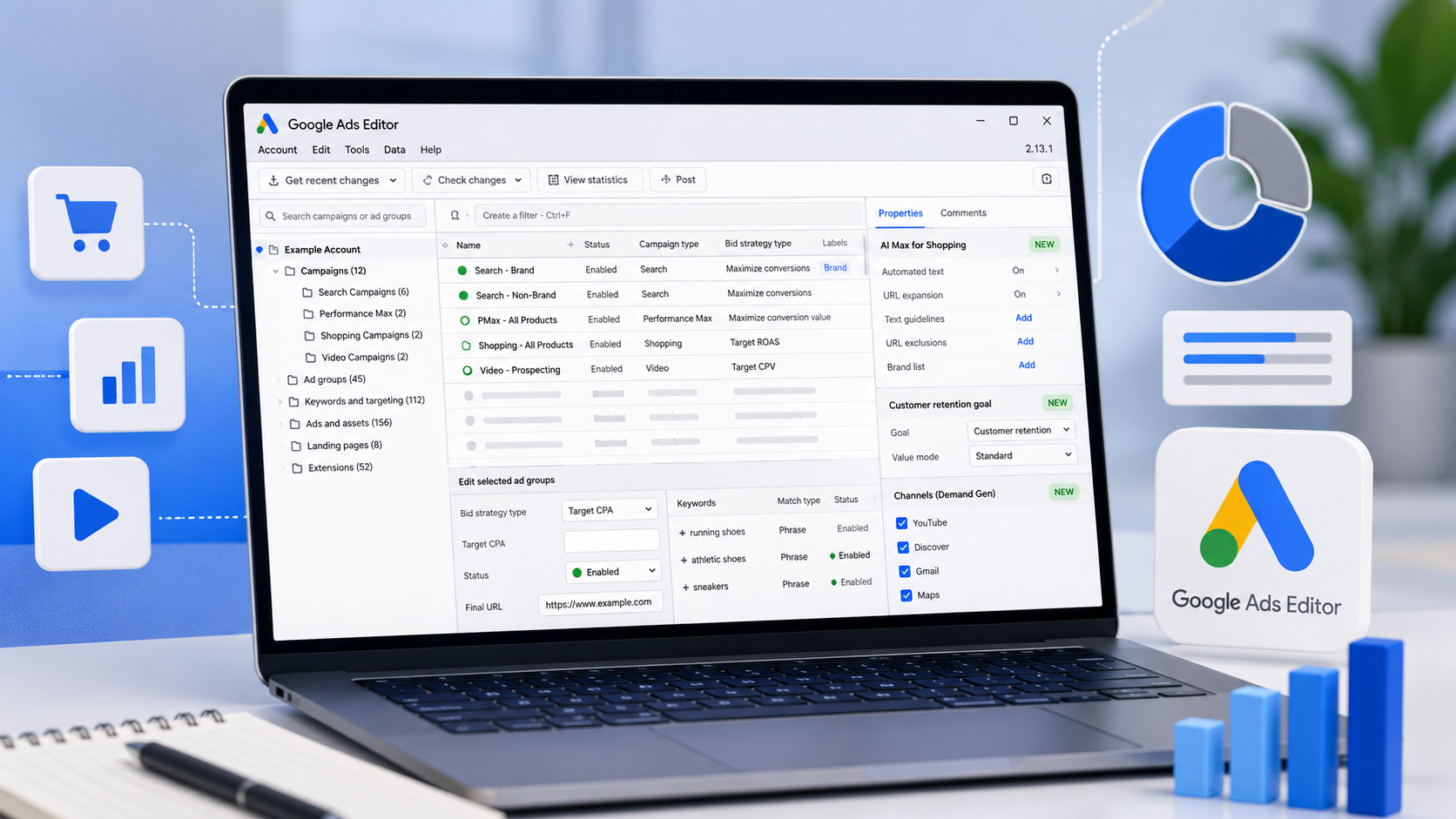
The standout feature of Google Ads Editor 2.13 is undoubtedly the integration of AI Max for Shopping campaigns. This enhancement brings sophisticated AI-driven optimization capabilities directly into the offline editing environment, mirroring the advanced functionalities previously exclusive to the web interface for Search and Performance Max campaigns. Shopping campaigns, which are central to e-commerce advertisers, involve intricate product feeds, bidding strategies, and audience targeting. Traditionally, managing these elements at scale required meticulous manual oversight or frequent toggling between Editor and the online platform for specific AI-powered optimizations.
AI Max for Shopping leverages Google’s advanced machine learning algorithms to automate and optimize various aspects of a campaign, including bidding, budget allocation, and ad serving, to maximize return on investment (ROI). For advertisers, this translates into the ability to fine-tune product groups, adjust bids, and implement sophisticated targeting strategies with the added layer of AI intelligence, all within the familiar Editor interface. This move is particularly significant given the sheer volume and complexity of Shopping campaigns, which often involve thousands, if not tens of thousands, of products. The AI system can analyze vast datasets, including user behavior, product attributes, and market trends, to identify optimal opportunities for displaying products to the most relevant audiences at the most opportune times.
The integration of AI Max aims to free up advertisers’ time from repetitive optimization tasks, allowing them to focus more on strategic planning, creative development, and comprehensive performance analysis. It signifies Google’s continued push towards more autonomous, intelligent campaign management, where AI acts as a co-pilot, guiding campaigns towards better performance outcomes. Industry analysts predict that this deeper integration of AI will not only boost campaign efficiency but also level the playing field for businesses of all sizes, making sophisticated optimization accessible without extensive manual effort.
Enhancing Performance Max and Demand Gen Capabilities
Beyond AI Max for Shopping, Google Ads Editor 2.13 significantly bolsters the capabilities of two other pivotal campaign types: Performance Max and Demand Gen.
Performance Max Retention Goals: Since its introduction, Performance Max has rapidly become a cornerstone of Google’s advertising strategy, offering an all-in-one campaign type that leverages AI across all Google channels (Search, Display, YouTube, Gmail, Discover, Maps) to drive conversions. The addition of new retention goals within Editor 2.13 for Performance Max campaigns marks a crucial evolution. While initial Performance Max goals often centered on new customer acquisition or immediate conversions, these new retention goals empower advertisers to optimize for customer loyalty, repeat purchases, and long-term customer value.
For businesses focused on subscription models, e-commerce brands aiming to foster customer lifetime value, or service providers seeking to reduce churn, these retention goals provide a powerful mechanism. By allowing advertisers to define and track metrics related to existing customer engagement and retention directly within Performance Max, Google is enabling a more holistic approach to the customer journey. This reflects a broader industry trend where businesses recognize that acquiring new customers is often more expensive than retaining existing ones. The ability to manage these sophisticated retention strategies offline through Editor 2.13 streamlines operations for large enterprises and agencies managing extensive customer databases. This feature solidifies Performance Max’s position as a versatile campaign solution capable of addressing both top-of-funnel acquisition and bottom-of-funnel loyalty objectives.
Expanded Demand Gen Features: The update also brings expanded features for Demand Gen campaigns. Demand Gen is Google’s answer to consolidating and enhancing interest-based targeting across YouTube, Discover, and Gmail, designed to drive demand and consideration earlier in the customer journey. The expanded capabilities in Editor 2.13 mean advertisers can now manage a broader array of creative assets, targeting options, and bidding strategies for Demand Gen campaigns offline. This is particularly relevant given the simultaneous deprecation of Video Action campaigns, positioning Demand Gen as the primary vehicle for reaching engaged audiences across Google’s immersive surfaces. The expansion signifies Google’s intent to provide a robust, AI-driven solution for brand awareness and lead generation, moving away from fragmented campaign types towards more unified, intelligent platforms. Advertisers can now build out comprehensive Demand Gen strategies, including diverse video and image assets, detailed audience segments, and budget allocations, all within the efficiency of the Editor.
The Evolution of Google Ads Editor: From Bulk Tool to Comprehensive Platform
Google Ads Editor has long been an indispensable tool for digital marketers, especially those managing large accounts with numerous campaigns, ad groups, and keywords. Its primary appeal has always been the ability to perform bulk edits, manage campaigns offline, and quickly implement changes without constant internet connectivity. However, the trajectory of Editor 2.13 signals a significant evolution from its origins as a simple bulk editing tool.
Historical Context and Growing Importance: Since its inception, Google Ads Editor has served as a cornerstone for efficiency in PPC management. For agencies juggling dozens or hundreds of client accounts, or large corporations with vast product inventories, the Editor’s ability to download entire accounts, make changes, and then upload them in one go has been a massive time-saver. Before Editor, such tasks would involve tedious, error-prone manual adjustments within the web interface. The offline nature also allows for meticulous planning and review before changes go live, reducing the risk of costly mistakes.
Bridging the Feature Gap: Historically, there has often been a lag between new features appearing in the Google Ads web interface and their integration into Editor. This update, however, demonstrates a concerted effort by Google to minimize this gap, especially concerning AI-powered functionalities. The inclusion of AI Max for Shopping and advanced Performance Max features directly addresses a critical need for feature parity. This ensures that advertisers leveraging Editor are not disadvantaged by using an offline tool but rather empowered with the same cutting-edge capabilities available online. This strategic alignment underlines Google’s vision for Editor as not just a utility for bulk changes but a fully capable, integrated campaign management platform that supports the latest advertising innovations.
Workflow Improvements: Beyond the headline features, Editor 2.13 also introduces several practical workflow enhancements that streamline daily operations. These include improved column management, allowing advertisers to customize their views more effectively for faster data analysis. Resume download support is another significant addition, providing greater stability for users with unstable internet connections or those managing exceptionally large accounts, preventing lost progress during downloads. Updates to bidding strategy management further refine the process of applying and adjusting automated bidding strategies, ensuring consistency and efficiency across campaigns. These seemingly minor improvements collectively contribute to a more robust, user-friendly experience, reinforcing Editor’s role as an essential tool for sophisticated ad management.
Strategic Shift: Deprecation of Video Action Campaigns
A notable development in this release is the official retirement of support for creating new Video Action campaigns (VACs). This move is not an isolated incident but rather a continuation of Google’s broader strategy to consolidate and streamline its advertising products, pushing advertisers towards more unified, AI-driven solutions.
The Rationale Behind the Shift: Video Action campaigns, while effective in their time for driving conversions through YouTube and other video partners, represented a more singular focus. Google’s current strategy favors comprehensive, multi-channel solutions like Demand Gen and Performance Max, which leverage AI to optimize across a wider array of placements and formats. The deprecation of VACs encourages advertisers to adopt these newer, more intelligent platforms that offer greater flexibility, broader reach, and enhanced optimization capabilities powered by machine learning. This consolidation aims to reduce complexity for advertisers by offering fewer, more powerful campaign types rather than a fragmented suite of specialized options. It reflects Google’s belief that integrated AI solutions can achieve better overall results than siloed campaign types, particularly in a rapidly evolving digital landscape.
Impact on Advertisers: For advertisers who heavily relied on Video Action campaigns, this change necessitates a migration to Demand Gen or Performance Max for their video-centric conversion objectives. While this might initially require some adjustment, Google’s intention is to provide a more robust and future-proof solution. Demand Gen, in particular, is designed to serve as the spiritual successor to VACs, offering expanded creative options and targeting capabilities across YouTube, Discover, and Gmail, all optimized by AI for demand generation and consideration. This strategic pivot ensures that advertisers remain aligned with Google’s most advanced technologies, ultimately aiming for improved campaign performance and efficiency. It also reinforces the idea that Google is consistently refining its ad platform, moving towards a more automated and integrated future.
Broader Implications for Digital Advertising
The release of Google Ads Editor 2.13 carries significant implications for the broader digital advertising ecosystem, touching upon the role of AI, the evolving skills required for PPC professionals, and the future trajectory of ad platform development.
Accelerated AI Adoption: This update is a clear indicator of Google’s unwavering commitment to AI-first advertising. The deeper integration of AI Max, Performance Max, and Demand Gen underscores a future where machine learning plays an even more central role in campaign optimization, audience targeting, and creative selection. Advertisers are increasingly expected to leverage these AI capabilities to remain competitive, shifting their focus from manual adjustments to strategic oversight and data interpretation. Industry reports consistently show a surging investment in AI-powered marketing tools, with projections indicating significant growth in AI-driven ad spend in the coming years. Google, as a market leader, is driving this trend, making sophisticated AI tools more accessible and integrated into daily workflows.
Evolving Role of the PPC Professional: With more aspects of campaign management becoming automated, the role of the PPC professional is evolving. Instead of spending hours on granular bidding adjustments or keyword research, marketers can now dedicate more time to higher-level strategy, creative development, A/B testing, and understanding the nuances of their target audience. The "AI compliance tools" mentioned in the update also highlight the growing importance of ethical AI use, data privacy, and brand safety, requiring advertisers to understand not just how AI works but also how to ensure its responsible application. This shift necessitates a new skill set, emphasizing data analysis, strategic thinking, and creative direction over purely operational tasks.
Data and Compliance: The inclusion of new reporting capabilities and AI compliance tools is particularly pertinent in an era of heightened data privacy concerns and regulatory scrutiny. As AI systems become more autonomous, ensuring transparency, fairness, and adherence to privacy regulations (like GDPR and CCPA) becomes critical. These tools aim to provide advertisers with greater visibility into how AI is making decisions and to ensure that campaigns remain compliant with evolving legal and ethical standards. This move is crucial for maintaining trust in AI-powered advertising, which is increasingly reliant on vast amounts of user data.
Consolidation and Unification: The strategic shift away from legacy campaign types like Video Action campaigns towards unified solutions such as Performance Max and Demand Gen reflects a broader industry trend towards consolidation. Advertisers are often overwhelmed by the sheer number of options and campaign types available. By streamlining its offerings into more comprehensive, AI-driven platforms, Google aims to simplify campaign setup, reduce complexity, and improve overall performance by leveraging cross-channel synergies. This unification strategy also enhances the value proposition of tools like Google Ads Editor, which can now serve as a centralized hub for managing these multifaceted campaigns offline.
Market Context and Future Outlook: Google Ads continues to dominate a significant portion of the global digital advertising market, with billions in ad revenue generated annually. In a competitive landscape featuring strong players like Meta, Amazon, and TikTok, Google’s continuous innovation in AI and automation is crucial for maintaining its leadership position. This update to Google Ads Editor 2.13 is a testament to Google’s ongoing investment in its core advertising products, ensuring they remain at the forefront of technological advancement. The future of Google Ads appears to be one of increasing automation, deeper AI integration, and a more unified, intelligent approach to campaign management, with tools like the Editor playing a pivotal role in enabling advertisers to harness these powerful capabilities at scale.
In conclusion, Google Ads Editor 2.13 delivers one of its most impactful updates in recent memory. By integrating AI Max for Shopping, expanding Performance Max capabilities with retention goals, enhancing Demand Gen features, and introducing crucial workflow and compliance tools, Google is empowering advertisers to manage their campaigns with unprecedented efficiency and intelligence. This release not only brings the offline Editor in line with the cutting edge of Google’s AI-powered advertising but also signifies a strategic move towards a more consolidated, automated, and sophisticated future for digital marketing. For advertisers, staying abreast of these developments and adapting their strategies to leverage these new tools will be essential for maintaining a competitive edge in the dynamic world of online advertising.