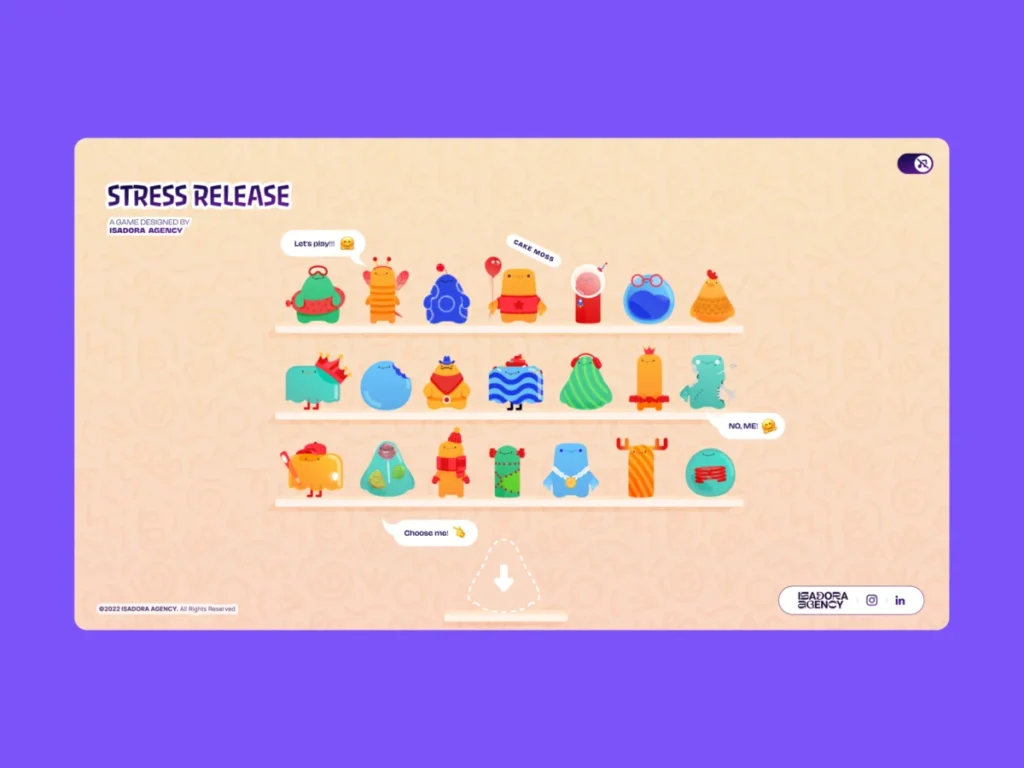

In the evolving landscape of digital design, the demand for highly interactive, tactile web experiences has pushed front-end engineers to seek alternatives to traditional physics engines. When tasked with building "Stress Release," a digital stress-relief squeeze toy application, the engineering team at Isadora Agency navigated a critical crossroads: rely on the stochastic nature of physics libraries or build a custom, deterministic framework that preserves the artistic integrity of bespoke animations. Their solution, which eschews WebGL and Matter.js in favor of programmatic Lottie state control, DOM manipulation, and distance-based mathematics, offers a blueprint for developers prioritizing intentional motion over simulated reality.
The project originated from a desire to create a web interface that feels inherently physical—allowing users to manipulate, distort, and interact with animated characters in a way that provides immediate, satisfying feedback. While standard industry practice often dictates the use of libraries like Matter.js, Cannon.js, or complex WebGL environments to achieve these "squishy" effects, these tools were deemed unsuitable for the project’s specific needs. Physics engines are designed to create plausible, emergent motion, which is ideal for scenarios involving gravity, collision, and momentum. However, for "Stress Release," the animators had crafted specific, keyframe-perfect reactions. The necessity for absolute, frame-by-frame control led the team to abandon traditional physics simulations entirely.
The Shift Toward Deterministic Design
The core requirement for the "Stress Release" project was the preservation of "intentional motion." When an animator defines a specific 181-frame build-up sequence for a character’s "mega squeeze," any interference from a physics engine’s force-based calculations risks degrading that artistic intent. By utilizing the native Lottie API, the developers ensured that the interaction layer acted as a flawless, deterministic trigger for the animation layer.
This approach acknowledges a growing trend in UX engineering: the move toward "curated interactivity." As web performance improves, the capacity for high-fidelity animations increases, yet the need for performance-optimized, predictable state management remains paramount. By mapping user input directly to Lottie segments, the team eliminated the "uncanny valley" effect often found in poorly tuned physics simulations, ensuring that the user’s experience—from the initial click to the character’s reaction—remains strictly within the boundaries defined by the design team.
Engineering the Tactile Feedback Loop
To create the sensation of a tactile, physical interaction without a physics engine, the Isadora Agency team implemented a radial input mapping system. The challenge was to bridge the gap between abstract user input (a mouse click or screen tap) and the character’s coordinate space.

The implementation begins with the translation of page coordinates into a local coordinate space for the specific character element. By calculating the center point of the character and measuring the vector from that center to the click position using the Pythagorean theorem, the system generates a precise distance value. This value serves as the primary driver for all subsequent feedback.
Data-driven zones were established to correlate the click’s proximity to the center with a reward score. For instance, a click within 10 pixels of the center triggers a "bullseye" reward of 100 points, while clicks further from the center result in progressively lower scores. Critically, this same distance vector is used to position the explosion animation. By dynamically adjusting the margins of the explosion element based on the calculated (a, b) vector, the team ensures that the visual feedback appears exactly where the user clicked, reinforcing the tactile illusion of impact.
Synchronizing Interaction and Narrative
The narrative structure of the game relies on a series of animation segments—idle loops, light reactions, and high-intensity squeezes—stored as frame ranges within JSON files. The state management logic is designed to be reactive yet strictly controlled. When a user interacts with a character, the application halts the current idle loop, forces a jump to the specified reaction segment, and momentarily locks further clicks to prevent state conflicts. Once the animation completes, the application automatically reverts to the idle state.

This method of "narrative-based interaction" is significantly more efficient than real-time physics simulations. It allows for complex, high-fidelity visual distortion that would be computationally expensive to render via real-time vertex displacement in WebGL. By pre-calculating these distortions into the Lottie files, the team achieved a "high-end" look with significantly lower CPU overhead.
Responsive Design and Cross-Platform Consistency
A major hurdle in building interactive web experiences is maintaining consistent behavior across diverse hardware, from desktop workstations to mobile devices with varying touch sensitivity. The decision to use DOM-managed elements rather than a canvas-based approach provided the team with an inherent advantage: the ability to leverage CSS for responsiveness.
The development team utilized CSS variables to manage layout, recalculating these properties on window resize events. This allows the Lottie SVGs to scale fluidly within their containers without the need for complex bounding box remapping or collision vector adjustments, which are common pain points in canvas-based physics implementations. This approach effectively treats the interactive elements as part of the document flow, making the application inherently responsive.

Optimization Strategies for High-Fidelity Web Assets
Despite the efficiency of the programmatic approach, the use of multiple Lottie files introduces significant challenges regarding load times and memory usage. The project featured 21 distinct character animations, which could easily overwhelm a mobile browser if handled naively.
To mitigate this, the team implemented a tiered optimization strategy:
- Dynamic Quality Adjustment: The engine adjusts the Lottie quality settings based on the context. For the "shelf" view, where 21 animations play simultaneously, the quality is set to 50% with reduced playback speed. For the "play" view, where only one character is the focus, the quality is bumped to 100%.
- Path-Based Loading: By loading animations only when needed, the initial payload remains manageable, facilitating faster time-to-interactive (TTI) metrics.
- Event-Driven Rendering: By leveraging Lottie’s native API to stop and start segments, the browser avoids unnecessary frame calculations for inactive characters.
Implications for the Future of Web UX
The "Stress Release" project highlights a significant shift in how developers approach high-interactivity web interfaces. As the boundaries between web and native application performance continue to blur, the choice between "simulation" (physics) and "orchestration" (deterministic animation) becomes a pivotal architectural decision.

For projects requiring high artistic fidelity, orchestration provides a level of control that physics engines simply cannot match. It allows designers to act as the primary architects of the user experience, while the engineering team provides the robust, mathematical framework necessary to make those designs responsive and interactive.
Furthermore, the successful implementation of this system demonstrates that the DOM is more than capable of handling complex, interactive visual experiences when paired with optimized, vector-based animation formats. This has broad implications for the future of gamified marketing, educational tools, and digital wellness applications, where the "feel" of the interaction is just as important as the functionality itself. By prioritizing deterministic control, developers can create experiences that feel both deeply tactile and perfectly polished, setting a new standard for web-based interactivity.