
The integration of Artificial Intelligence (AI) into content marketing has ignited a fervent debate, leaving many professionals grappling with how and when to best leverage these powerful new tools. While some staunchly advocate for traditional, human-centric content creation, emphasizing authenticity and the nuanced human voice, others champion AI as an indispensable asset, arguing that its adoption is no longer optional but essential for staying competitive. This divergence of opinions highlights a critical juncture for the industry, as marketers navigate the evolving landscape of content creation and strategy.
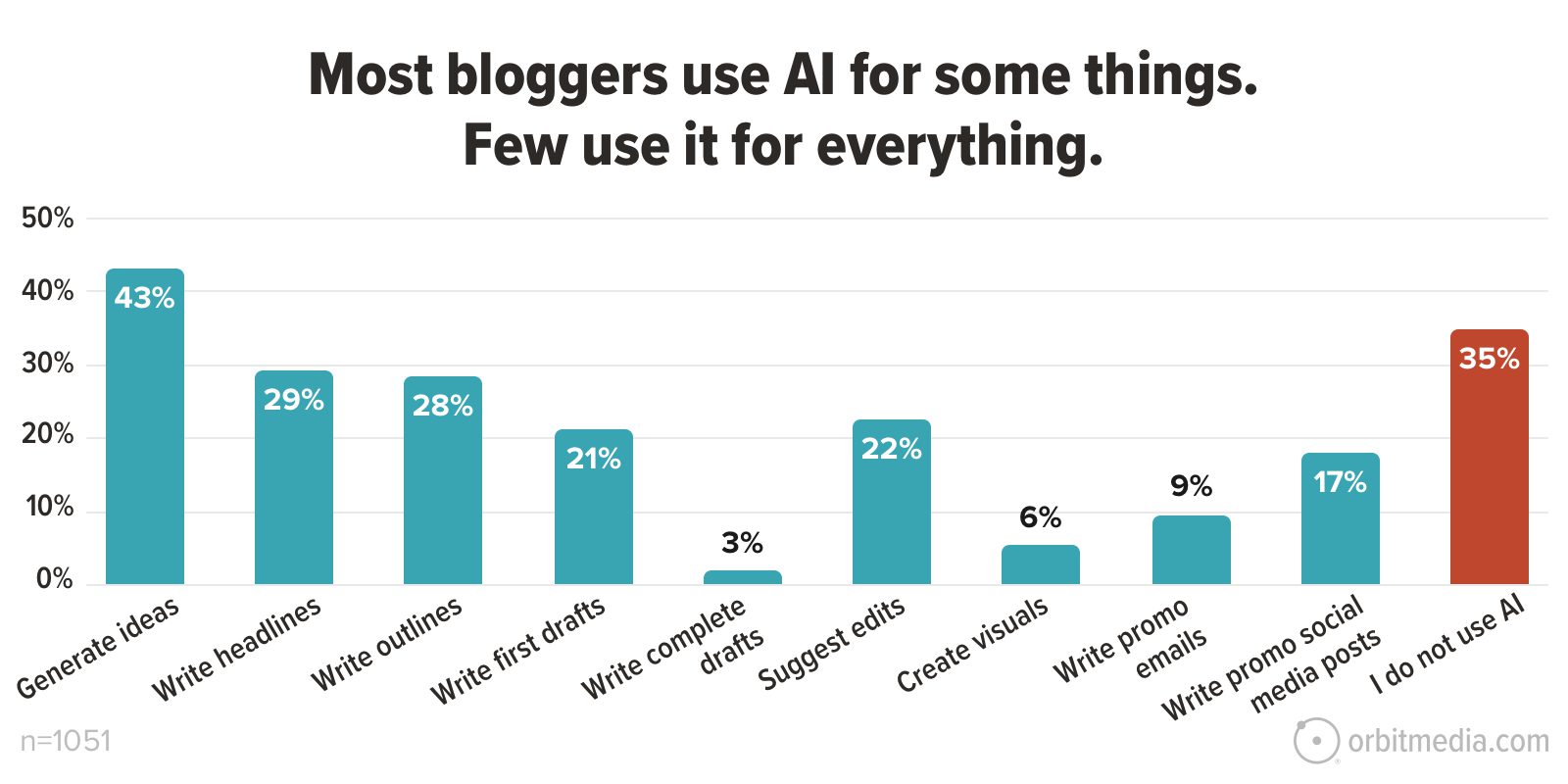
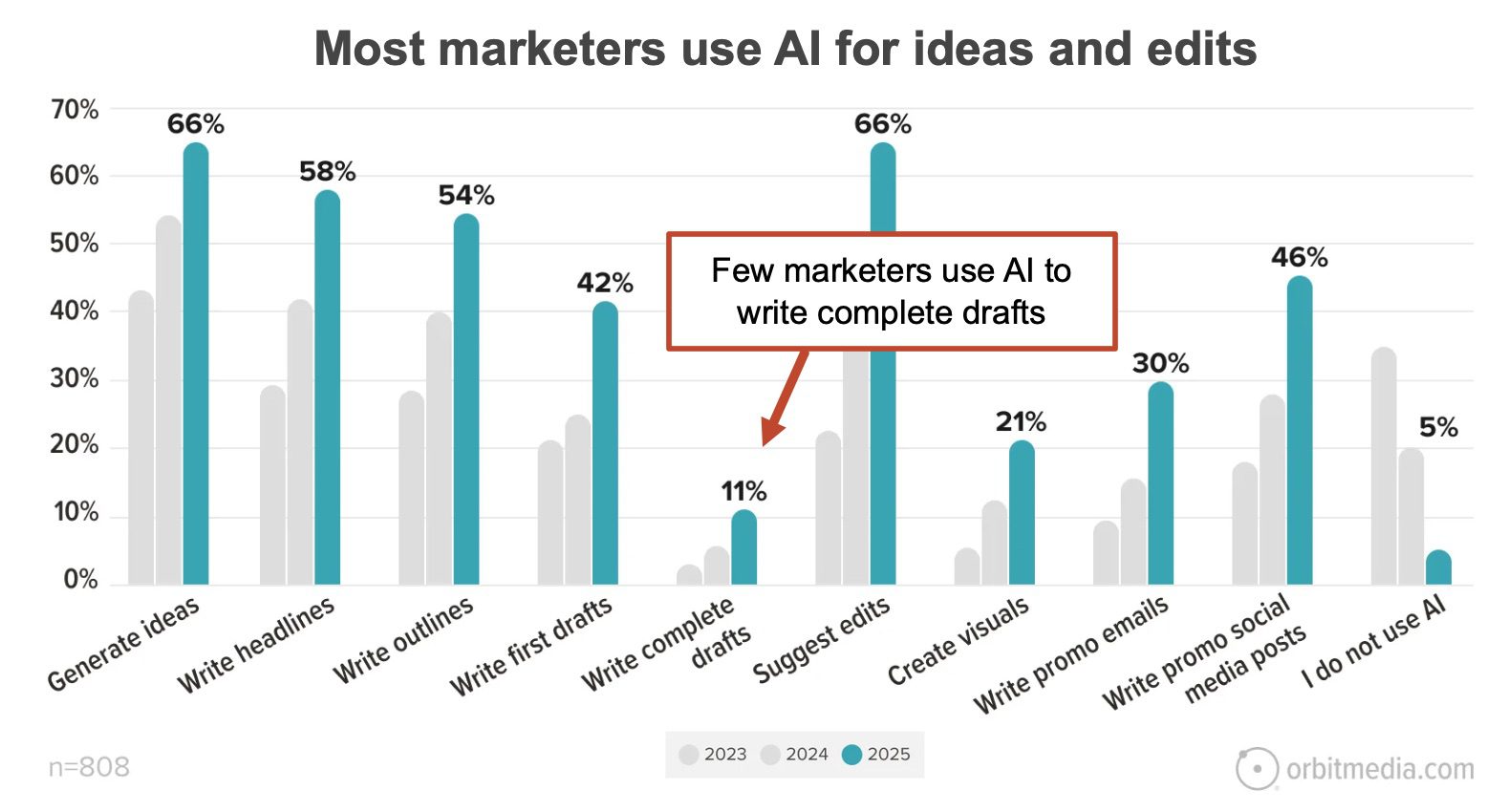
While the allure of AI-generated content is undeniable, the reality for most content marketers leans towards a more measured approach. According to Orbit Media’s annual survey, a mere 11% of content marketers draft entire articles using AI. The vast majority, however, are harnessing AI’s capabilities for more targeted applications, primarily in the ideation and editing phases. This suggests a broader understanding that AI can serve as a powerful assistant, augmenting human creativity rather than replacing it entirely. The survey data, visualized in a bar chart, clearly illustrates this trend: 66% of marketers utilize AI for suggesting edits, while only 11% rely on it for complete drafts. This distribution underscores a strategic adoption, focusing on AI’s strengths in efficiency and suggestion, while retaining human oversight for the core creative process.
Beyond the immediate act of writing, AI offers a wealth of opportunities for refining content strategy, from initial brainstorming and topic generation to in-depth audits and performance analysis. This article will explore five such applications, providing practical prompts that content marketers can implement to enhance their strategic output. We will delve into how AI can be used for quick website audits, the meticulous research of compelling topics, the critical evaluation of individual articles, the discovery of audience "watering holes," and the alignment of content with specific marketing channels based on performance data.
The Strategic Audit: AI’s Role in Content Performance Analysis
A fundamental aspect of successful content marketing involves not just creating content, but ensuring the platform on which it lives is optimized for success. Before publishing new material, a comprehensive audit of the content hub – typically a blog – is crucial. This audit should assess key success factors that contribute to reader engagement and conversion.
One of the most critical elements on a blog’s homepage is the email signup CTA. Ineffective or poorly placed signup forms can significantly hinder list growth. Examining examples of both effective and ineffective forms reveals stark differences in their ability to capture visitor interest. AI can provide a systematic approach to evaluating these elements.
Blog Homepage Subscription Audit Prompt:
This prompt is designed to guide an AI in acting as an email growth strategist, assessing a blog homepage’s effectiveness in converting visitors into subscribers. The AI is instructed to extract key topics from the provided URL and screenshot, and then evaluate the page against eight criteria, with a particular emphasis on conversion-path elements.
- Topic Scan: Identify 3-5 main topics covered by the blog.
- Page Score: Rate the homepage across eight criteria, using a 1-5 scale (1-2: Poor, 3: Average, 4-5: Excellent). The first four criteria are deemed "conversion-critical" and carry the most weight. The table format requires: Criterion | Score | Observed Details | Specific Fix.
- Conversion-Critical Criteria:
- Clear Value Proposition: Does the homepage immediately communicate the blog’s core benefit to the visitor?
- Prominent Email Signup: Is the subscription form easily visible and accessible?
- Compelling CTA: Is the call to action clear, benefit-driven, and persuasive?
- Trust Signals: Are there elements like testimonials, social proof, or author bios that build credibility?
- Supporting Criteria:
- Content Organization: Is the blog content well-categorized and easy to navigate?
- Visual Appeal: Is the design engaging and user-friendly?
- Readability: Is the text easy to scan and understand?
- Mobile Responsiveness: Does the page function well on all devices?
- Conversion-Critical Criteria:
- Strategic Gaps: Identify any overarching structural or strategic issues not captured by the row-by-row fixes.
- Verdict: Provide a concise recommendation on the page’s overall effectiveness.
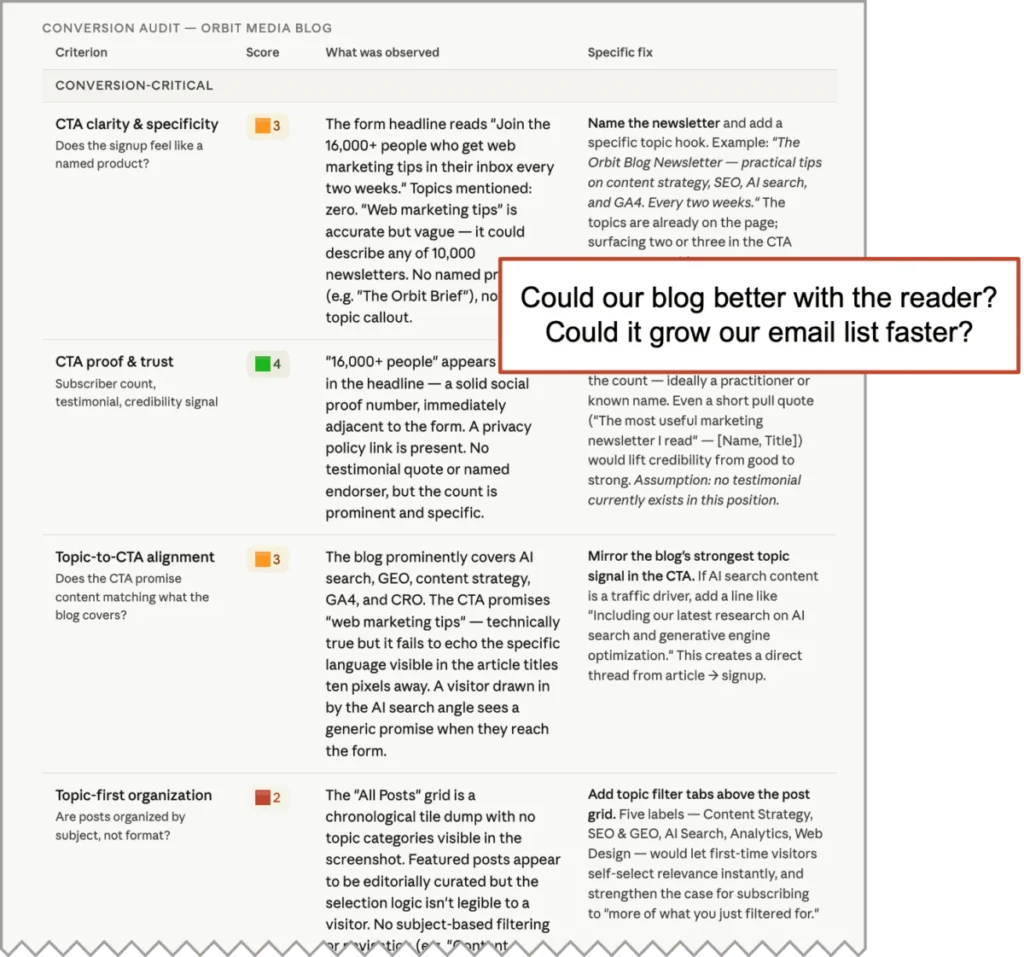
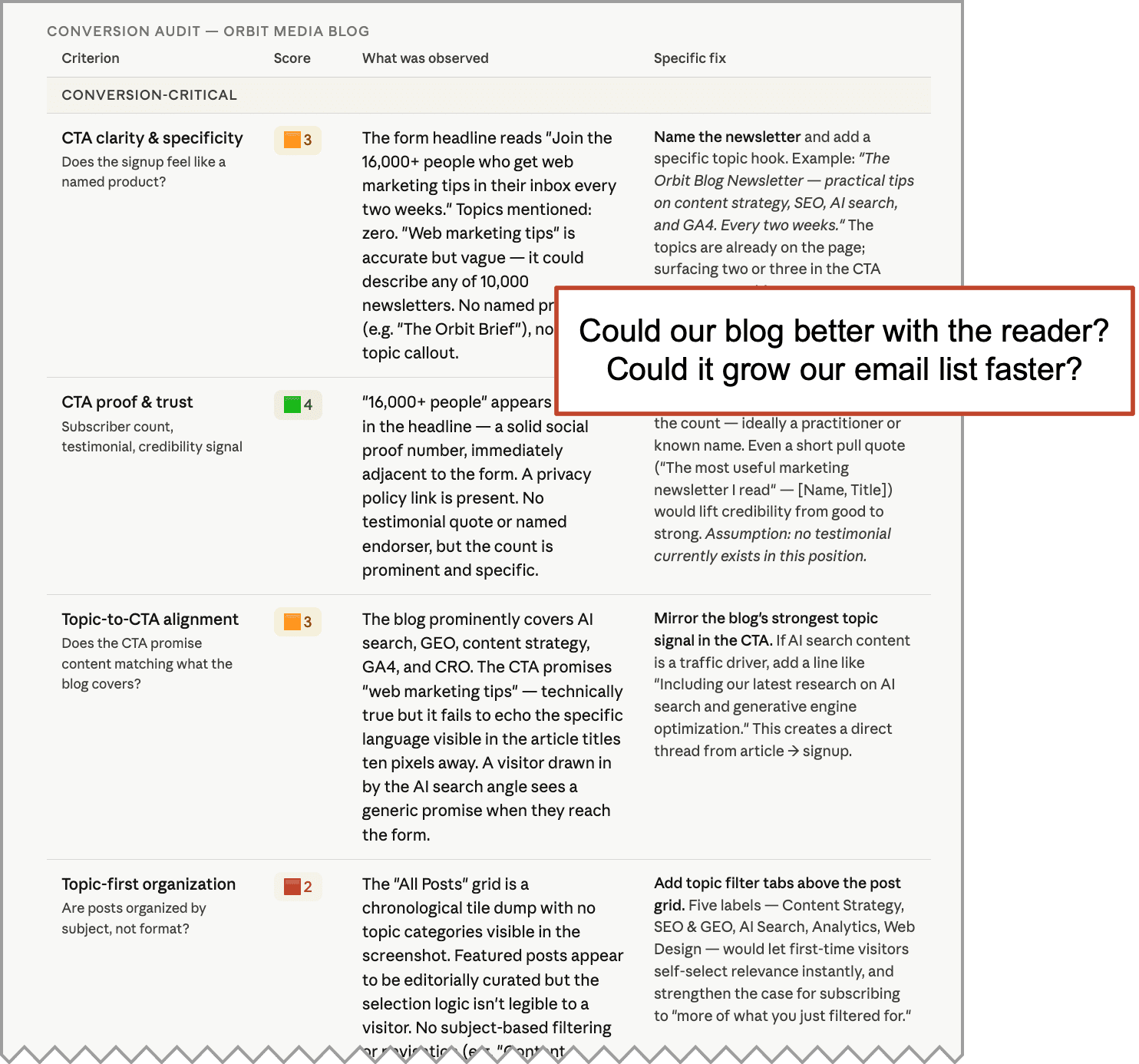
The input for this prompt includes a full-page screenshot of the blog homepage and optional details about the target audience and existing proof points (subscriber count, testimonials). This comprehensive analysis can reveal overlooked opportunities for improving user experience and driving subscriber growth. For instance, an AI might flag a "chronological tile dump" of blog posts as a potential area for improvement, suggesting more curated or topic-based displays.

Unearthing Unique Content Opportunities with AI
In the competitive content landscape, generic "how-to" articles that lack unique insights or data often struggle to gain traction. The most impactful content typically falls into three categories: thought leadership, original research, and topics that address niche or overlooked aspects of a subject. AI can be instrumental in uncovering these high-performing content avenues.
The "Provocative-But-Mundane Topics" Prompt:
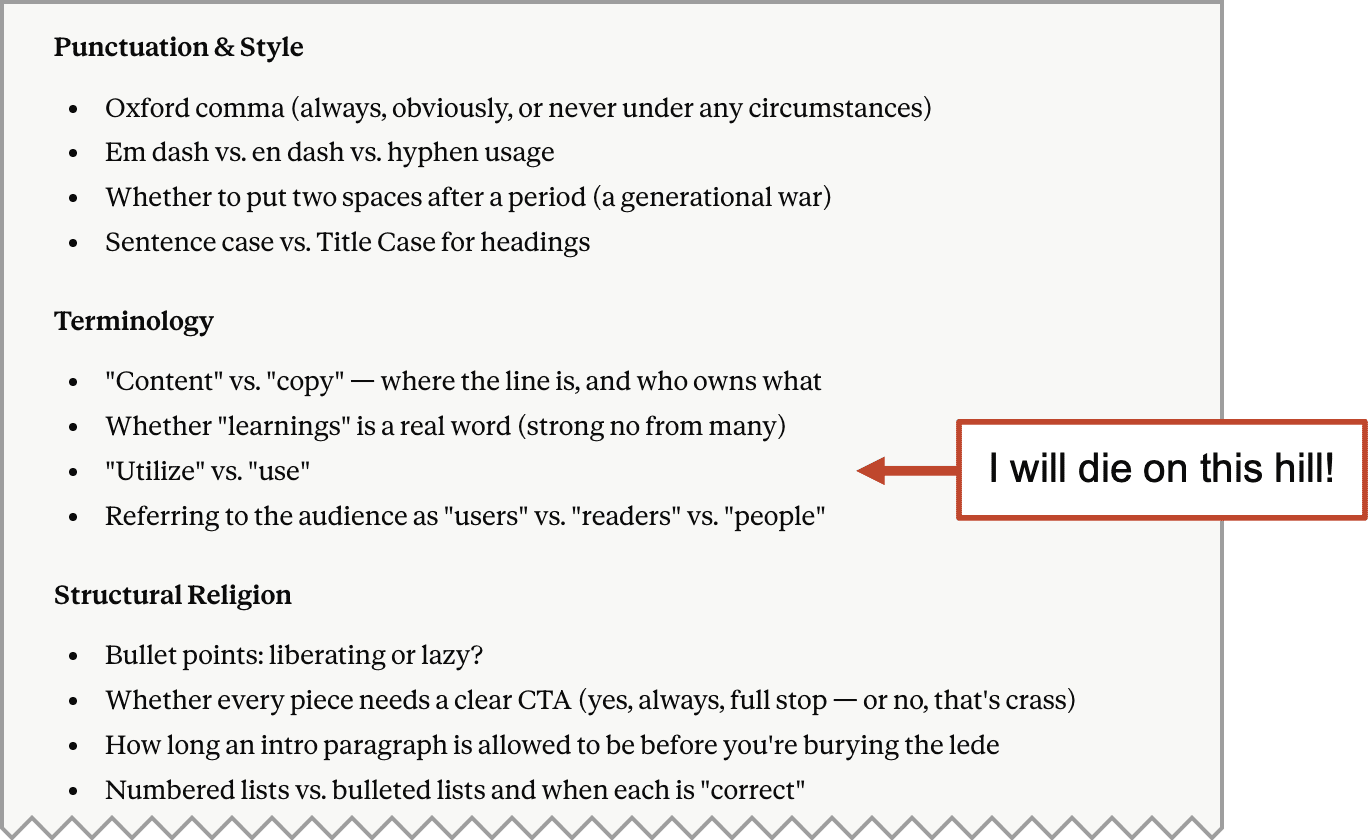
This prompt aims to uncover topics that elicit strong opinions without being overtly controversial. By specifying a target job title, AI can identify seemingly trivial subjects that professionals in that field feel passionately about.
- Prompt: "What are some relatively mundane, almost trivial topics that [job title] has very strong opinions about?"
The AI’s response to such a prompt can be surprisingly insightful, often revealing linguistic nuances or stylistic preferences that spark debate. For example, a "content strategist" might have strong opinions about the difference between "utilize" and "use," a seemingly minor point that can nonetheless be a fertile ground for engaging content. The key takeaway here is that AI cannot replicate genuine human opinion or lived experience, making these topics prime candidates for authentic, human-authored thought leadership.
The "Original Research Topics" Prompt:
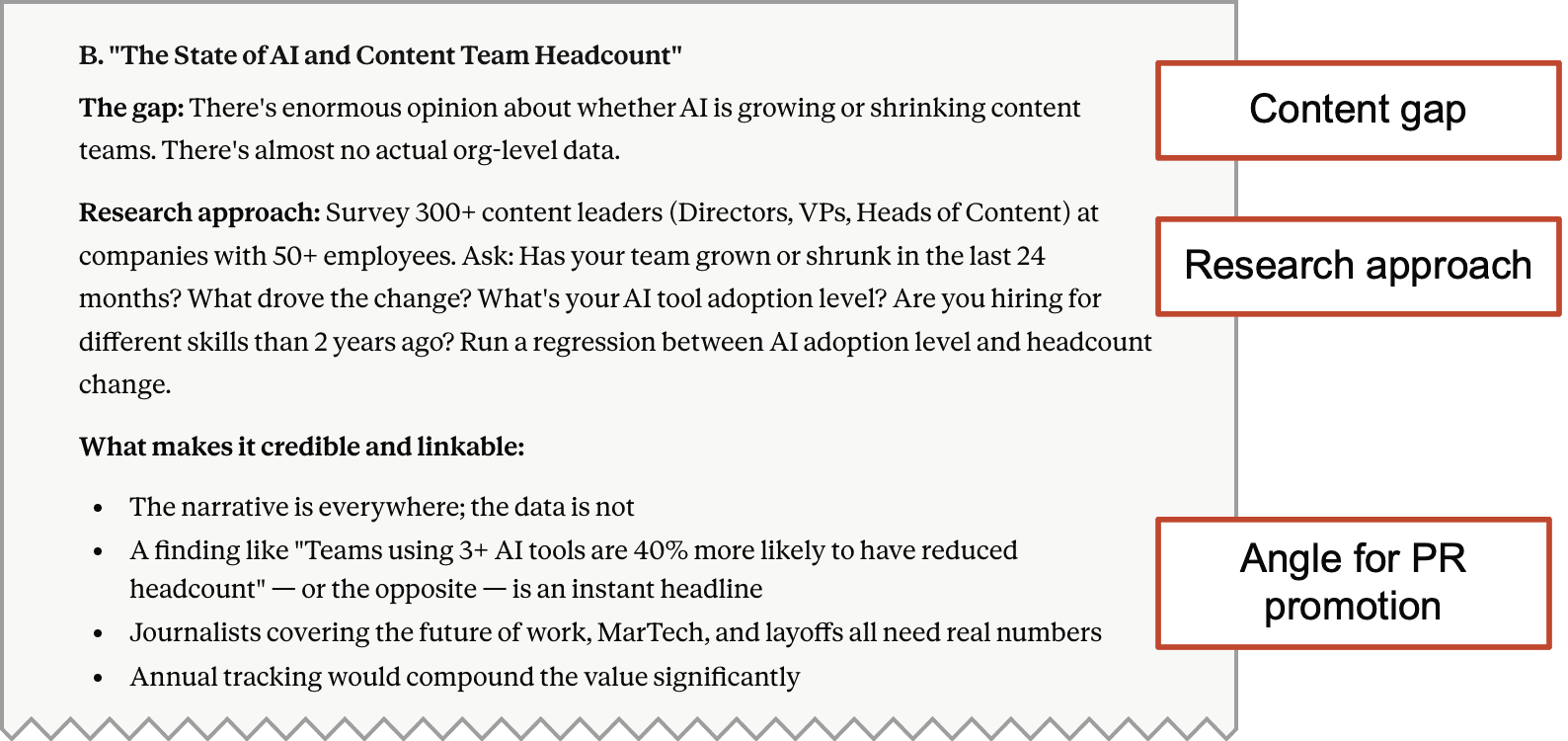
This prompt focuses on identifying gaps in existing industry knowledge, specifically looking for frequently asserted but rarely substantiated claims.
- Prompt:
- "Target audience job [job title]"
- "Suggest original research topics relevant to the industry of the role above. The goal is to identify frequently asserted but rarely supported claims – statements everyone repeats but nobody has actually measured. The best topics, once researched, would be cited by journalists, editors, and bloggers looking for fresh data."
- "Answer these three questions:
- What is the claim or assertion?
- What data would prove or disprove it?
- What is the PR angle or potential headline?"
The output of this prompt can guide the creation of data-driven content that attracts backlinks and establishes authority. By identifying "missing stats" or commonly held beliefs that lack empirical support, content creators can fill crucial voids in the information ecosystem. This approach not only benefits SEO through increased backlinks but also positions content for discovery by AI systems that increasingly rely on authoritative sources.
The "Topics-Rarely-Covered" Prompt:
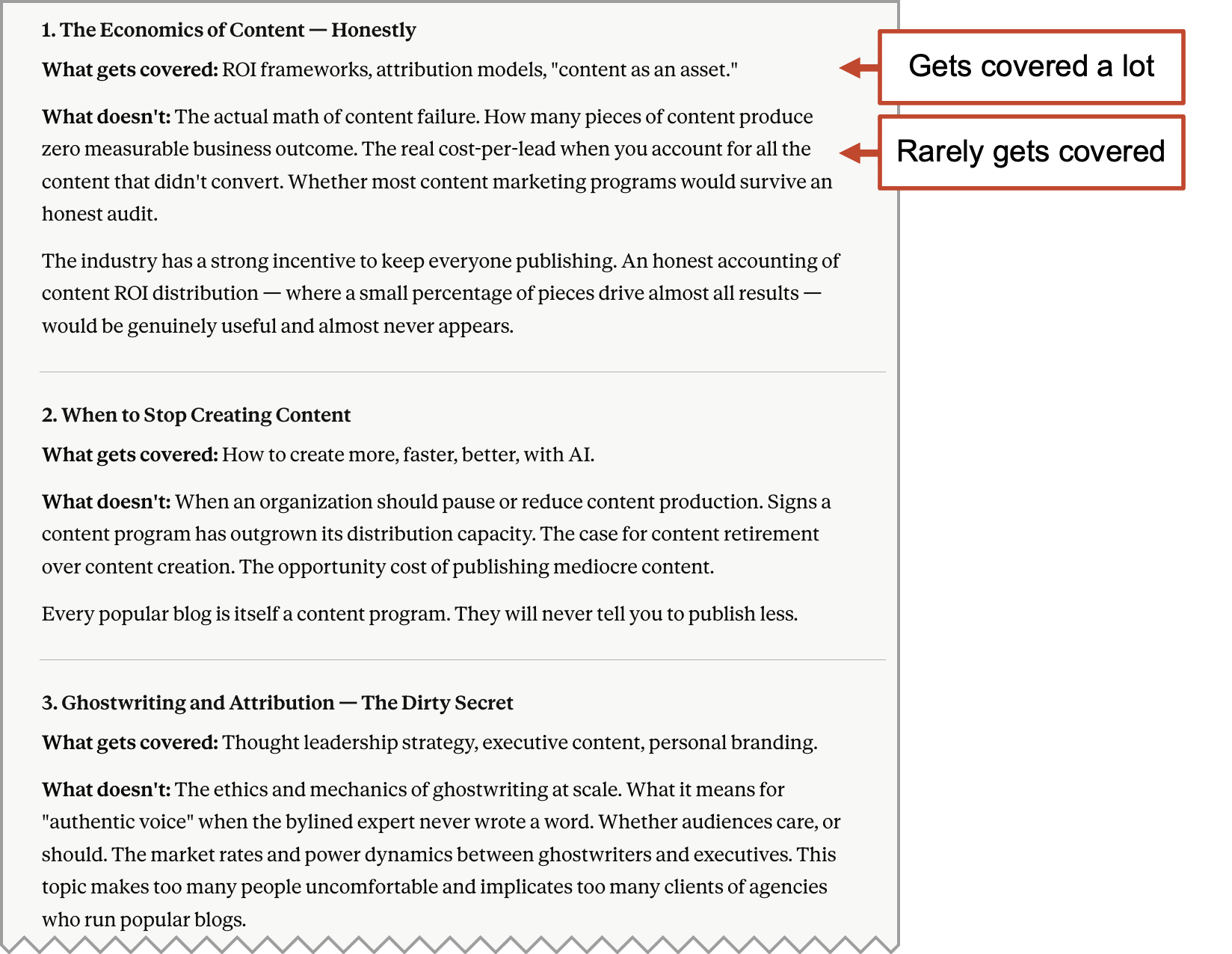
This prompt aims to identify content opportunities by pinpointing subjects within an industry that are significantly underrepresented in popular publications.
- Prompt: "What are the most important topics in the [job title]’s industry that are the least likely to be covered by the popular blogs?"
AI’s ability to process vast amounts of information allows it to identify these underserved niches, presenting content creators with a landscape of highly differentiated topic possibilities. This can lead to content that stands out, captures attention, and fosters deeper engagement by addressing unmet reader needs.
AI-Assisted Article Audits: Elevating Content Quality
Once an article has been drafted, a thorough review against content best practices is essential before publication. Key elements to consider include clarity, evidence, expert input, visual appeal, and calls to action. AI can significantly streamline this review process.
Article Audit Prompt:
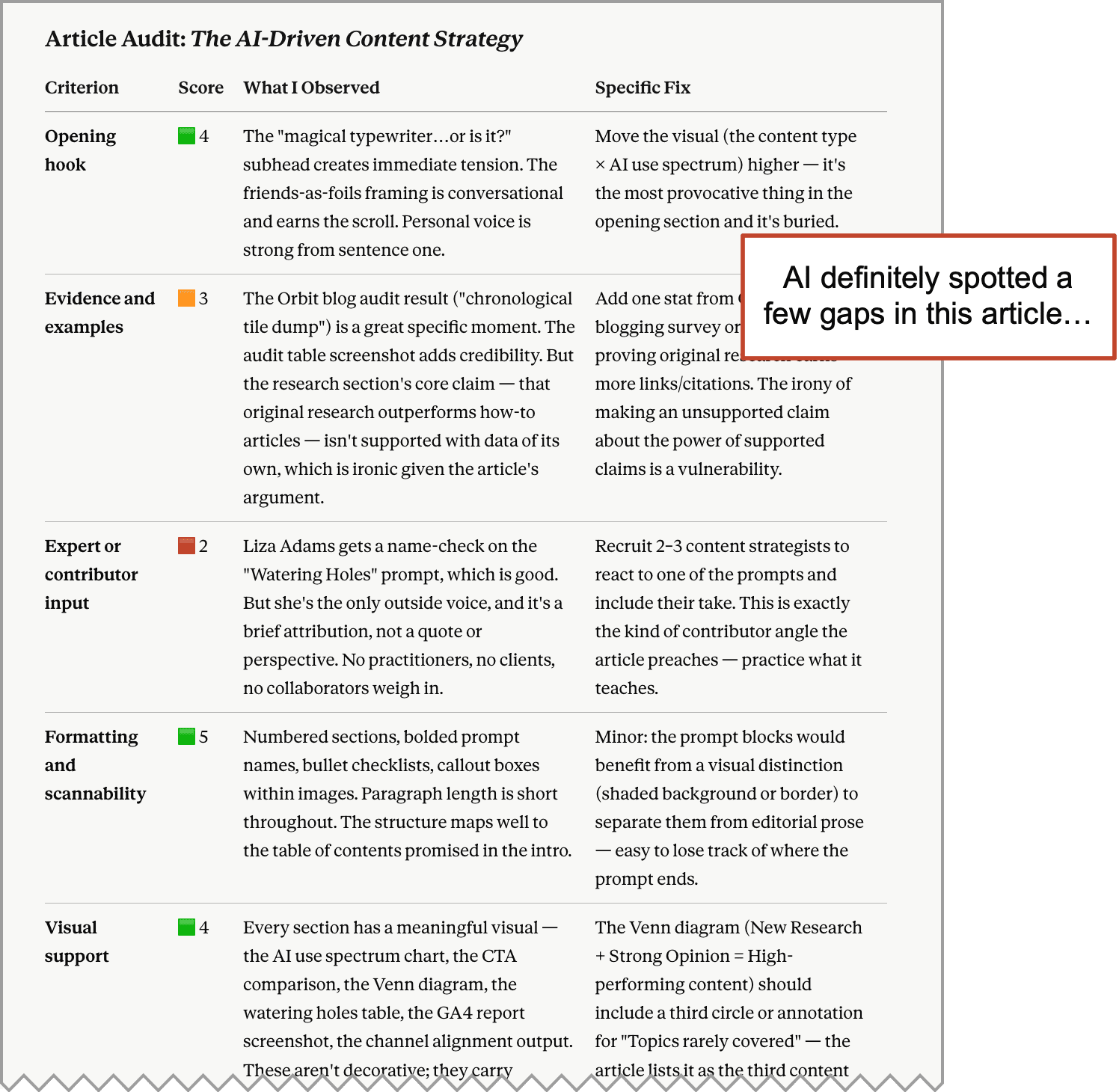
This prompt positions the AI as a content strategist acting on behalf of an editor, tasked with making a decisive recommendation on an article’s fate – update, rewrite, or remove.
- Prompt:
- "You are a content strategist auditing this article on behalf of an editor who needs to decide whether to update, rewrite, or remove it. Your job is to make a clear recommendation, not hedge."
- "Score the article across these eight criteria. Present results as a table with four columns: Criterion | Score (1-2 / 3 / 4-5) | What you observed | Specific fix."
- Evidence: Is the article well-supported with data, examples, and citations?
- Expert Input: Are there quotes or insights from industry experts?
- Visual Support: Are relevant images, charts, or videos included?
- Clarity & Conciseness: Is the language clear, direct, and easy to understand?
- Call to Action: Is there a clear next step for the reader?
- SEO Optimization: Is the article optimized for relevant keywords and search intent?
- Readability: Is the text formatted for easy scanning and comprehension?
- Originality: Does the article offer a unique perspective or new information?
- "Strategic Gaps: After scoring, identify one or two things the table can’t capture: positioning weaknesses, missing angles, or structural issues that no amount of polishing would fix."
- "Verdict: Provide a clear recommendation."
- "[Upload a full-page screenshot of the article – include top, mid-page, and bottom if the article is long]"
This audit prompts a critical self-assessment, pushing creators to strengthen arguments, incorporate expert opinions, and ensure robust evidence backs their claims. The AI’s analysis can identify specific areas for improvement, such as a lack of expert quotes or insufficient visual aids, leading to a more impactful and persuasive final piece.
Discovering Audience "Watering Holes" with AI
Effective content strategy extends beyond a brand’s own website. Understanding where the target audience congregates for information and engagement is crucial for extending reach and building influence. AI can help identify these "watering holes."
A Simplified "Watering Holes" Prompt:
This prompt leverages AI to identify where a specific audience learns, engages, and connects, moving beyond owned media to explore earned and shared channels.
- Prompt:
- "You are a content strategist familiar with [job title and industry]. Identify the ‘watering holes’ where this audience learns, engages, and connects."
- "For each category, name specific real examples – actual communities, publications, associations, events, podcasts, YouTube channels, forums, newsletters, and influencers."
- "Create a table with watering hole categories as rows and specific named examples as cells. For each, note the opportunity type: places to publish or pitch guest content, podcasts or channels to pitch yourself as a guest, events to attend or sponsor, communities to listen and engage in, or partnerships to pursue."
- "Finally, add a short section recommending the three highest-priority watering holes for someone just starting to build presence in this market, with a one-sentence rationale for each."
This prompt, particularly when combined with audience intelligence tools like Sparktoro, can yield a comprehensive list of relevant platforms. For instance, targeting "Marketing Directors" in "Healthcare Tech" might reveal specific industry publications, relevant trade shows, and influential LinkedIn groups. The AI can then categorize these opportunities, indicating whether they are suitable for guest posting, podcast appearances, or active community engagement. This strategic approach allows marketers to meet their audience where they already are, fostering more authentic connections and driving targeted traffic.

Aligning Content with Channels Using GA4 Data and AI
A sophisticated content strategy involves understanding which topics resonate best across different marketing channels. AI can analyze performance data from sources like Google Analytics 4 (GA4) to provide data-driven insights into channel-topic alignment.
The "Top Channel Alignment" Prompt:
This prompt instructs AI to analyze GA4 data and suggest new article topics tailored to specific channels based on past performance.

- Prompt:
- "You are a content strategist skilled at using data to identify which topics perform well in which channels. I’m giving you a GA4 report showing blog content performance by traffic source, for a blog targeting [job title]. Suggest 10 new article topics matched to the channels where they’re likely to perform well. For each, note the visitor mindset (e.g., answer-seeking, scroll-stopping), explain the channel fit, and suggest one promotion tactic."
- "[upload GA4 report]"
The power of this prompt lies in its reliance on proprietary data. Instead of generic best practices, it analyzes what has historically worked for a specific brand and audience. By uploading a GA4 report detailing traffic sources, engagement metrics, and conversion rates for various articles, AI can identify patterns. For example, it might suggest creating more long-form, question-answering content for search engines, while recommending visually compelling, emotionally resonant topics for social media. This data-driven approach ensures that content creation efforts are strategically aligned with distribution channels, maximizing impact and efficiency.
The Future of Content Strategy: A Human-AI Collaboration
The five AI applications discussed – blog homepage audits, topic research, article reviews, audience "watering hole" discovery, and channel alignment – represent just the beginning of AI’s potential in content strategy. The ongoing development of AI tools, such as ChatGPT and Claude, promises to further streamline and enhance other critical aspects of content marketing, including persona development, competitive analysis, keyword research, and content calendar planning.
However, it is crucial to reiterate that AI is a tool, not a replacement for human expertise. While AI can provide valuable insights and accelerate processes, the critical thinking, strategic decision-making, and authentic voice of human content creators remain indispensable. The most effective approach involves a collaborative partnership, where AI augments human capabilities, allowing marketers to focus on higher-level strategy, creativity, and building genuine connections with their audience. The goal is not to automate content creation entirely, but to leverage AI to produce more effective, data-informed, and audience-centric content, while always maintaining a critical eye and ensuring the human element of quality and perspective is preserved.