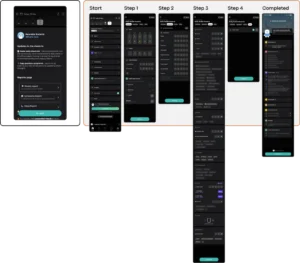


The transition of artificial intelligence from experimental chat interfaces to mission-critical production environments has exposed a fundamental engineering bottleneck: unstructured prompts and single-model architectures frequently collapse under real-world usage. Addressing this systemic volatility, software development firm Monogram has engineered and deployed a sophisticated nine-agent automated pipeline capable of transforming natural language instructions into functional software code, interactive graphical previews, and comprehensive implementation guides in under four minutes.
Operating at a consistent volume of 800 to 1,000 active users daily, the system demonstrates how complex software generation can be achieved reliably through rigorous architectural constraints. However, the path to this operational efficiency required overcoming substantial computational overhead. The initial production release of the platform consumed approximately 30,000 tokens per user request while executing 15 to 20 high-tier model calls. Through systematic architectural iteration, the engineering team transformed an expensive proof-of-concept into a streamlined, high-performance microservices environment. The core revelation from this implementation is not merely that multi-agent systems can handle broader problem sets, but that true production reliability emerges from strict workload partitioning, mandatory contextual boundaries, and the calculated replacement of probabilistic generation with deterministic programming.
Deconstructing Workflows Around Failure Boundaries
In traditional monolithic prompt design, developers instruct a single large language model to handle an entire sequence of tasks simultaneously. Applied to software development, this requires a model to analyze a user request, identify necessary application programming interfaces, design visual configurations, write code, inspect syntax, repair defects, and draft documentation within a single overarching context window. This approach inevitably introduces bloated context sizes, unpredictable outputs, and an inability to isolate the root cause of failures.
To eliminate these vulnerabilities, Monogram’s architecture deconstructs the development lifecycle into nine specialized operational nodes. A central root agent manages global session states, request routing, and runtime instruction assembly. Meanwhile, specialized subordinate agents take charge of individual domains, including linguistic analysis, UI styling, code generation, evaluation, refinement, and technical documentation drafting. Each agent operates under a strictly defined operational envelope characterized by a narrow responsibility, explicit input requirements, and a predetermined output schema.
This granular separation establishes vital operational boundaries. For instance, style configurations undergo automated validation independently from the underlying code generation cycles. Similarly, evaluation agents can intercept and reject insecure code segments without forcing the system to regenerate unrelated application logic. Consequently, engineering teams can independently test, tune, and assign specific model tiers based strictly on the computational complexity of each isolated task.
Nevertheless, architectural decomposition is not without its trade-offs. Introducing multiple operational boundaries inherently increases orchestration overhead, state transfer complexity, and potential points of failure. The Monogram architecture justifies this complexity because the underlying software generation workflow naturally consists of distinct tasks governed by disparate validation rules. Applying multi-agent distribution to ambiguous, unstructured prompts would merely scatter uncertainty rather than resolve it. Industry best practices suggest that decomposition is warranted whenever a task can be bound by a clear contractual agreement and evaluated independently from the broader system output.
Replacing Probabilistic Generation with Deterministic Code
A prevailing misconception in modern software engineering is that large language models should be utilized for every component of an AI-driven application. Monogram’s pipeline challenges this assumption by integrating entirely deterministic, programmatic stages where probabilistic reasoning offers no functional benefit.
Specifically, the system’s Schema Validator and Documentation Builder execute zero calls to large language models. The Schema Validator performs strict programmatic checks against generated configurations, while the Documentation Builder scans final code outputs to map utilized application programming interfaces directly to official documentation URLs retrieved from a canonical registry. Neither task benefits from linguistic creativity or heuristic interpretation. By executing these functions programmatically, the system eliminates two major vectors for model hallucination while reducing the token consumption of those specific stages to absolute zero.
This philosophical division extends to the interplay between code generation, evaluation, and refinement loops. Allowing a model to evaluate and approve its own generated code creates a dangerously weak feedback loop susceptible to cascading errors. To mitigate this risk, the pipeline enforces a strict separation of concerns: an independent evaluation agent applies rigorous automated rules and security vulnerability scans, passing explicit findings to a secondary refiner agent responsible strictly for targeted corrections.
Furthermore, every agent tasked with generating code or structural configuration must adhere rigidly to a structured output schema. This mechanism prevents unstructured conversational commentary from contaminating machine-consumed payloads, optimizes token economy, and supplies downstream agents with cleanly parseable inputs devoid of intermediate text-extraction steps.
Ensuring Context Integrity Through Mandatory Injection
Managing contextual relevance remains one of the primary hurdles in enterprise AI deployment. To supply agents with up-to-date technical data, Monogram integrated the Model Context Protocol (MCP), providing code generation and evaluation agents with live access to an indexed knowledge base of API documentation. To preserve system performance, query results are aggressively throttled, and the MCP server operates as an isolated microservice, ensuring that documentation retrieval operations never contend with model inference calls for upstream API rate limits.
However, empirical testing revealed that reliance on dynamic retrieval alone was insufficient to guarantee code correctness. Because MCP tool calls are initiated autonomously by the agents, highly confident models occasionally bypassed knowledge retrieval entirely under the false assumption that their pre-training data was fully comprehensive. This behavior introduced pathways for the generation of plausible yet fundamentally invalid code.
To close this vulnerability vector, the engineering team implemented a dynamic instruction injection framework. During the initial analysis phase, the system identifies the precise APIs required by a user request. Canonical code examples corresponding to those specific APIs are then injected directly into the system instructions for downstream agents. While exploratory queries continue to utilize optional MCP retrieval, mandatory implementation patterns are supplied as compulsory context.
This dual-track contextual strategy yielded dramatic operational efficiencies. Transitioning from static, universal examples embedded in every prompt to dynamic, runtime-injected reference material reduced per-request token consumption by 73 percent.
Chronology and Evolutionary Phases of the Engineering Lifecycle
The development of the pipeline did not occur in a single deployment cycle; rather, it evolved through five distinct engineering phases informed strictly by empirical production telemetry.
Phase one marked the initial proof-of-concept release, which relied heavily on Gemini 2.5 Pro across all pipeline stages, including generation, evaluation, and refinement. While functionally successful, this uniform reliance on a premier-tier model generated unsustainable latency profiles and prohibitive operational costs under commercial production volumes.
Phase two focused on prompt optimization and contextual reduction. Through the implementation of dynamic instruction injection, the engineering team successfully stripped extraneous conversational overhead from individual prompt structures, lowering baseline token usage.
Phase three introduced model tiering. By mapping specific tasks to appropriately scaled model variants based on functional complexity, the system achieved a 70 percent reduction in evaluation cycle latency without any measurable degradation in output quality.
Phase four addressed caching mechanisms and granular budgetary controls, systematically eliminating redundant computational cycles for frequently requested design patterns.
Phase five cemented production resilience through comprehensive telemetry integration. By coupling BigQuery analytics with structured observability frameworks, the engineering team gained real-time visibility into pipeline performance, enabling data-driven tuning of retry logic, fallback protocols, and security auto-fix loops.
Broader Industry Implications and Enterprise Impact
The operational framework established by Monogram offers a transferable blueprint for engineering enterprise-grade artificial intelligence services. By treating model selection, prompt context management, caching policies, retries, and deterministic code execution as unified components within a single architectural system, organizations can successfully transition AI applications from brittle experimental prototypes to dependable production services.
As corporate demand for automated software generation and natural language processing pipelines accelerates, the industry is shifting away from monolithic prompt engineering toward modular, contract-driven agent architectures. The success of Monogram’s pipeline underscores a foundational reality of modern software development: sustainable AI deployment relies less on the raw linguistic capabilities of any single model and more on the rigorous engineering discipline applied to the systems that surround it.