
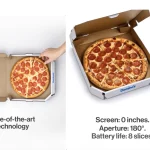

In the fast-paced ecosystem of consumer electronics and global marketing, timing is everything. When tech giant Apple unveiled its latest iteration of a foldable smartphone last week, the announcement dominated headlines, social media feeds, and industry discussions across the globe. For most consumer brands, the launch of a revolutionary mobile device by one of the world’s most valuable companies represents an intimidating news cycle to break into. However, marketing agency Foolish and fast-food titan Domino’s Pizza France recognized an immediate, highly creative opening for real-time marketing. Capitalizing on the tech industry’s obsession with hinges, flexible displays, and pocket-sized portability, Domino’s launched a witty, high-production-value social media campaign that cleverly asserts a bold claim: long before Silicon Valley engineered folding screens, Domino’s was the original master of the foldable format.
The campaign, which rolled out across major social media platforms immediately following Apple’s keynote announcements, borrows the sophisticated, ultra-polished visual aesthetic of Silicon Valley product reveals. Complete with dramatic lighting, precise macro cinematography, sleek typography, and deadpan voiceovers, the digital spots parody the hyper-serious tone of modern tech advertisements. Instead of highlighting cutting-edge microprocessors, battery efficiency, or multi-lens camera arrays, however, the advertisements celebrate functional, everyday design: the cardboard pizza box.
By treating a simple corrugated cardboard container with the reverent gravity usually reserved for thousand-dollar flagships, Domino’s and Foolish successfully injected humor and culinary relevance into an otherwise unrelated tech news cycle. The campaign humorously reframes the humble pizza box as an engineering marvel, noting its precision folding, structural integrity, and multi-size availability. Ultimately, instead of unveiling a digital screen when opened, the device reveals one of humanity’s most enduring and popular inventions: a hot, freshly baked pizza.
The Rise of the Foldable Trend and Real-Time Marketing
To understand the cultural resonance of the Domino’s campaign, one must examine the broader technological context of the consumer electronics market. Over the past half-decade, foldable displays have transitioned from speculative design concepts to mainstream commercial realities. Smartphone manufacturers have invested billions of dollars in researching hinge durability, ultra-thin flexible glass, and software optimization to make foldable devices more accessible to everyday consumers. Every time a major manufacturer unveils a new foldable handset, it generates a massive wave of media attention, setting off a domino effect of digital discourse.
In the realm of modern advertising, "newsjacking" or real-time marketing has become an essential strategy for brands seeking to maintain cultural relevance. By anchoring their creative output to trending global events, brands can bypass traditional advertising fatigue and capture the attention of audiences who are already actively engaged online. However, successful real-time marketing requires a delicate balance of speed, wit, and brand alignment. If a brand’s connection to the trending topic feels forced or artificial, it risks alienating consumers.
Domino’s and Foolish navigated this challenge by leaning into a literal, undeniable truth about their core product. Long before smartphones featured hinges, Domino’s Pizza boxes were manufactured flat, shipped in stacks, and folded by hand or machine into functional, heat-retaining containers designed to transport food safely to consumers’ doors. By playfully reclaiming the word "foldable," Domino’s positioned itself not as a follower of tech trends, but as a legacy pioneer of the concept.
Anatomy of a Tech Parody Campaign
The campaign comprises a series of short-form video assets meticulously designed to mimic tech launch trailers. Each video focuses on a specific aspect of product engineering, subverting viewer expectations with deadpan comedic timing.
In one spot, the video highlights "screen aperture" and "battery life"—common smartphone metrics—before seamlessly pivoting to the heat retention and steam-venting capabilities of a corrugated pizza box. Another video, titled "Slice-of-the-art technology," showcases the precise geometric folding patterns required to assemble the box, treating the cardboard creases with the same reverence Apple applies to its titanium chassis. Additional spots highlight color options (such as the brand’s classic corporate blue and red motifs) and software updates, which are humorously translated into culinary customizations like adding extra pepperoni.
The meticulous attention to detail in these spots is a testament to the collaborative effort between Domino’s Pizza France and the creative agency Foolish. Every frame was crafted to mirror the minimalist, high-end visual language associated with Cupertino-style product launches. The use of macro lenses, moody studio lighting, and smooth camera tracking shots creates an ironic dissonance: the viewer is primed to witness the unveiling of an advanced computing device, only to be confronted with a pepperoni pizza.
Behind the Creative Vision: Agency and Brand Credits
The successful execution of the campaign required a synchronized effort across multiple departments at both Foolish and Domino’s Pizza France. The creative agency Foolish, known for its disruptive and culturally attuned advertising work, assembled a dedicated team to conceptualize, script, and produce the campaign under tight deadlines.
At the helm of Foolish, President Matthieu Reinartz and Managing Director Enguerran Barreau oversaw the strategic direction of the project. The creative vision was shaped by Chief Creative Officers Olivier Bancal and Philippe Boucheron, who guided the parody aesthetic. The art direction was handled by Thibaut Belis and Charlotte Sindic, while the copywriting responsibilities were shared by Djavid Karmaly and Damien Bazile. Post-production and video editing were managed by David Turner, ensuring that the pacing and visual fidelity closely mirrored authentic tech commercials. Account management was coordinated by Noémie Corrieri and Elisa Treglia.
On the client side, Domino’s Pizza was represented by a robust marketing and communications team. Chloé Allègre, Head of Brand Strategy, Partnerships & Activations, played a pivotal role in aligning the campaign with the brand’s overarching voice. Pierre Hesry served as the French Creative Team Manager, while Margaud Gales managed social media project coordination to ensure the rapid deployment of the assets across digital channels following Apple’s announcement.
The Broader Implications for Fast-Food Marketing
The Foolish-crafted campaign for Domino’s highlights a broader evolution in how fast-food chains and consumer-packaged-goods brands utilize social media. Traditional advertising models, which relied heavily on long-term media planning and static television spots, have increasingly given way to agile, agile-response campaigns designed for platforms like Instagram, TikTok, and X (formerly Twitter).
By participating in cultural conversations outside of the culinary space, brands can expand their demographic reach and engage with younger, tech-savvy consumers who consume media primarily through digital channels. The humor inherent in comparing a high-end smartphone to a pizza box creates a shareable moment, encouraging organic amplification through user shares, retweets, and comments. This peer-to-peer distribution is far more cost-effective and trusted by consumers than traditional paid media impressions.
Furthermore, the campaign underscores the power of self-awareness in modern branding. Domino’s has a long history of leaning into humor, transparency, and self-deprecation in its marketing. By acknowledging the simple, unpretentious nature of a cardboard box while elevating it through high-end production values, the brand reinforces its approachable, customer-centric identity.
Conclusion and Industry Reception
As digital marketing continues to evolve at a breakneck pace, campaigns that successfully bridge disparate industries—such as consumer technology and fast food—stand out for their ingenuity and cultural relevance. The collaboration between Foolish and Domino’s Pizza France serves as a textbook example of how brands can leverage real-time marketing to hijack a major global news cycle without spending exorbitant sums on traditional media buys.
By positioning the pizza box as "The Original Foldable," Domino’s successfully captured the public’s imagination, generated widespread digital engagement, and reminded consumers that innovation isn’t solely the domain of Silicon Valley. Sometimes, the most functional, beloved foldable design in history is the one holding your Friday night dinner.