

As the United States approaches a critical electoral cycle, technology platforms are aggressively positioning themselves as indispensable partners for political campaigns seeking to capture the attention of a highly digitized electorate. In a strategic pitch for political advertising dollars, Snapchat has published a comprehensive new research report detailing the civic engagement habits, mindset, and media consumption patterns of its user base. Released ahead of the November midterm elections, the study aims to demonstrate to campaigns and political action committees that the platform offers a uniquely receptive audience, particularly among younger demographics who traditionally prove difficult to reach through legacy media channels.
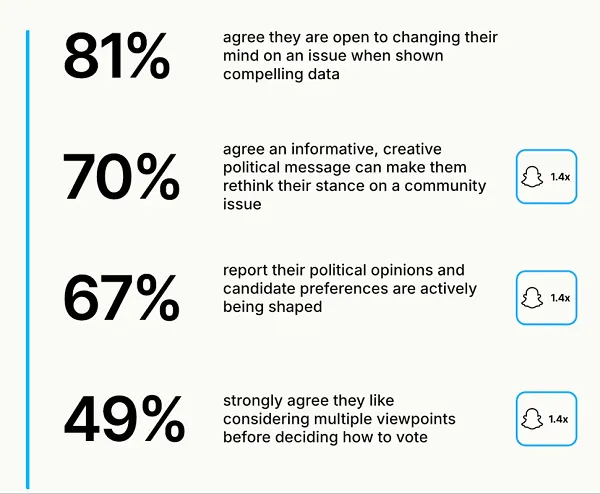
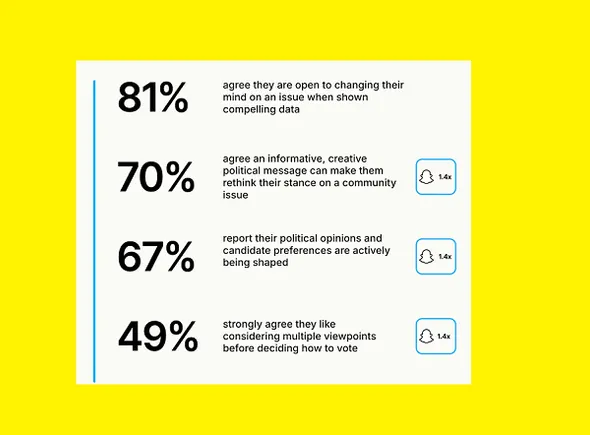
The empirical foundation of the report stems from a specialized survey commissioned earlier this year and conducted by market research firm Alter Agents. Researchers surveyed more than 1,000 Snapchat users ranging in age from 18 to 45, capturing a broad cross-section of millennials and Generation Z. The findings offer a nuanced look at how contemporary digital natives approach politics, contrasting sharply with the conventional wisdom that young voters are either politically apathetic or rigidly entrenched in ideological echo chambers. According to the platform’s data, Snapchat users exhibit a high degree of openness, actively seeking out diverse viewpoints before finalizing their voting decisions and remaining remarkably flexible in their political positions.
Main Facts and Core Findings of the Research
The headline figure of the Snapchat-commissioned study indicates that nearly 80 percent—specifically 78 percent—of surveyed platform users intend to cast a ballot in the upcoming midterm elections. When contextualized against broader demographic baselines, this statistic reveals that active Snapchat users are approximately 1.2 times more likely to participate in the electoral process than non-users within the same age cohorts. This challenges the persistent narrative that image-centric, ephemeral messaging applications foster superficial engagement divorced from civic responsibility.
Furthermore, the data underscores the profound impact of digital advertising in shaping political awareness. Approximately 80 percent of respondents reported that in-app political promotions and advertisements successfully introduced them to candidates, ballot measures, and sociopolitical causes they were previously unaware of. This discovery highlights the platform’s utility not merely as a mobilization tool for established supporters, but as a top-of-funnel discovery engine for lesser-known candidates and grassroots initiatives.
Compounding this discovery, 74 percent of survey participants indicated that viewing political ads on Snapchat directly motivated them to conduct independent research regarding the candidates and their policy platforms. Rather than passively consuming promotional content, users are utilizing the platform as a catalyst for deeper informational inquiry. Snap’s internal analysis summarizes this behavioral trend by noting that in an increasingly polarized and complex political landscape, its users remain uniquely open-minded, prioritizing exploratory research over dogmatic partisanship.
Chronology of Snapchat’s Civic Engagement Initiatives
Snapchat’s aggressive push into the political advertising market does not exist in a vacuum; it represents the culmination of a multi-year strategy focused on institutionalizing civic participation within the application’s core user experience. Understanding the platform’s current pitch requires examining the historical evolution of its civic tech initiatives, which have steadily scaled in both sophistication and impact over successive election cycles.
The platform’s formalized voter registration efforts gained significant momentum during the 2018 U.S. midterm elections. Recognizing the administrative hurdles that frequently disenfranchise first-time and young voters—such as complex registration deadlines and unfamiliarity with polling procedures—Snapchat integrated native registration tools directly into its interface. Collaborating with non-partisan organizations, the platform deployed targeted in-app prompts, filters, and sticker campaigns. By the conclusion of the 2018 cycle, internal metrics revealed that Snapchat had directly facilitated the voter registration of more than 450,000 individuals, proving the platform’s viability as a civic mobilization infrastructure.
Building upon this success, the 2021 Citizensnap report and the preceding 2020 presidential election cycle marked a quantum leap in the platform’s civic output. Amidst the unprecedented logistical challenges posed by the COVID-19 pandemic, Snapchat intensified its in-app messaging, leveraging its reach to guide users through mail-in voting procedures, absentee ballot requests, and early voting schedules. These coordinated nudges and educational campaigns culminated in a milestone achievement: Snapchat directly drove an estimated 1.2 million users to register to vote in 2020. This nearly threefold increase from the 2018 midterms cemented the platform’s reputation among political strategists as a premier channel for youth voter turnout.
As the political calendar advanced toward the subsequent midterm elections, the platform recognized an opportunity to monetize this established trust. By commissioning the Alter Agents study, Snap transitioned its civic engagement narrative from a pure public service initiative into a commercially viable value proposition for political advertisers seeking measurable returns on investment.
Detailed Breakdown of Supporting Data and User Demographics
A granular examination of the survey data illuminates specific behavioral patterns that distinguish Snapchat users from consumers of other social media ecosystems. The demographic sweet spot of the platform—individuals aged 18 to 45—represents a critical voting bloc encompassing the entirety of Generation Z and a substantial majority of millennials. These generations are characterized by high digital literacy, skepticism toward traditional institutional messaging, and a strong affinity for cause-driven civic participation.
The research indicates that Snapchat users respond exceptionally well to values-based and cause-oriented outreach. Rather than engaging purely with tribal party politics, this audience is motivated by tangible issues, ranging from economic policy and environmental sustainability to social justice and healthcare reform. When political campaigns tailor their messaging to highlight specific causes rather than relying exclusively on attack ads or generalized party branding, they achieve significantly higher resonance within the app.
Moreover, the data emphasizes the efficacy of visual and interactive formats in political communication. In an era where banner blindness diminishes the effectiveness of traditional display advertising, Snapchat’s immersive formats—such as Story ads, Collection ads, and augmented reality (AR) lenses—capture sustained user attention. The finding that four out of five users learn about unfamiliar political entities through these formats suggests that creative, native advertising formats can bridge the information gap for voters who do not actively consume local news broadcasts or read metropolitan newspapers.

Industry Reactions and Strategic Implications for Campaigns
The release of the report has elicited considerable discussion among political consultants, media buyers, and digital strategists. While legacy political advertising has historically concentrated heavily on linear television for older demographics and Facebook or Twitter for general digital discourse, the shifting demographic weight toward Millennials and Gen Z has forced a strategic recalibration.
Industry analysts observe that campaigns operating on tight budgets must maximize the efficiency of their ad spend. Snapchat’s data provides a compelling justification for campaigns to allocate a larger percentage of their digital budgets toward mobile-first, ephemeral platforms. By demonstrating that its users are not only reachable but actively seeking guidance on unfamiliar candidates, Snapchat offers campaigns a high-conversion environment that traditional media channels increasingly struggle to match.
However, political communications experts also note potential challenges associated with advertising on the platform. The demographic skew toward younger voters means that campaigns targeting older, more reliable voters—such as retirees—will find limited utility in Snapchat ad placements. Furthermore, the platform’s strict transparency policies regarding political and advocacy ads require campaigns to undergo rigorous vetting and verification processes before launching promotional content. These safeguards, designed to prevent foreign interference and misinformation, demand careful administrative planning from campaign media teams.
Broader Impact on the Future of Political Discourse
The intersection of youth culture, civic participation, and commercial platform strategy points toward a broader transformation in how democratic processes are mediated in the twenty-first century. As physical town halls and door-to-door canvassing compete with digital touchpoints, platforms like Snapchat are redefining the civic public square.
By lowering the friction associated with voter registration and candidate discovery, technology companies are playing an active role in shaping electoral outcomes, whether intentionally or as a byproduct of commercial operations. The empirical proof that digital natives rely on in-app prompts to inform their voting behavior suggests that platform architecture directly influences civic health.
Looking forward, the success of Snapchat’s political ad pitch in the lead-up to the midterms may set a precedent for other youth-centric platforms, such as TikTok and Instagram. As campaigns observe the measurable conversion rates of cause-based digital outreach, the allocation of political ad spend will likely continue its migration away from traditional broadcast media toward hyper-targeted, mobile-first environments. Ultimately, the report serves as both a marketing pitch for Snap Inc. and a window into the evolving psychology of the modern American voter—one who demands transparency, values exploration, and consumes democracy through a smartphone screen.