

Technology has fundamentally shifted from a tool that humans operate to an immersive environment in which people operate. Driven by breakthroughs in artificial intelligence, digital interactions have evolved rapidly from static, transactional exchanges into dynamic, conversational experiences. Rather than merely displaying pre-existing information, modern interfaces generate real-time context and content, creating an environment that feels increasingly alive.
This transition marks a watershed moment for brand marketing. As communication between consumers and corporations becomes heavily mediated by autonomous digital assistants, traditional paradigms of brand building are undergoing radical re-evaluation. Industry veterans and brand strategists are scrambling to adapt legacy frameworks to a commercial landscape where machines act as the primary gatekeepers of consumer attention.
The Evolution of Connection: From Lovemarks to Agentic Interfaces
The imperative to establish emotional connections between consumers and commercial entities is nearly a century old, having entered marketing theory in the early 20th century. Over decades, emotional persuasion evolved into sophisticated loyalty strategies, anchored by the foundational premise that deep psychological attachment drives long-term retention and repeat business.
To help brands humanize their identities, Margaret Mark and Carol Pearson introduced the 12-brand archetype model 25 years ago in their seminal work, The Hero and the Outlaw. This framework provided a rational, human-inspired personality structure that dictated how a brand looked, spoke, and behaved. It gave marketers a tangible tool to operationalize irrational consumer behavior and foster brand love.
However, industry leaders argue that these traditional archetypes are no longer sufficient for the emerging agentic economy. Arjan Kapteijns, former CEO of Saatchi & Saatchi Netherlands, recently re-examined Kevin Roberts’ famous concept of a "Lovemark" for an AI-infused world. Kapteijns introduced the framework of "Agentic Lovemarks," arguing that earning consumer affection and trust is no longer directed solely at human-managed channels, but increasingly at digital agents acting on behalf of brands. While the foundational goal—creating deep emotional resonance—remains unchanged, that connection is now orchestrated entirely by machines.

The Legible-Lovable Law and the Need for Precision
The inadequacy of traditional archetypes in the age of AI stems from their inherent ambiguity. Archetypes provide a broad behavioral direction, but they leave vast room for interpretation. In a one-on-one, conversational interaction mediated by a complex large language model (LLM), leaving personality to loose interpretation is catastrophic. Allowing an AI to randomly extrapolate a brand voice from a generic archetype would yield a wildly inconsistent consumer experience, akin to generating a completely different corporate logo every time a user searched for a brand.
To address this operational challenge, Thomas Marzano, former brand leader at Philips and ASML, outlined a new standard in his manifesto, Brand Constitutions. Marzano established the "Legible-Lovable Law," which posits that modern brands must satisfy two critical requirements in an agentic economy: they must be legible to artificial intelligence so that machines can accurately recognize, understand, and recommend them, and they must remain lovable to human users to influence their final purchasing decisions.
Under this model, technical infrastructure reinforces emotional connection. If an AI cannot accurately read, render, and interpret a brand’s parameters, the resulting interaction defaults to generic, uninspired machine language, devoid of any genuine brand equity.
Introducing the PRISM Model: A Structural Framework for AI Personalities
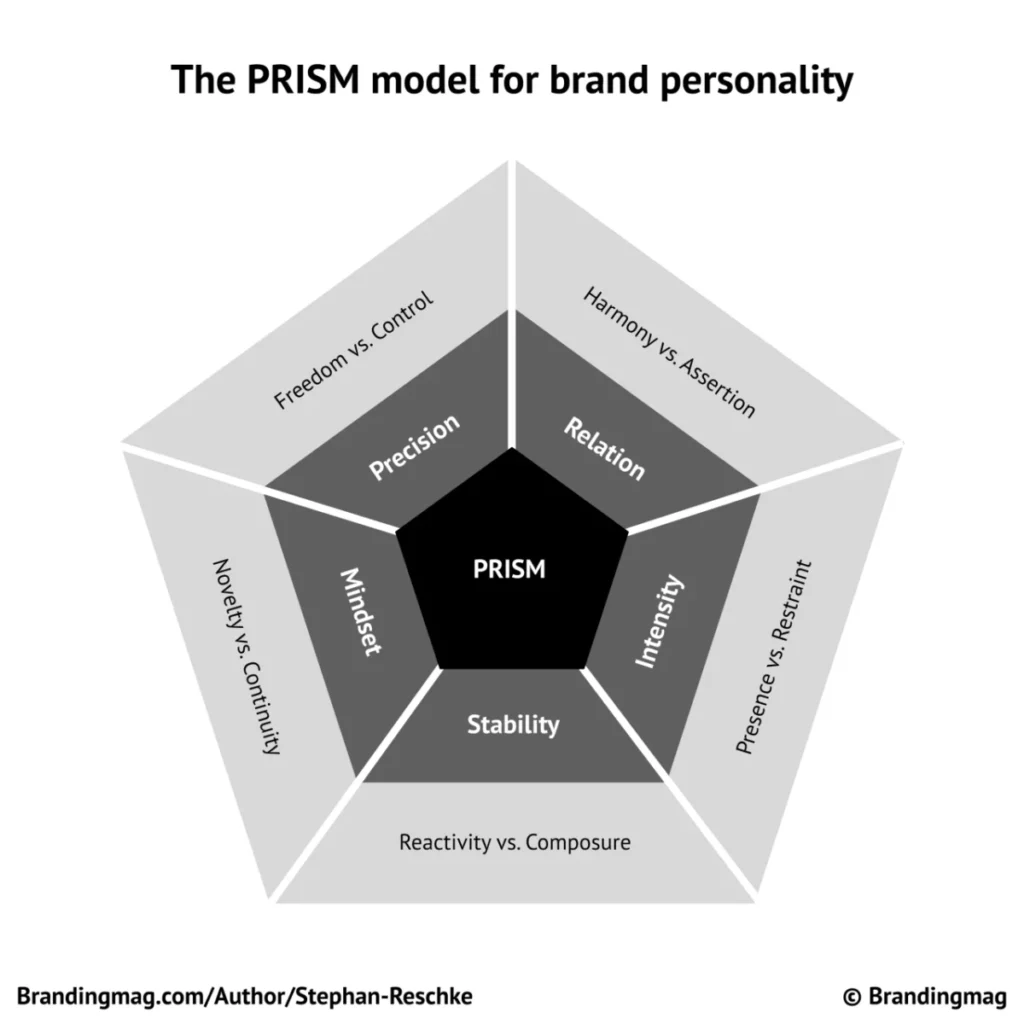
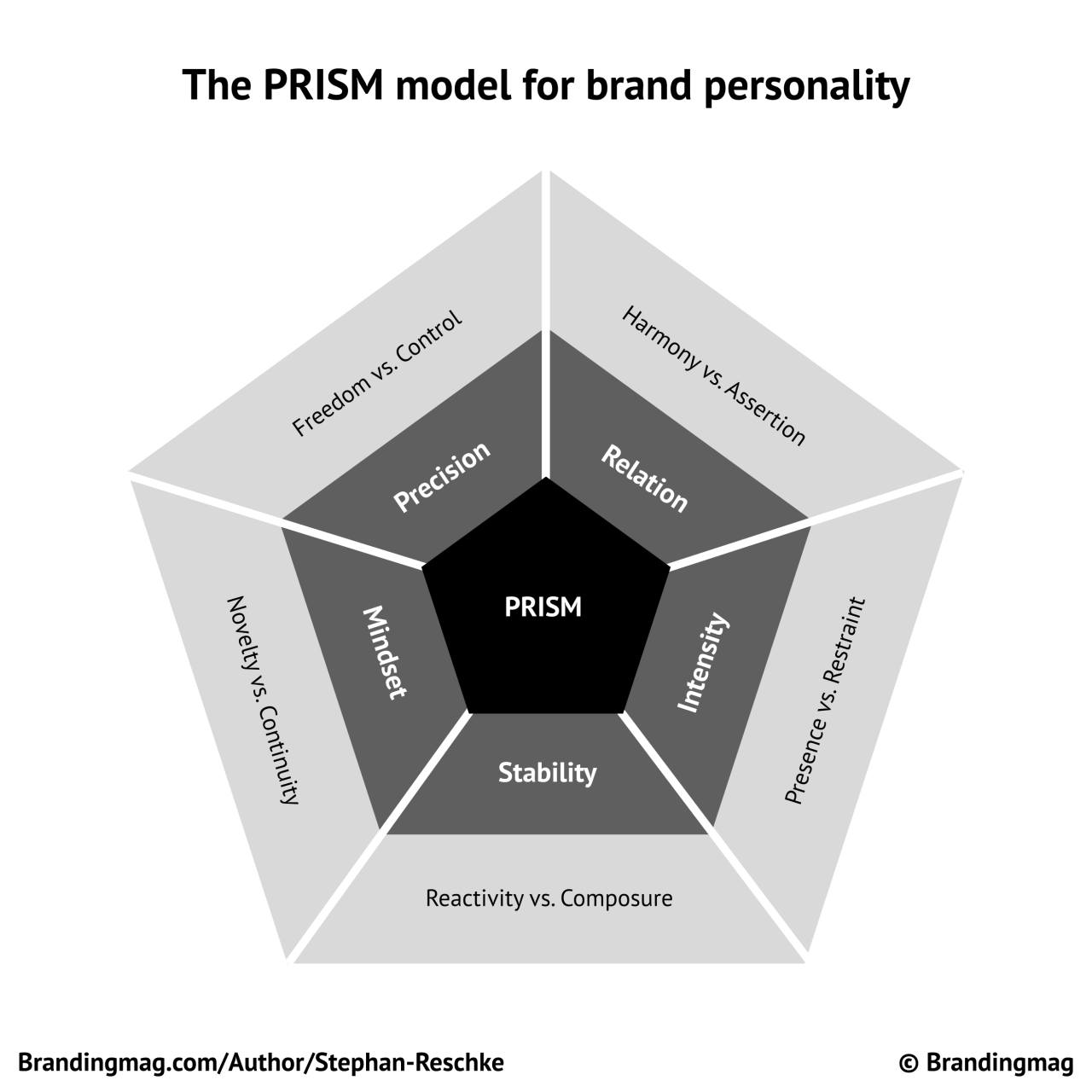
To bridge the gap between high-level brand strategy and machine execution, marketing theorists have introduced the PRISM model. Derived from the widely accepted human psychology framework known as OCEAN—or the "Big Five" personality traits—PRISM has been meticulously recalibrated for corporate and artificial identities.
Rather than relying on exclusive, broad categories like traditional archetypes, the PRISM model evaluates a brand’s digital personality across five core psychological domains:
- Openness to experience and innovation
- Conscientiousness, reliability, and precision
- Extraversion, energy, and social presence
- Agreeableness, empathy, and collaboration
- Neuroticism or emotional stability and resilience under pressure
Each of these core domains encompasses six distinct sub-characteristics, evaluated along a granular sliding scale. This multi-dimensional mapping captures the intricate nuances required to govern complex human-to-machine interactions. By translating brand values into quantifiable data points, the PRISM model provides a rigorous, non-interpretative personality guideline that AI agents can directly read, process, and execute.
Operationalizing Brand Language Over Campaigns
As voice-driven technology and conversational interfaces replace traditional visual advertising touchpoints, language has emerged as the primary medium of exchange between consumers and brands. In an agentic economy, LLMs do not consume traditional media campaigns; instead, they ingest raw data, analyze contextual parameters, and synthesize natural language responses.
Consequently, the development of a precise brand language—governed by specific vocabulary, grammatical structures, tone, and vocal delivery—has become indispensable. The PRISM model serves as the underlying engine for this linguistic framework. Rather than residing solely within static PDF brand guidelines, PRISM parameters are directly integrated into system prompts deployed within LLM infrastructure.
By embedding these parameters directly into the technological architecture, organizations empower their digital touchpoints to maintain consistent tone, adapt fluidly to individual user sentiment, and dynamically scale personalized experiences. This technological integration forms the core of Marzano’s "Experience Engine," enabling real-time, on-demand brand interactions that fulfill the criteria of true Agentic Lovemarks.
Broader Implications and Strategic Outlook
The rapid acceleration of agentic AI introduces a complex mix of professional excitement and operational anxiety across the marketing sector. Much of this industry-wide apprehension stems from the profound uncertainty surrounding how autonomous systems will alter traditional consumer journeys.
Industry analysts suggest that the most effective antidote to this uncertainty is proactive exploration, continuous experimentation, and cross-disciplinary dialogue. Frameworks like the PRISM model offer organizations a tangible methodology to comprehend and navigate a future where human consumers, autonomous AI agents, and corporate brands intersect at an unprecedented level of complexity.
As corporate adoption of generative AI architectures accelerates, the foundational work of defining machine-readable brand personalities is moving from a theoretical exercise to an urgent operational priority. The conversational era of brand building has officially begun, prompting organizations worldwide to re-engineer their digital identities for the age of intelligent agents.