
Jim Parkinson, a preeminent figure in the world of lettering art, type design, and painting, passed away on June 26, 2025, at his home in Oakland, California. He was 83 years old and had been engaged in a prolonged battle with Alzheimer’s disease. Parkinson’s profound impact on visual communication and design was evident throughout his distinguished career, spanning over five decades. He is survived by his wife, Dorothy A. Yule, a book artist and his devoted caregiver during his years of declining health.
Born in Oakland on October 23, 1941, Parkinson’s fascination with the art of letters was ignited early in life. His childhood across the street from Abraham Lincoln Paulsen, a renowned calligrapher known as the "Wizard Penman," exposed him to the intricate and often overlooked beauty of hand-drawn typography. Paulsen’s remarkable ability to pen the Gettysburg Address upside down and backward using only the numeral ‘2’ served as a powerful early inspiration for Parkinson. This formative experience instilled in him a deep appreciation for historical styles and a unique perspective that would define his artistic approach. He meticulously collected vintage lettering manuals and correspondence-school textbooks, drawing inspiration from decades-old techniques and reinterpreting them with his own distinctive flair—a hallmark of his prolific career.
Parkinson’s formal artistic education began at the California College of Arts and Crafts, where he studied design and painting, graduating in 1963. Following his studies, he relocated to Kansas City, Missouri, to join the staff artists at Hallmark Cards. Initially tasked with illustrating, Parkinson soon found his true calling when he was moved to the company’s lettering department. It was here that he discovered his innate talent for rendering any letterform by hand with exceptional skill and precision. This realization solidified his commitment to lettering as not just a professional pursuit, but a lifelong passion. After returning to Oakland, he embarked on a freelance career that would extend for more than half a century, establishing himself as a leading authority in his field.
A Prolific Career Shaping Visual Identity
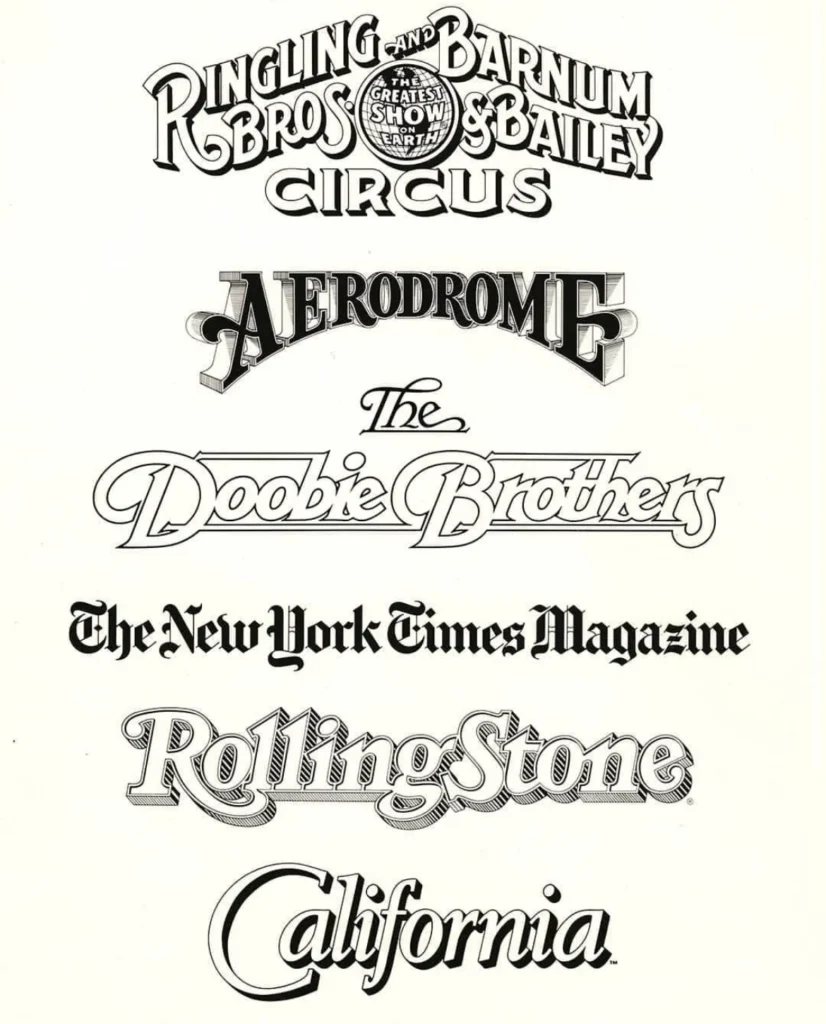
Throughout his extensive career, Jim Parkinson’s versatile mastery of lettering allowed him to tackle a vast array of projects, from intricate logos to complete typeface families. His work graced countless publications, advertisements, and branding initiatives, making his distinctive hand visible to millions worldwide. He possessed an uncanny ability to imbue every letter with character and purpose, whether it was for the bold headlines of advertisements, the iconic logos of legendary music groups like the Doobie Brothers, or the grand spectacle of the Ringling Brothers and Barnum & Bailey Circus.
Parkinson was instrumental in the creation of dozens of custom and retail typefaces, each bearing his unique touch. His nameplates for prominent magazines, including Rolling Stone, and newspapers like the Los Angeles Times, became instantly recognizable. The sheer volume and ubiquity of his work are difficult to overstate; a visit to any newsstand in the United States, and even many internationally, would likely feature Parkinson’s lettering on multiple covers. He became an indispensable resource for art directors seeking to revitalize their publication’s visual identity, often undertaking multiple redraws of titles over the years to keep them fresh and relevant.

The scope of his influence can be further illustrated by the fact that his work is held in prestigious collections, such as the Letterform Archive. A detail from one of Parkinson’s promotional posters, showcasing his hand-lettered logos for prominent entities like Ringling Bros. and Barnum & Bailey Circus, the Doobie Brothers, Rolling Stone, and The New York Times Magazine, serves as a testament to his significant contributions to the visual landscape. This collection, curated by institutions like the Letterform Archive, ensures that his legacy will be preserved and studied by future generations of designers and typographers.
Beyond Letters: A Painter of Nostalgic Americana
In his later years, Parkinson channeled his artistic energies into a personal passion: painting vintage neon signage. This endeavor transcended mere replication; Parkinson transformed these often-dilapidated relics of American commerce into evocative fine art. Drawing inspiration from road trips across the American West, his photo albums became a rich source for dozens of large-scale paintings. These artworks meticulously captured the nuances of peeling paint, fractured glass tubes, and the fading glow of neon, often appearing even more vibrant and resonant than the original photographs. His paintings offered a poignant reflection on a bygone era of roadside Americana, imbued with a sense of nostalgia and artistic reverence.
A Mentor and Friend: The Parkinson Legacy of Generosity
Stephen Coles, the author of this tribute and a long-time admirer of Parkinson’s work, first connected with him in 2004. Coles recounts Parkinson’s exceptional generosity and welcoming nature, describing how he readily opened his home and his extensive personal collection of ephemera, type books, and his own artwork to visitors. This practice of sharing his passion and knowledge fostered a vibrant community around him. Coles fondly remembers bringing friends to Parkinson’s home, witnessing their awe as he revealed flat files filled with original artwork.
Parkinson was a beloved fixture at semiregular gatherings of designers and typographers, where he consistently radiated "joy and wisdom." His approach to life and work was characterized by a "casual silliness" that, despite his immense talent, kept him grounded and accessible. He embodied the mantra of Dame Margot Fonteyn: "Take your work seriously, but never yourself." This philosophy was evident in his wry levity, which permeated his remarkably maintained website, secured in the early days of the internet, and in a video interview conducted in 2010.
Preserving a Life in Words: A Forthcoming Memoir

Jim Parkinson’s gift for storytelling was as profound as his artistic skill. It is with great anticipation that the Letterform Archive will publish his memoir in 2026. This posthumous publication offers a unique opportunity for those who did not have the privilege of meeting Parkinson to connect with him through his own words, gaining insight into his life, his creative process, and his enduring impact on the world of design. Interested parties are encouraged to sign up for notifications from the Letterform Archive to ensure they are among the first to access this significant literary contribution.
A Farewell and a Call for Remembrance
A memorial service for Jim Parkinson is planned for the fall, bringing together family, friends, and colleagues to celebrate his remarkable life and career. In lieu of flowers, the family requests that donations be made to the Alzheimer’s Association, a cause deeply personal to them given Parkinson’s struggle with the disease. The community is also invited to share their memories and tributes in the comments section of this article, further enriching the collective remembrance of this exceptional artist.
The Enduring Impact of Jim Parkinson
Jim Parkinson’s legacy extends far beyond the individual pieces he created. He was a craftsman in the truest sense, a master of his medium who elevated lettering to an art form. His dedication to historical styles, combined with his innovative spirit, set a standard for excellence that continues to inspire designers worldwide. His passing marks the end of an era, but his contributions will undoubtedly continue to shape the visual language of our world for years to come. The publication of his memoir and the preservation of his extensive body of work by institutions like the Letterform Archive will ensure that his stories, his art, and his profound influence are not forgotten. The design community mourns the loss of a true titan, a man whose hands shaped the very letters we read every day, imbuing them with a life and character that will resonate for generations.