
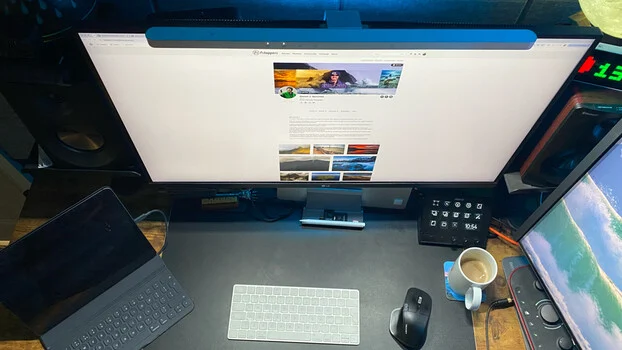

The modern desktop workspace has undergone a profound aesthetic and functional evolution over the past decade. As professionals, creatives, and remote workers spend increasingly long hours in front of computer displays, ergonomic and environmental factors have moved to the forefront of workstation design. While significant capital and consideration are routinely invested in ergonomic chairs, mechanical keyboards, and high-resolution monitors, desk illumination has historically remained an afterthought. Traditional incandescent or LED desk lamps frequently occupy valuable real estate on work surfaces, create distracting reflections on glass panels, and fail to provide uniform horizontal distribution.
To address these perennial workspace inefficiencies, Taiwanese electronics and technology multinational BenQ Corporation pioneered the monitor light bar category several years ago. By shifting the light source directly above the display and angling the illumination downward onto the desk surface, these specialized fixtures successfully eliminate screen glare while preserving precious square footage. Expanding upon this proven product architecture, BenQ introduced the iScreenBar, a specialized lighting solution engineered primarily for Apple’s line of all-in-one desktop computers. While officially designated for specific 24-inch iMac models released from 2021 onward, the hardware’s broader implications, design philosophy, and performance metrics warrant a comprehensive examination of how integrated desktop illumination is maturing.
Background Context and Evolution of Monitor Lighting
The genesis of the monitor light bar lies in the intersection of human-centric lighting design and space-constrained office architecture. Traditional desk lamps suffer from inherent geometric limitations. Positioned to the side or behind a monitor, they frequently project light vectors that bounce directly off glass or matte display panels, resulting in eye strain, reduced contrast, and cognitive fatigue. Furthermore, bulky lamp bases consume valuable desk space that could otherwise be utilized for writing pads, drawing tablets, or peripheral devices.
BenQ disrupted this traditional paradigm by developing asymmetric optical engineering. By utilizing precisely calculated internal reflectors and precision-cut LEDs, monitor light bars project a forward-leaning beam that illuminates the immediate workspace—specifically the keyboard, mouse, and documents—while keeping zero light directed toward the glass screen. Powering these units via universal serial bus standards further streamlined workspace aesthetics by eliminating the need for bulky AC adapters running down to floor outlets. Over successive product generations, BenQ refined these concepts, introducing ambient light sensors, automated color temperature adjustments, and wireless desktop controller dials. The introduction of the iScreenBar represents a targeted pivot toward ecosystem-specific hardware integration, aligning closely with the minimalist design language popularized by Apple hardware.
Design, Materials, and Aesthetic Integration
The physical architecture of the BenQ iScreenBar reflects a meticulous approach to industrial design. Constructed primarily from high-grade aluminum with a silver finish, the chassis mirrors the exact aesthetic vernacular of modern Apple hardware, particularly the color-matched bezels of contemporary iMacs. Weighing in at a fraction of a traditional desk lamp, the unit features a sleek, low-profile tubular housing that integrates seamlessly onto the top bezel of a display.
Tactile control interfaces on the iScreenBar maintain this commitment to minimalism. Eschewing protruding mechanical switches or tethered control pucks, the unit incorporates flush, touch-sensitive capacitive sensors embedded directly into the upper casing. Users can effortlessly modulate brightness levels and shift color temperatures across a spectrum ranging from cool, productivity-enhancing daylight tones to warm, relaxing evening hues. The incorporation of a dedicated macOS software utility further extends functionality, enabling users to program automated lighting presets, adjust intensity curves, and save customized profiles tailored to specific daily workflows.
Beneath the minimalist exterior lies a robust mounting mechanism designed to secure the fixture without exerting damaging pressure on delicate LCD panels. Cable management is equally considered; the discreet USB-C power cable can be routed cleanly down the rear axis of the stand, nearly disappearing from view and preserving an uncluttered workspace aesthetic.
Optical Performance and Asymmetric Engineering
At its core, a lighting accessory must be judged by the quality and distribution of its illumination. The BenQ iScreenBar utilizes advanced asymmetric optical design to ensure that light is strictly demarcated from the display surface. According to manufacturer specifications, the unit delivers a rigorous 500 lux coverage area spanning approximately 85 centimeters by 50 centimeters—an optimal footprint that covers the primary interaction zone directly in front of a standard desktop monitor.
For professional imaging specialists, photographers, and graphic designers who rely on color-calibrated displays, the complete absence of screen glare is a critical functional advantage. Traditional desk lamps often introduce stray photons that degrade perceived black levels, wash out contrast, and skew color perception. By establishing a clean optical cutoff line at the top edge of the display, the iScreenBar ensures that the monitor’s panel remains the primary and uncontaminated source of visual information.
Moreover, the gradual falloff of light prevents the creation of harsh, localized hot spots on the desk surface. This prevents the physiological fatigue associated with uneven visual fields, where the eyes must constantly adapt to high-contrast zones between a glowing monitor and an overly bright patch of desktop.
Smart Features: Video Mode and Presence Detection
Modern peripheral hardware increasingly relies on software intelligence and automated sensors to enhance user convenience. The iScreenBar incorporates two notable advanced features: Video Mode and automated presence detection.
Video Mode is engineered specifically to optimize environmental lighting during video conferencing sessions. When engaged, the central portion of the LED array powers down, leaving only the peripheral diode sources active. This intentional distribution shift prevents direct light from washing out webcam sensors or casting unflattering shadows across the user’s face during virtual meetings, resulting in a more balanced and professional video feed.
Automated presence detection leverages integrated proximity sensors to govern power states dynamically. The light automatically illuminates when a user approaches the workstation and powers down when they step away. However, field implementation reveals minor behavioral quirks inherent to passive sensing technology. Prolonged periods of static concentration—such as meticulous retouching, reading dense academic texts, or fine-tuning code—can cause the system to misinterpret stillness as an empty workstation, prompting the unit to extinguish after approximately three minutes of inactivity. While easily remedied by a minor hand gesture or a tap on the touch panel, this operational nuance highlights the ongoing challenge of balancing automation with uninterrupted creative workflows.
Ecosystem Compatibility and Market Positioning
The most significant operational talking point surrounding the BenQ iScreenBar involves its intended deployment ecosystem. BenQ officially engineered and marketed the hardware exclusively for compatible 24-inch iMac models manufactured from 2021 onward. The physical clamp and internal calibration profiles are optimized specifically for the precise bezel thickness, structural weight distribution, and thermal dissipation channels of Apple’s proprietary all-in-one desktop architecture.
Consequently, deploying the iScreenBar on alternative display hardware or third-party monitors falls outside official manufacturer specifications. While adventurous consumers utilizing non-iMac setups have reported successful physical mounting and functional utility regarding lighting output, touch controls, and glare reduction, the lack of official cross-platform support underscores the growing trend of hyper-targeted accessory design. Manufacturers are increasingly abandoning universal compatibility in favor of bespoke integrations that extract maximum aesthetic and functional harmony from specific hardware ecosystems.
Priced at an MSRP of $189, the iScreenBar occupies the premium tier of the desktop accessory market. Budget-conscious consumers seeking rudimentary keyboard illumination can readily source generic USB LED strips or inexpensive clamp lamps for a fraction of the cost. However, market analysts note that consumers purchasing hardware at this price point are investing in a holistic workspace philosophy rather than mere photon emission. The valuation encompasses the proprietary optical engineering, premium aluminum metallurgy, software integration, automated sensor arrays, and space-saving ergonomic architecture.
Broader Industry Implications and Future Outlook
The trajectory of the BenQ iScreenBar offers a revealing glimpse into the future of ergonomic office accessories. As remote and hybrid work models solidify their permanence within the global corporate structure, the home office has transitioned from a temporary makeshift setup into a permanent, highly curated architectural space. Workers are increasingly willing to invest in premium, integrated hardware that bridges the gap between commercial office productivity tools and interior design aesthetics.
Furthermore, the rise of ecosystem-specific peripherals reflects a broader maturation of the consumer electronics market. Just as specialized docks, mounts, and charging stations are tailored to specific laptop and tablet geometries, lighting infrastructure is now being engineered to harmonize with the physical contours of industry-standard displays.
As optical technologies continue to advance, future iterations of monitor-mounted lighting systems will likely incorporate more sophisticated machine learning algorithms to adapt color temperatures dynamically based on circadian rhythms, ambient room conditions, and specific software application profiles. Until then, products like the iScreenBar demonstrate that even mature product categories can be successfully reinvented through rigorous industrial design, advanced optical physics, and a steadfast commitment to decluttering the modern workspace.