
Artificial intelligence has rapidly transitioned from an experimental novelty into an integrated component of daily life for millions of consumers worldwide. As the technology matures, public perception surrounding AI assistants, chatbots, and automated tools is undergoing a profound transformation. A newly published report by Snapchat, titled Navigating the Age of AI, sheds light on these evolving attitudes. Based on a comprehensive survey of over 4,200 AI users conducted in partnership with research firms Ipsos and WPP, the findings offer a detailed look at how everyday consumers, creators, and marketers interact with artificial intelligence, where they place their trust, and where boundaries continue to be drawn.
The research highlights a significant normalization of AI in routine tasks. According to the data, 48% of surveyed consumers now utilize artificial intelligence on a daily basis. Furthermore, 50% of content creators and marketing professionals identify AI as a core, indispensable part of their regular workflow. These figures underscore a broader cultural shift: artificial intelligence is no longer viewed merely as a futuristic concept or an isolated productivity hack, but rather as an accessible, trusted partner capable of guiding decision-making and shaping interpersonal communication.
The Evolution of AI Adoption and Everyday Integration
To understand the current state of consumer trust in artificial intelligence, it is helpful to examine the timeline of how conversational technology has integrated into mainstream digital platforms. Over the past five years, generative AI has evolved from closed-environment research models into accessible consumer-facing applications embedded directly into social media networks, messaging apps, and operating systems.
In the early phases of generative AI adoption, users primarily experimented with novelty tasks—generating humorous images, writing short poems, or testing the limits of text-based models. However, the introduction of integrated conversational assistants by major technology companies shifted consumer habits. Platforms like Snapchat integrated proprietary AI chatbots directly into user interfaces, normalizing real-time interactions with synthetic assistants.
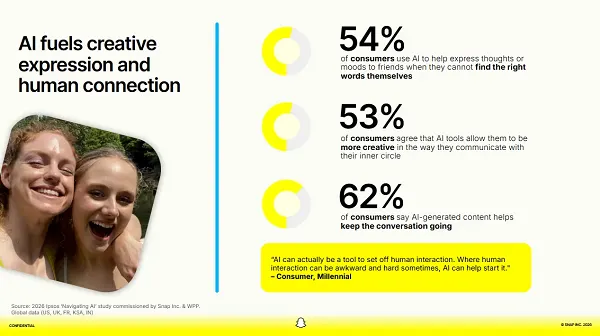
As users became accustomed to these features, reliance on AI expanded from entertainment to functional utility. The latest data from Snapchat indicates that 62% of AI users actively rely on these tools to help maintain conversations, manage thoughts, and structure ideas. This trend points to a growing psychological comfort with artificial intelligence acting as an intermediate sounding board for human expression.
Social Dynamics, Creativity, and the Judgment-Free Zone
One of the most striking findings in the Snapchat report is the degree to which younger demographics—particularly Snapchatters—integrate AI into their social lives. The data reveals that Snapchat users are 2.2 times more likely to agree that artificial intelligence positively contributes to their social well-being, and 1.6 times more likely to leverage AI tools when planning real-world activities with friends.
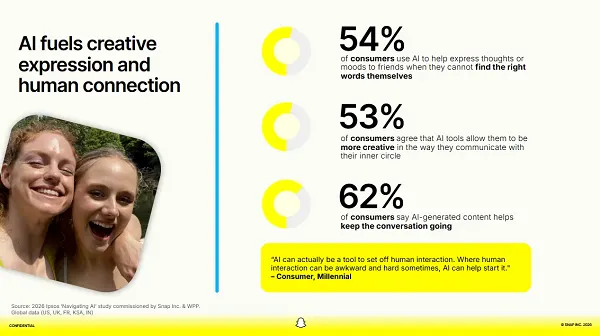
This integration is largely driven by the perceived safety of interacting with a non-human entity. Over 80% of respondents described artificial intelligence as friendly and collaborative. More notably, 74% of users view AI as a judgment-free space. For many individuals, chatbots serve as private coaches, allowing users to articulate complex feelings, draft difficult messages, or rehearse challenging conversations before sharing them with human peers.
Industry analysts point out that this psychological safety net is a primary driver of retention for consumer-facing AI tools. By removing the fear of social repercussion or embarrassment, AI assistants provide a frictionless environment for emotional exploration and brainstorming.
The Paradox of Privacy and the Value Exchange
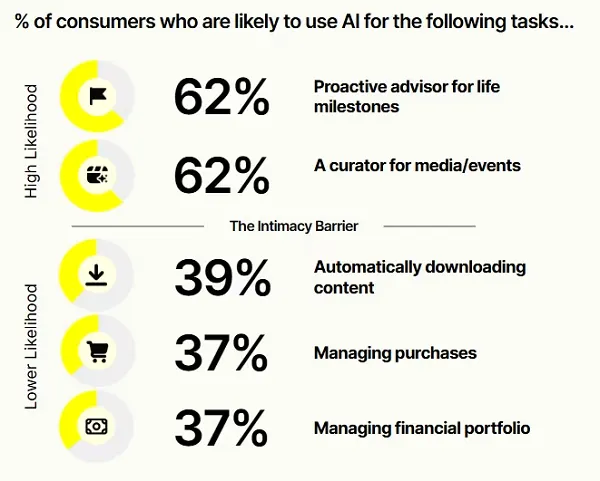
Despite the growing reliance on AI for personal communication and creative tasks, clear boundaries remain regarding sensitive applications. The Snapchat report indicates that consumers still harbor significant reservations about utilizing artificial intelligence to manage personal finances, handle sensitive administrative tasks, or complete commercial purchases.
Yet, the report challenges traditional assumptions about absolute data privacy in the digital age, framing privacy not as a static right, but as a dynamic sliding scale. According to the findings, modern consumers rarely ask whether a specific tool or platform is entirely private; instead, they weigh privacy against utility, asking whether the immediate value provided by the service is worth the data surrendered.
"Consumers aren’t asking, ‘Is this private?’ They’re asking, ‘Is this worth it?’" the report states. "The reality is that users will willingly trade data for personalized AI experiences when the immediate value is obvious. But that value exchange has boundaries."
This perspective reflects a decades-long trajectory observed across the digital economy, where users routinely exchange personal data for free or low-cost software utility. However, this philosophical stance creates a notable internal contradiction within consumer sentiment regarding advertising and automated content.
The Duality of Consumer Sentiment: Utility Versus Intrusiveness
While users embrace AI as a conversational aid and creative partner, their enthusiasm drops significantly when artificial intelligence is deployed for commercial targeting and automated content creation. The Snapchat report highlights a profound dichotomy in how people perceive synthetic technology depending on its application.
Specifically, 70% of consumers reported finding personal data usage in hyper-personalized AI advertisements to be intrusive. Additionally, 56% of respondents considered 100% AI-generated content to be soulless or lacking genuine human connection.
This creates a complex challenge for brands, marketers, and platform operators. Consumers are increasingly comfortable engaging with AI chatbots for personal guidance and creative brainstorming, yet they express aversion toward transparently automated marketing efforts and synthetic advertising campaigns that rely on their personal data profiles. The data suggests that while users value AI as an inward-facing tool for self-improvement and private dialogue, they remain skeptical of outward-facing commercial mechanisms that utilize the same underlying technology.
Industry Implications and Future Outlook
The findings from Snapchat’s report carry broad implications for the technology sector, digital advertisers, and regulatory bodies monitoring consumer privacy. As artificial intelligence becomes deeply entrenched in social infrastructure, platforms must navigate the delicate balance between personalization and perceived intrusion.
For businesses and marketers, the challenge lies in deploying AI tools that offer undeniable utility without triggering consumer skepticism over data collection. Legitimizing data collection as a fair trade-off for software functionality has been a cornerstone of the social media business model for nearly twenty years. However, as public awareness of data privacy grows—bolstered by legislative frameworks such as the European Union’s General Data Protection Regulation (GDPR) and various state-level privacy laws in the United States—consumers are increasingly vocal about the boundaries of that trade-off.
Experts analyzing the report suggest that future success in AI integration will depend heavily on transparency and user control. Platforms that empower users to clearly define how their data is used—and offer robust opt-out mechanisms for commercial targeting—are more likely to maintain long-term trust. Conversely, platforms that overreach in utilizing personal data for hyper-personalized ads risk alienating users who otherwise enjoy the conversational and creative benefits of AI assistants.
Ultimately, Snapchat’s findings illustrate a society in transition. Consumers are rapidly adopting artificial intelligence as a trusted confidant, a creative muse, and an organizational aide in their everyday lives. Yet, this adoption is tempered by a healthy skepticism regarding commercial exploitation and the erosion of human authenticity. As the technology continues to evolve, the ability of developers and platforms to respect these psychological and privacy boundaries will determine the sustainable future of human-AI collaboration.