
Meta Platforms is confronting a high-stakes balancing act as consumer adoption of its flagship artificial intelligence agent, Muse, accelerates alongside skyrocketing infrastructure costs. During the company’s Q3 earnings call, Meta leadership unveiled crucial metrics regarding the app’s trajectory, shedding light on user growth, commercial monetization pathways, and the mounting financial and regulatory pressures facing the tech giant as it maneuvers to capture a dominant share of the generative AI market.
While initial download figures and transaction volumes indicate strong early consumer demand, looming hurdles—including retention drop-offs, severe privacy vulnerabilities, and unprecedented capital expenditures—illustrate the complex road ahead for CEO Mark Zuckerberg’s ambitions.
The Launch and Early Trajectory of Meta Muse
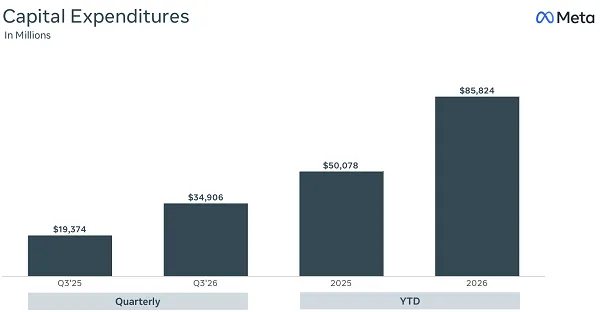
Launched last month to users in the United States and Canada, Muse represents Meta’s most ambitious attempt to date to commercialize its massive investments in artificial intelligence infrastructure. For years, Wall Street and industry analysts have scrutinized Meta’s heavy capital outlays, which are projected to approach hundreds of billions—and potentially trillions cumulatively—over the long term. With investors demanding a clear return on these outlays, Muse is envisioned as the primary vehicle to translate computational infrastructure into tangible revenue streams.
According to data shared by Zuckerberg during the Q3 earnings presentation, Muse has achieved more than 10 million downloads since its debut. The application has proven exceptionally popular on mobile distribution platforms, holding the top spot in the Apple App Store on nearly a daily basis since its release.
"Growth continues to be strong, and we have been the number one app in the App Store almost every day," Zuckerberg told analysts and investors during the call. "Engagement and retention are also off to a strong start. About 25% of people who have set up Muse use it on any given day."
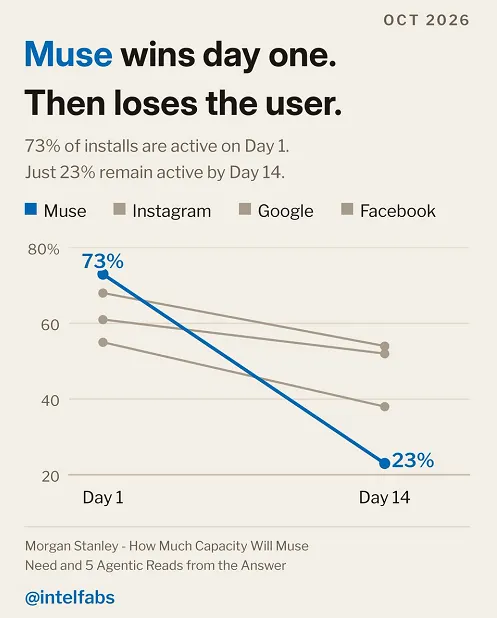
Despite these enthusiastic opening figures, independent third-party analytics paint a more nuanced picture of user engagement over time. Data compiled by market intelligence firm Sensor Tower and highlighted by industry analysts on social media indicates that while initial curiosity is high, daily active usage and user retention for Muse experience a significant decline roughly two weeks post-download.
This retention curve is not entirely unique to Meta; historical data across the generative AI landscape shows that conversational agents and standalone utility chatbots frequently suffer from sharp drop-offs in daily engagement after the initial novelty wears off. However, the plateauing of retention poses a strategic challenge for Meta, given the astronomical financial capital tied to the platform’s long-term viability.
Monetization Through Commerce: The Power of AI-Driven Shopping
To justify its sweeping AI expenditures, Meta is relying heavily on transactional commerce to establish a direct pathway to profitability. Rather than relying solely on subscription models or traditional advertising, Muse is being engineered as an intelligent concierge capable of driving direct-to-consumer sales, allowing Meta to capture a percentage of transactions facilitated within the ecosystem.
Zuckerberg revealed that shopping has emerged as the most prominent use case for the platform, with more than 25% of active Muse users leveraging the AI agent to scout for deals, compare products, and complete purchases. Furthermore, the average transaction size facilitated through Muse is reported to be robust, exceeding $200 per purchase.
This surge in commercial activity has placed unexpected demands on Meta’s financial technology partners. Zuckerberg highlighted the unprecedented volume of transactions coursing through the platform, noting that external infrastructure partners had to rapidly adapt to handle the scale.
"Plaid told us they hadn’t seen activity like they’re seeing with their connector on any other service before," Zuckerberg stated. "And in the first week, we had to work with Stripe to raise credit limits since the volumes were above what any of us expected."
Industry observers note that if Meta can successfully cement Muse as a trusted transactional intermediary, it could disrupt traditional e-commerce search funnels. By streamlining the path from product discovery to checkout via conversational AI, Meta creates a closed-loop economic ecosystem that complements its existing advertising empire across Facebook, Instagram, and WhatsApp.
Privacy Controversies and Security Vulnerabilities Cast a Shadow
While commercial metrics provide an optimistic narrative for investors, Meta’s broader regulatory and cybersecurity landscape remains fraught with peril. The company’s push into hyper-personalized, data-intensive AI agents coincides with intense scrutiny regarding its data collection practices and user privacy protections.
Just days prior to the Q3 earnings disclosures, a New Mexico judge ordered Meta to pay a staggering $25 billion in fines following a jury verdict finding that the company had systematically misled consumers regarding the privacy and security of their personal data. This monumental legal blow underscores the deep skepticism regulators and legal systems hold toward major tech platforms handling sensitive user information.
Compounding these regulatory challenges, specific security flaws within the Muse application itself have drawn sharp criticism from cybersecurity researchers. Prominent tech publication Ars Technica reported that a security group successfully extracted extensive logs of user queries and personal disclosures simply by utilizing basic exploration techniques within the app’s interface.
These revelations strike at the core of consumer trust, which is vital for an AI agent designed to manage financial transactions, credit information, and personal shopping habits. In response to mounting concerns, Zuckerberg announced that Meta is actively developing a specialized security architecture known as the "Muse Confidential VM" (Virtual Machine) to fortify data isolation and protect user conversations from unauthorized access.
Nevertheless, privacy and data security advocacy groups argue that winning back consumer confidence will require more than technical patches, especially as Meta targets a scale of billions of users globally.
The Vision for the Future: The "Muse Network" and Hardware Integration
Looking beyond standalone chat and shopping assistance, Meta’s long-term roadmap for Muse involves a fundamental shift toward an interconnected agent ecosystem. Zuckerberg outlined plans to evolve Muse from a solitary assistant into a collaborative, decentralized network of autonomous agents.
"Building what I refer to as the Muse network is making it so that Muse is not just a kind of single-player game where you have your Muse, but making it so that your Muses can work with your friends and your families," Zuckerberg explained. "And if you want to buy something, it’s not just navigating to that business’ website. It’s talking to their agent. I think that getting that all to work well together is going to unlock tremendous value at scale."
This network architecture envisions a future where individual user agents communicate directly with corporate AI representatives to negotiate purchases, coordinate schedules, and optimize everyday tasks autonomously. The concept bears conceptual similarities to previous exploratory initiatives by Meta regarding automated bots within its social applications, though the Muse network is explicitly tailored to utility, task automation, and commerce.
Furthermore, Meta is preparing to expand the availability of Muse beyond mobile screens and web interfaces. Zuckerberg confirmed that Muse integration is scheduled to arrive on Meta’s smart glasses lineup in November, marking a significant step toward ambient, wearable artificial intelligence. Bringing the agent to hardware devices aligns with Meta’s broader strategic pivot toward augmented and mixed reality, positioning the AI assistant as a persistent, multimodal companion in the physical world.
Financial Realities and Strategic Implications
As Meta navigates the complex rollout of Muse, financial analysts continue to weigh the immense capital expenditure against short-term revenue generation. With infrastructure spending projected to remain at historic highs, the pressure on Meta’s product teams to deliver scalable monetization channels has never been greater.
The early commercial success of Muse’s shopping features offers a vital glimmer of hope for investors looking for tangible financial returns on AI investments. However, the combination of declining retention rates, acute cybersecurity scrutiny, and historic regulatory fines illustrates that the path to widespread, sustainable adoption is fraught with significant execution risks.
As the platform prepares for its upcoming hardware integration on Meta glasses and the eventual deployment of the inter-agent Muse network, the coming quarters will prove critical. Meta must successfully prove that its AI agent can transition from a high-growth novelty into a secure, indispensable utility capable of generating sustainable long-term revenue in an increasingly competitive technological landscape.