
The landscape of professional audio equipment has long been dominated by established industry leaders such as DJI and Rode, leaving little room for newcomers unless they offer a significant technological leap or multi-device utility. Entering this competitive arena, the Insta360 Mic Pro positions itself as a robust alternative for content creators, videographers, and journalists operating across diverse production environments. Rather than relying solely on brand recognition or incremental upgrades, the system introduces a blend of high-end specifications—including 32-bit float recording, multi-pattern microphone arrays, and innovative E-Ink transmitter displays—aimed at bridging the gap between studio-quality sound and field-ready durability.
Background and Market Context
Over the past five years, the market for 2.4 GHz wireless microphone systems has expanded rapidly, driven by the surge in solo content creation, vlogging, and mobile journalism. Manufacturers have continually iterated on form factor, battery life, and digital signal processing to eliminate the audio gremlins that historically plagued wireless transmission. While companies like Rode with the Wireless PRO and DJI with the Mic 2 have set high benchmarks for reliability and sonic clarity, workflow fragmentation remains a persistent challenge for creators who constantly switch between dedicated mirrorless cameras, smartphones, laptops, and action cameras.
Insta360’s strategic entry into this vertical is not an isolated experiment but part of a broader ecosystem expansion. Known primarily for action and 360-degree cameras, the company has increasingly focused on the holistic creator workflow. By engineering a microphone system that interfaces natively with select Insta360 hardware without requiring an intermediary receiver, the brand seeks to streamline audio-visual synchronization and minimize gear footprint. This approach directly addresses the operational bottlenecks faced by mobile creators who require rapid deployment and minimal cabling.
Design Innovations: The E-Ink Display and Hardware Versatility
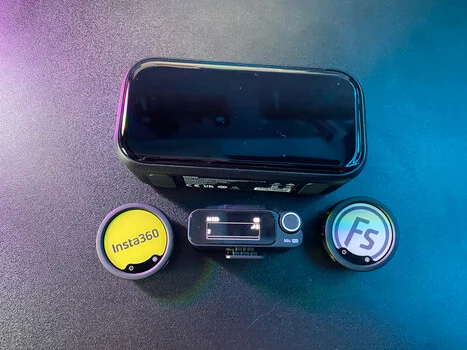
One of the most notable design divergences in the Insta360 Mic Pro is the integration of customisable E-Ink displays on the transmitters. Traditional wireless microphone systems rely on standard LCD or OLED panels, which provide real-time battery and connection status but continuously draw power to keep text or meters illuminated. By adopting Electronic Ink technology, Insta360 has engineered a display that only consumes electrical current when the visual state changes.
Beyond power efficiency, the E-Ink interface offers practical advantages in multi-person interview scenarios or fast-paced documentary shoots. Creators can personalize each transmitter with specific text, icons, or identifiers via the companion Insta360 mobile application. This eliminates the guesswork often associated with dual-transmitter setups, allowing producers to identify at a glance which microphone is assigned to a specific subject without navigating menu trees or inspecting receiver pairing logs.
The physical architecture of the system extends further into multi-role functionality. Rather than serving strictly as a conventional clip-on lavalier microphone for talking-head videos, the Mic Pro transmitters can operate as standalone field recorders, function as a compact shotgun microphone replacement in constrained spaces, or connect seamlessly via digital or analog outputs to computers and smartphones. The included charging case provides secure housing for the transmitters and receiver; however, ergonomic reviews highlight a minor oversight: the absence of dedicated internal compartments for auxiliary cables and magnetic windshields, requiring users to store accessories separately in their transport bags.
Audio Engineering and Signal Processing Capabilities
At the core of any professional audio apparatus is fidelity and dynamic range management. The Insta360 Mic Pro supports 32-bit float recording, a critical feature for field recordists operating in acoustically unpredictable environments. By capturing a vastly wider dynamic range, 32-bit float technology prevents clipping caused by sudden, loud sound spikes while preserving quiet dialogue from disappearing into the noise floor. This provides a crucial safety net for solo operators who cannot constantly monitor audio levels during live takes.
Acoustic testing of the microphone capsule reveals a clean frequency response, though initial monitoring indicates a characteristically mid-heavy profile. While this profile aids in vocal intelligibility, audio professionals will likely apply minor equalization (EQ) adjustments in post-production to achieve a completely neutral soundstage. Once equalized, the Mic Pro performs on par with established high-end broadcast systems, delivering crisp and articulate speech reproduction.
A standout engineering feature is the triple-microphone array housed within each transmitter. Unlike standard omnidirectional lavaliers, the Mic Pro allows users to toggle between multiple pickup patterns, including Cardioid, Figure-8, Omnidirectional, and a specialized Voice Focus mode. This array grants the system exceptional adaptability, enabling it to transition effortlessly from personal body-worn recording to boundary miking, table discussions, or targeted directional capture.
Environmental Noise Cancellation and Real-World Performance
Outdoor production presents persistent acoustic obstacles, from heavy wind shear and vehicular traffic to ambient crowd noise. The Mic Pro addresses these challenges through a dual-tier artificial intelligence (AI) noise-cancellation algorithm, offering weak and strong suppression modes. Industry evaluations of noise-cancellation algorithms often highlight a common flaw: over-processed vocal delivery that sounds hollow or metallic. Insta360’s processing successfully suppresses background soundscapes while preserving the natural timbre of the human voice, making it a viable tool for live-action documentary and vlog production.
Range and Transmission Reliability
Wireless transmission stability remains a critical performance metric for 2.4 GHz radio frequency (RF) equipment. Insta360 officially rates the Mic Pro for a maximum line-of-sight range of up to 400 meters. However, real-world deployment across various operational scenarios demonstrates that environmental obstacles and user positioning significantly impact signal integrity.
During field testing, signal dropouts occurred when the transmitting unit was positioned directly behind the subject’s body relative to the receiver. This phenomenon, caused by human tissue attenuating the 2.4 GHz signal, is common across the wireless microphone industry rather than a defect unique to Insta360. Creators shooting landscape video, walking away from stationary cameras, or operating in congested urban RF environments are advised to treat the 400-meter specification as an optimal laboratory metric rather than a guarantee in obstructed field conditions.
Ecosystem Integration and Workflow Implications
The broader implications of the Insta360 Mic Pro lie in its cross-platform compatibility and ecosystem synergy. For independent creators utilizing diverse capture devices—ranging from mirrorless cameras and mobile phones to action cams and laptops—the ability to deploy a single microphone system across all hardware classes reduces equipment expenditure and learning curves.
Furthermore, the direct-to-camera pairing capability with compatible Insta360 hardware eliminates the physical clutter of a receiver unit, embodying the minimalist ethos increasingly demanded by mobile journalists and travel videographers. By reducing the physical barriers to setup, the hardware allows creators to direct their focus toward content generation rather than technical troubleshooting.
Summary of Technical Merits and Areas for Refinement
Industry analysis of the Insta360 Mic Pro highlights a comprehensive set of strengths balanced by minor operational compromises:
Strengths:
- Exceptional versatility across multiple deployment modes (clip-on, handheld, shotgun alternative, direct-to-device).
- Power-efficient E-Ink customizable displays for effortless transmitter identification.
- Robust 32-bit float recording capacity for dynamic range protection.
- Advanced AI noise cancellation that preserves natural vocal tone.
- Native integration with select Insta360 camera hardware, minimizing gear footprint.
Areas for Improvement:
- The charging case lacks dedicated internal storage for connection cables and acoustic windshields.
- The default frequency response leans mid-heavy, requiring post-production equalization for a neutral profile.
- Real-world wireless range is subject to body-blocking attenuation, typical of 2.4 GHz systems operating beyond optimal line-of-sight conditions.
Conclusion and Industry Outlook
The introduction of the Insta360 Mic Pro signals a maturing hardware strategy by a company expanding beyond imaging into comprehensive audio-visual production tools. By pairing advanced features such as 32-bit float recording and multi-pattern microphone arrays with practical innovations like E-Ink displays and targeted AI noise cancellation, Insta360 has delivered a compelling contender in a saturated market. While minor ergonomic refinements to the charging case and a flatter default frequency response would enhance the out-of-the-box experience, the system’s overall flexibility, reliable audio fidelity, and cross-platform compatibility make it a significant and highly recommended addition to the modern creator’s toolkit.