
Authorities in Baltimore County, Maryland, have arrested two men following an investigation into an unlicensed business venture that utilized exotic animals as props for high-end photography. Vernon Crowfey III, 32, the owner of a photography business branded as “Photogeniks,” and his associate, Jayden Evans, owner of “Tarzan Exoticz,” face a series of criminal charges ranging from the illegal possession of primates to felony animal cruelty. The arrests conclude a multi-agency investigation triggered by social media footage showing the men using fire and endangered species in a public parking structure, raising significant concerns regarding public safety and animal welfare.
The case has drawn national attention to the intersection of social media aesthetics and the illegal exotic animal trade. Investigators allege that Crowfey and Evans collaborated to provide clients with “personalized photoshoots” featuring a variety of animals, including a spider monkey, a lemur, and various reptiles. According to charging documents, the operation lacked the necessary state and federal permits required to exhibit or house these animals, particularly primates, which are strictly regulated under Maryland law.
The Towson Town Center Incident and Investigative Launch
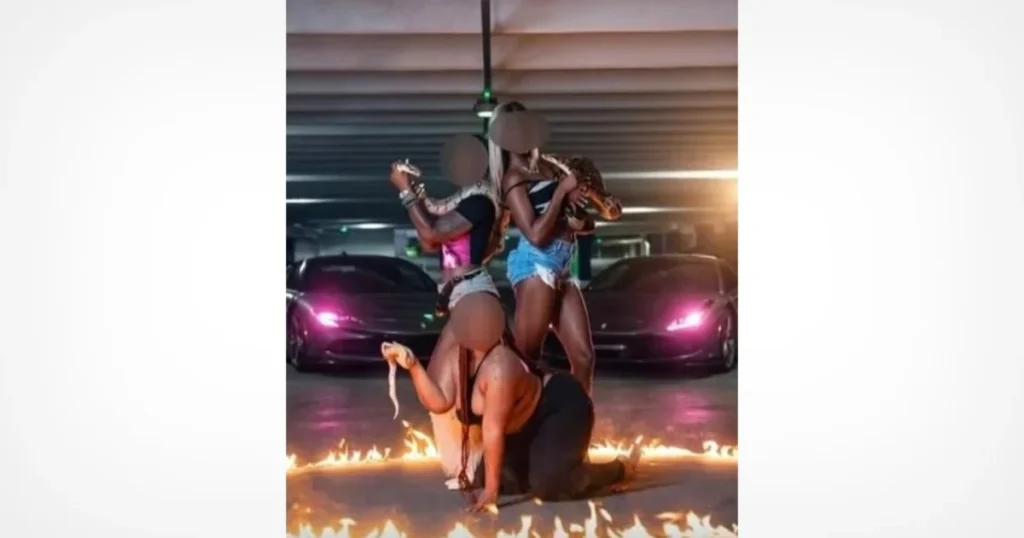
The investigation began in earnest following an incident on June 13 at the Towson Town Center, a prominent shopping mall in Baltimore County. Evidence gathered by investigators, including video footage and photographs circulated on Instagram and Facebook, depicted a photoshoot taking place within one of the mall’s parking garages. The visuals showed three women posing with a spider monkey, a lemur, and snakes.
What particularly alarmed authorities was the use of pyrotechnics in the shoot. Footage showed sections of the concrete garage floor being set ablaze with lighter fluid to create a dramatic background effect while the animals and models were in close proximity to the flames. This activity, conducted without the knowledge or consent of the mall’s corporate management, posed a fire hazard and physical risk to the animals and participants alike.
Following the social media discovery, Baltimore County police and animal control officers began monitoring the digital footprints of “Photogeniks” and “Tarzan Exoticz.” They found a sophisticated marketing operation where Crowfey was marketed as the primary photographer and Evans was presented as the expert animal handler. The pair’s website and social media profiles offered tiered packages for clients wishing to pose with "exotic wildlife," a practice that is heavily restricted in the state of Maryland due to both conservation and safety concerns.
Undercover Operation and Subsequent Arrests
To secure evidence of the illegal commercial activity, an undercover officer from the Baltimore County Police Department contacted the duo in July. The officer arranged for a photoshoot involving a lemur and a spider monkey, scheduled for July 16 at a location in Parkville. This sting operation allowed investigators to confirm that Crowfey and Evans were actively soliciting business and transporting the animals across the county for profit without the required licensure.
Following the sting, authorities executed a search warrant at Evans’ residence in Maryland. During the search, officers discovered a menagerie of animals kept in conditions that investigators described as inadequate. The inventory of seized animals included snakes, lizards, rabbits, a tarantula, and the two primates featured in the social media advertisements.
The arrests of Crowfey and Evans were processed shortly after the search. Both men now face several misdemeanor counts related to the illegal possession and exhibition of animals, along with a felony charge connected to the specific circumstances of the June 13 photoshoot at the mall.
Animal Neglect and Health Concerns
The most harrowing details of the case emerged from the charging documents regarding the physical state of the animals. Upon inspection by animal welfare experts, it was determined that the spider monkey and the lemur had not received proper veterinary care. Most distressingly, investigators noted that the spider monkey suffered from a severe physical condition where its "spinal cord was fully exposed through its fur."
The presence of such an injury suggests a prolonged period of neglect or trauma, which stands in stark contrast to the "exotic" and "luxurious" image the duo attempted to project online. The Maryland Zoo was called upon to assist in the recovery effort, taking custody of several animals, including the spider monkey. While a spokesperson for the Maryland Zoo declined to provide specific updates on the health of the animals due to the ongoing legal proceedings, they confirmed that the animals are receiving professional diagnostic care and stabilization.
The condition of the monkey highlights a common issue in the illegal exotic pet trade: the inability of private owners to meet the complex nutritional, social, and medical needs of primates. Spider monkeys, native to the tropical forests of Central and South America, are highly social animals that require specialized diets and vast spaces to thrive. When kept in domestic or commercial "prop" environments, they often suffer from metabolic bone disease, self-mutilation, and extreme psychological stress.
Legal Framework: Maryland’s Prohibition on Primates
The charges against Crowfey and Evans are grounded in Maryland’s strict statutes regarding the private ownership of certain wildlife. Under Maryland law, specifically the state’s criminal code regarding animal welfare and public safety, it is illegal for private citizens to possess nonhuman primates. The law states: “A person may not import into the state, offer for sale, trade, barter, possess, breed, or exchange a live nonhuman primate.”
This prohibition is not only an animal welfare measure but also a public safety initiative. Primates can carry zoonotic diseases, including Herpes B virus, tuberculosis, and various parasites, which can be transmitted to humans. Furthermore, as primates reach sexual maturity, they often become unpredictable and aggressive, posing a physical threat to their owners and the public.
By operating a business that utilized these animals for public photoshoots, the defendants are alleged to have bypassed the Maryland Department of Natural Resources (DNR) and the U.S. Department of Agriculture (USDA), the latter of which oversees the Animal Welfare Act (AWA). Any business exhibiting warm-blooded animals to the public must be licensed by the USDA, a process that involves regular inspections and strict adherence to housing and care standards.
Defense and Statements from the Accused
In the wake of the arrests, Vernon Crowfey III has defended the actions of the pair, specifically addressing the incident at the Towson Town Center. Speaking to local news outlets, Crowfey claimed that they had received verbal permission from a mall security guard to conduct the shoot.
“We spoke with the security at the mall as well,” Crowfey told CBS News Baltimore. “We explained to him that we was gonna have the fire flame photo shoot. He told us basically just be out before the mall closed.”
Crowfey further minimized the danger of the fire used during the session, describing the location as an "empty parking lot, with no civilians, full of concrete." He expressed skepticism that lighter fluid on concrete posed a significant threat, stating, “I don’t think I’ve ever seen a parking lot be set on fire with lighter fluid.”
However, legal experts note that verbal permission from a third-party security contractor does not supersede state laws regarding animal possession or local fire codes. Furthermore, mall management has not corroborated Crowfey’s claim of permission, and the presence of flammable liquids in a public structure generally requires a permit from the fire marshal, regardless of the time of day or the presence of bystanders.
Broader Implications of "Aesthetic" Animal Exploitation
The case of "Photogeniks" and "Tarzan Exoticz" reflects a growing trend in the digital age where exotic animals are treated as status symbols or "props" for social media engagement. Platforms like Instagram and TikTok have seen a rise in "animal influencers" and photographers who use rare species to gain followers and premium clients.
Animal rights organizations, such as PETA and the Humane Society of the United States, have long warned that this trend fuels the illegal wildlife trade. When animals are used for photoshoots, they are often subjected to loud noises, bright lights, and improper handling, all of which trigger a fight-or-flight response. In the case of infants, such as baby monkeys or lemurs, they are frequently taken from their mothers prematurely to make them more "tractable" for photos, leading to lifelong psychological trauma.
This incident serves as a reminder to the public and the creative industry that the use of exotic animals in media requires rigorous adherence to ethical standards and legal mandates. For photographers, the allure of a unique portfolio piece must be weighed against the legal consequences of participating in the unlicensed exhibition of protected species.
Timeline of Events
- June 13: Crowfey and Evans conduct a photoshoot at the Towson Town Center parking garage featuring fire, a spider monkey, a lemur, and snakes.
- Late June: Social media footage of the shoot alerts Baltimore County authorities, initiating an investigation.
- July: Investigators monitor the "Photogeniks" and "Tarzan Exoticz" digital platforms, identifying the business model and animal inventory.
- July 16: An undercover officer successfully schedules a shoot with the suspects in Parkville, confirming the illegal commercial activity.
- Late July: A search warrant is executed at Evans’ residence. Multiple animals are seized, and the suspects are taken into custody.
- Present: The Maryland Zoo continues to provide care for the seized animals as the Baltimore County State’s Attorney’s Office prepares the case for trial.
Conclusion and Future Proceedings
As the legal process moves forward, Vernon Crowfey III and Jayden Evans remain under scrutiny for their roles in what authorities describe as a reckless and illegal enterprise. The felony charges reflect the severity of the alleged animal cruelty, particularly the condition of the spider monkey.
The case underscores the importance of state-level prohibitions on exotic animal ownership and the role of digital monitoring in modern law enforcement. For the animals involved, the transition from being "props" in a parking garage to receiving professional care at the Maryland Zoo represents a significant shift in their quality of life, though the long-term health of the spider monkey remains a concern for veterinarians.
The Baltimore County Police Department has encouraged the public to report any unlicensed exhibition of exotic animals, emphasizing that the safety of the community and the welfare of the animals are inextricably linked. The trial will likely serve as a benchmark for how Maryland handles the intersection of animal rights and the commercial photography industry in the years to come.