
The digital advertising landscape is undergoing a profound transformation, driven largely by rapid advancements in machine learning and artificial intelligence. In recent disclosures regarding its evolving ad delivery systems, Meta has provided fresh insights into how its heavy investments in AI infrastructure are yielding tangible dividends for digital marketers. By refining its ad ranking algorithms and expanding its data analysis capabilities, the tech giant is empowering brands to achieve substantially higher engagement, more efficient targeting, and robust conversion growth across its flagship platforms, including Facebook and Instagram.
According to data released by the company, these algorithmic upgrades are no longer just theoretical improvements; they are translating directly into increased return on ad spend (ROAS) for commercial partners worldwide. As brands increasingly navigate a crowded digital marketplace, Meta’s integration of AI-driven ranking systems is setting a new benchmark for programmatic ad performance, demonstrating how advanced predictive modeling can effectively bridge the gap between consumers and relevant commercial offerings.
Quantifying the Impact: Q2 Performance Metrics and Algorithmic Success
The tangible success of Meta’s updated infrastructure is best illustrated through hard performance metrics. In a comprehensive corporate announcement, the company revealed that incremental enhancements deployed to its core ads ranking system during the second quarter delivered a remarkable 8.3% increase in ad clicks alongside a 15.7% uplift in total conversions specifically on Facebook.
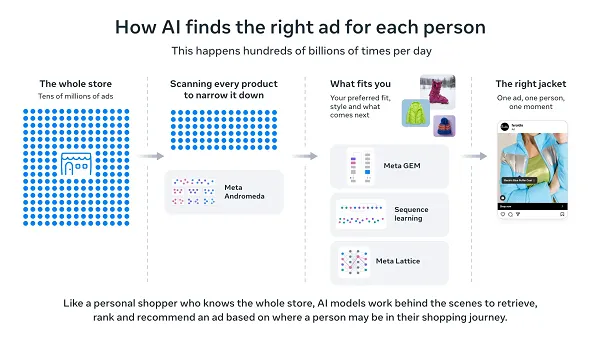
These figures highlight a fundamental shift in how advertisements are matched with end-users. Historically, ad delivery relied heavily on broad demographic parameters and static behavioral indicators. Today, Meta’s AI-powered ranking engine evaluates thousands of signals in real time, predicting user intent with unprecedented precision. By analyzing a broader spectrum of user actions and product interactions at a much faster rate, the system can dynamically adjust ad delivery to favor placements that are statistically most likely to result in meaningful consumer action.
Beyond the baseline performance metrics of traditional ad placements, Meta has also reported substantial breakthroughs regarding its proprietary AI business assistant. As the company gradually broadens accessibility to this conversational tool for advertisers globally, early deployment data indicates that the assistant is already generating a 5% increase in conversions while maintaining identical cost efficiency parameters. This suggests that automated creative optimization and conversational guidance are successfully lowering the barrier to entry for small and medium-sized enterprises (SMEs) looking to optimize their marketing funnels without extensive human oversight.
The Rise of Partnership Ads and In-Stream Commerce
In tandem with algorithmic ranking improvements, Meta’s ecosystem is benefiting from structural shifts in how brands collaborate with content creators. Partnership ads—formerly known as branded content ads—have emerged as a dominant growth engine within the platform’s advertising suite.
Recent figures released by the company indicate that partnership ads experienced a staggering year-over-year growth rate exceeding 97% during the third quarter. This explosive momentum has propelled the format past a monumental milestone, officially surpassing a $15 billion annual revenue run-rate. The convergence of authentic creator-led content with Meta’s sophisticated AI targeting infrastructure has created a powerful synergy, allowing brands to leverage the trust and engagement of established influencers while benefiting from hyper-targeted programmatic distribution.
Looking toward the immediate future, Meta is aggressively expanding its commercial capabilities by developing native checkout options directly within its conversational AI agents. Notable projects, including the integration of shopping pathways within specialized agents like Muse, are designed to shorten the distance between discovery and purchase. By embedding frictionless checkout features directly into in-stream AI interactions, Meta is positioning its ecosystem not merely as a discovery channel, but as a comprehensive end-to-end commerce destination.
Infrastructure Investments and the Foundation of Modern Ad Delivery
To fully contextualize these performance gains, one must examine the monumental financial and technical commitments Meta has made to upgrade its foundational data infrastructure. Over the past several years, the company has channeled hundreds of billions of dollars into capital expenditures aimed at expanding its global data center footprint and bolstering its high-performance computing clusters.
These extensive data center projects are the invisible engine powering Meta’s modern advertising apparatus. Modern AI models require vast computational capacity to process monumental volumes of audience response data simultaneously. By scaling its infrastructure, Meta has equipped its systems with the unprecedented capacity to ingest, analyze, and identify subtle behavioral trends that correlate with positive ad responses.
This expansive data processing capacity operates in tandem with advanced neural networks to streamline the ad auction and delivery process. Where legacy systems required days or weeks to optimize campaign delivery based on human adjustments, contemporary AI systems execute micro-optimizations continuously, ensuring that marketing budgets are allocated toward the highest-performing audience segments in real time.
Industry Analysis and Strategic Implications for Digital Marketers

From a macroeconomic and strategic perspective, Meta’s recent disclosures signal a broader industry trend: the transition from manual campaign management to autonomous, AI-driven marketing ecosystems. For digital marketers and brand strategists, these developments carry profound implications.
First, the democratization of campaign optimization through tools like Meta’s AI business assistant means that technical expertise is increasingly being superseded by strategic creativity. As algorithms become more adept at finding the right audience autonomously, the primary differentiator for campaign success shifts toward asset quality, narrative strength, and creative diversity. Advertisers are encouraged to provide a wide array of creative variations—such as text, imagery, and video assets—allowing Meta’s AI to mix and match elements dynamically to suit individual user preferences.
Second, the explosive growth of partnership ads underscores the diminishing returns of hyper-polished corporate advertising in favor of authentic, peer-validated content. Consumers increasingly rely on creator endorsements and community validation before making purchasing decisions. By equipping brands with the technical capability to scale these collaborative campaigns programmatically, Meta has bridged the gap between influencer marketing and traditional performance marketing.
Finally, the impending rollout of in-stream checkout features via AI agents points toward a frictionless future for social commerce. As conversational interfaces become primary touchpoints for customer service and product discovery, the ability to complete transactions natively within a chat interface will significantly reduce cart abandonment rates. For retailers, integrating inventory systems with Meta’s emerging AI infrastructure will likely become a critical operational priority in the coming quarters.
Conclusion: A New Era of Algorithmic Efficiency
Meta’s continuous refinement of its ad delivery systems demonstrates the transformative power of artificial intelligence when backed by world-class computational infrastructure. By achieving measurable double-digit gains in engagement and conversions, alongside record-breaking adoption of creator-led formats, the company has reinforced its position as an indispensable partner for global advertisers. As these AI enhancements mature and expand to include advanced conversational commerce capabilities, the digital advertising paradigm will continue to evolve, rewarding brands that embrace algorithmic agility and automated optimization.