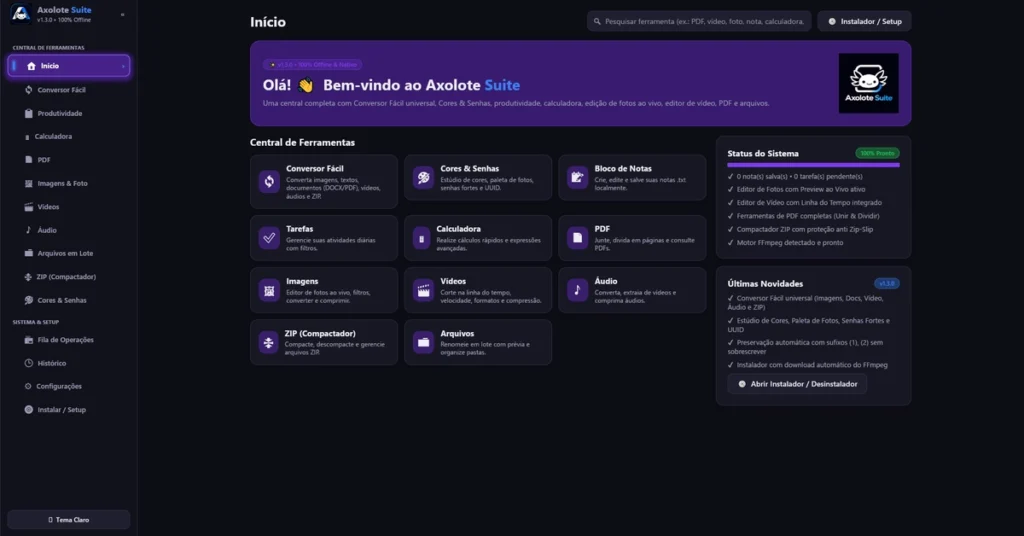

The landscape of desktop application development is undergoing a silent yet profound transformation, driven largely by the pursuit of memory safety, high performance, and cross-platform native rendering. Within this technological shift, open-source initiatives frequently rely on community-driven development to refine their ecosystems before reaching stable commercial or general-purpose readiness. The Axolote Suite project represents a notable entry into this methodology, having officially opened its doors to developers and Windows power users for a comprehensive testing and feedback phase. Built entirely on the Rust programming language and the Iced GUI library, the toolkit is positioned as a modern, performance-oriented utility designed to streamline complex desktop workflows.
By inviting the broader technical community to test the software, report bugs, and suggest feature enhancements, the creators of Axolote Suite are leveraging crowdsourced quality assurance to accelerate the platform’s maturity. As software development demands increasingly transparent collaboration, projects of this nature provide a valuable lens into how modern open-source ecosystems are constructed from the ground up.
Main Facts and Technical Foundation
At its core, Axolote Suite leverages a modern technology stack chosen specifically for its emphasis on safety, concurrency, and rapid execution. The choice of Rust—a systems programming language sponsored heavily for its memory-safety guarantees without garbage collection—places the toolkit in a growing category of next-generation developer tools. Rust has consistently topped developer satisfaction surveys for years, lauded for its strict compiler checks that eliminate entire classes of concurrency bugs and memory leaks common in C and C++ applications.
Complementing Rust is Iced, a cross-platform Graphical User Interface (GUI) library inspired by Elm. Iced utilizes a reactive programming model based on the Elm Architecture, which cleanly separates state, user interaction, and rendering logic. This architectural choice allows developers to build fluid, responsive interfaces that perform efficiently across multiple operating systems while maintaining a clean codebase. For Windows users, the combination of Rust and Iced translates to a lightweight application footprint, rapid startup times, and minimal resource consumption compared to electron-based alternatives that bundle heavy Chromium runtimes.
The development team has made the project repository publicly accessible via GitHub, accompanied by an official project website detailing installation guides and feature breakdowns. The current release phase is explicitly experimental, intended to stress-test the application architecture under real-world usage scenarios across diverse Windows environments, ranging from modern development workstations to legacy configurations.
Chronology and Development Milestones
The journey of Axolote Suite reflects the typical trajectory of modern, independent open-source software initiatives. While formal public testing commenced with the recent release announcement, the conceptualization and foundational coding of the toolkit began months prior within closed developer circles.
In the early stages, the primary objective was establishing a stable core architecture using Rust’s robust asynchronous runtime and modular crate system. Once the foundational business logic and data-handling layers were established, the development shifted toward UI integration using the Iced framework. This phase required substantial optimization to ensure that the reactive user interface remained responsive during heavy computational tasks handled by the underlying Rust backend.
Following internal alpha testing, the project reached a milestone where external validation became critical. The transition to a public beta testing phase marked the opening of the GitHub repository for issue tracking, pull requests, and community discussions. By shifting the project into the public sphere, the maintainers established a structured pipeline for continuous integration, allowing automated testing suites to evaluate contributions submitted by early adopters. This milestone represents a pivotal pivot from isolated creation to collaborative refinement, setting the stage for subsequent iterations leading up to a stable version 1.0 release.
Ecosystem Context and Supporting Data
The launch of Axolote Suite arrives amid broader structural shifts within the software development industry. According to recent developer ecosystem surveys conducted by organizations such as Stack Overflow and the Rust Foundation, adoption rates for memory-safe languages have surged by over 40% among enterprise and independent developers alike over the past five years. Concurrently, dissatisfaction with resource-heavy desktop frameworks has driven a renaissance in native and lightweight UI toolkits.
Data regarding desktop application performance highlights that users increasingly favor software with minimal RAM overhead and instantaneous responsiveness. Traditional cross-platform frameworks, while accelerating time-to-market, frequently draw criticism for high memory utilization. By utilizing Rust and Iced, Axolote Suite addresses these performance concerns directly. Benchmarks of comparable applications built with similar stacks indicate up to a 60% reduction in memory consumption and significantly faster compilation and execution metrics compared to web-tech wrappers.
Furthermore, the open-source community has demonstrated an increasing appetite for toolkits that prioritize modularity. Developers are actively seeking extensible frameworks that allow them to plug custom modules into existing workflows without being locked into proprietary ecosystems. Axolote Suite’s architecture is intentionally modular, allowing developers to inspect, modify, or extend individual components of the toolkit to suit specialized operational requirements.
Official Responses and Community Engagement
While independent open-source projects rarely boast corporate press offices, the communication channels established by the Axolote Suite maintainers convey a clear, collaborative ethos. In public statements accompanying the release, the project leads emphasized that community input is not merely welcome, but essential to the toolkit’s trajectory.
"We are looking for developers and Windows users willing to try Axolote Suite, an open-source toolkit built with Rust and Iced," the maintainers stated in their initial call for participation. "I’d love to hear your honest feedback! Try the application, explore its features, report bugs, and share your suggestions for improvement. Your opinion can help make the project better!"
This direct, transparent outreach model has resonated well within developer communities on platforms like GitHub and specialized programming forums. Early responses from the technical community have praised the clean organization of the repository and the documentation provided on the official website. Contributors have already begun filing initial bug reports and feature requests, focusing primarily on UI scaling across high-DPI Windows displays and edge-case error handling within the backend processing logic.
Broader Impact and Industry Implications
The implications of projects like Axolote Suite extend beyond the immediate utility of the application itself, offering insights into the future of independent software development. As tooling matures, the barrier to entry for building high-performance, enterprise-grade desktop software continues to lower for small teams and solo developers.
By championing open-source principles, Axolote Suite fosters a collaborative environment where developers can hone their skills in Rust and reactive GUI design while contributing to a shared utility. For the Windows ecosystem, the influx of lightweight, native-feeling applications developed in modern systems languages helps diversify the software landscape, offering alternatives to monolithic commercial suites.
As the testing phase progresses, the success of Axolote Suite will likely depend on the sustained engagement of its user base and the responsiveness of its maintainers in addressing reported issues. Should the project maintain its current momentum, it stands to serve as a compelling case study in how community-driven feedback loops can successfully guide an open-source utility from conceptual infancy to polished maturity. Developers and Windows users interested in participating can access the source code and documentation directly via the project’s official GitHub repository and website, contributing their insights to shape the next chapter of the toolkit’s evolution.