
Technology is no longer merely a tool that human operators manipulate from the outside; it has evolved into an immersive, living environment. As artificial intelligence fundamentally reshapes digital touchpoints, commercial interactions have shifted decisively from transactional to conversational. Today’s AI-driven responses do not merely retrieve and display static information from legacy databases; they synthesize new context, generate dynamic content, and simulate intuitive reasoning. This profound shift—where communication between human consumers and corporate entities relies entirely on autonomous software intermediaries—marks one of the most significant transformations in modern marketing and brand strategy.
The Evolution of Brand Connection: From Lovemarks to Agentic Interfaces
To contextualize this paradigm shift, industry leaders are looking toward new frameworks for emotional engagement. Arjan Kapteijns, former CEO of Saatchi & Saatchi Netherlands, recently re-examined Kevin Roberts’ foundational marketing concept of a "Lovemark" for an era infused with artificial intelligence. In this emerging reality, earning consumer love and respect is no longer directed exclusively at human-led corporations or physical storefronts, but rather at the digital agents that represent them. Kapteijns introduced the concept of "Agentic Lovemarks," providing marketers with a strategic playbook for brand-building in a machine-orchestrated future. While the fundamental objective remains unchanged—securing a profound emotional connection—the orchestration of that connection has been handed over to algorithms and large language models.
The marriage of psychology and marketing traces its roots back to the early 20th century, when industry pioneers first leveraged emotional catalysts to bind consumers to specific goods and services. What began as persuasive advertising eventually evolved into a sophisticated understanding that deep psychological affinity drives long-term customer loyalty and repeat transactions. However, for humans to forge an emotional bond with an inanimate product or service, that offering had to take on human characteristics.
This psychological necessity gave rise to the 12-brand archetype model introduced 25 years ago by Margaret Mark and Carol Pearson in their seminal work, The Hero and the Outlaw. Their human-inspired personality framework transformed modern brand building by providing a rational guide to seemingly irrational consumer behavior. It defined how a brand should look, speak, and behave to establish a holistic personality that audiences could recognize, trust, and ultimately love.
The Obsolescence of Traditional Frameworks in the Autonomous Economy
Despite their decades-long utility, traditional archetype frameworks are proving increasingly insufficient for the demands of the agentic economy. This inadequacy stems not from a flaw in their core psychological premises, but from a lack of technical specificity and operational instruction. Previously, brand custodians maintained tight, centralized control over how their identity was experienced across digital and physical touchpoints. They could manually curate visual assets, draft explicit tone-of-living guidelines, and rigidly oversee marketing campaigns.
Today, brands are forced—both directly and indirectly—to surrender that granular control to autonomous AI systems. Because software agents now operate and communicate independently on behalf of both human users and corporate entities, the nature of human-to-brand relationships has become intensely individualized and conversational.

Thomas Marzano, former global brand leader at Philips and ASML, addresses this operational reality in his strategic manifesto, Brand Constitutions: The Legible-Lovable Standard for Building Equity in an Agentic Economy. Marzano posits that in an agentic economy, brands must satisfy two critical criteria simultaneously: they must be legible to AI systems so that algorithms can accurately recognize and recommend them, and they must be lovable to human users to remain relevant during decision-making processes. He defines this dual requirement as the Legible-Lovable Law.
Under this law, brand equity requires technical reinforcement. An artificial intelligence can only champion a brand if it can read, parse, and accurately render that brand’s underlying identity. Without strict system-level instructions governing verbal tone, vocabulary, pitch, and response behavior, AI-driven interactions default to generic, sterile outputs stripped of emotional resonance.
Introducing the PRISM Model: A Psychological Framework for AI
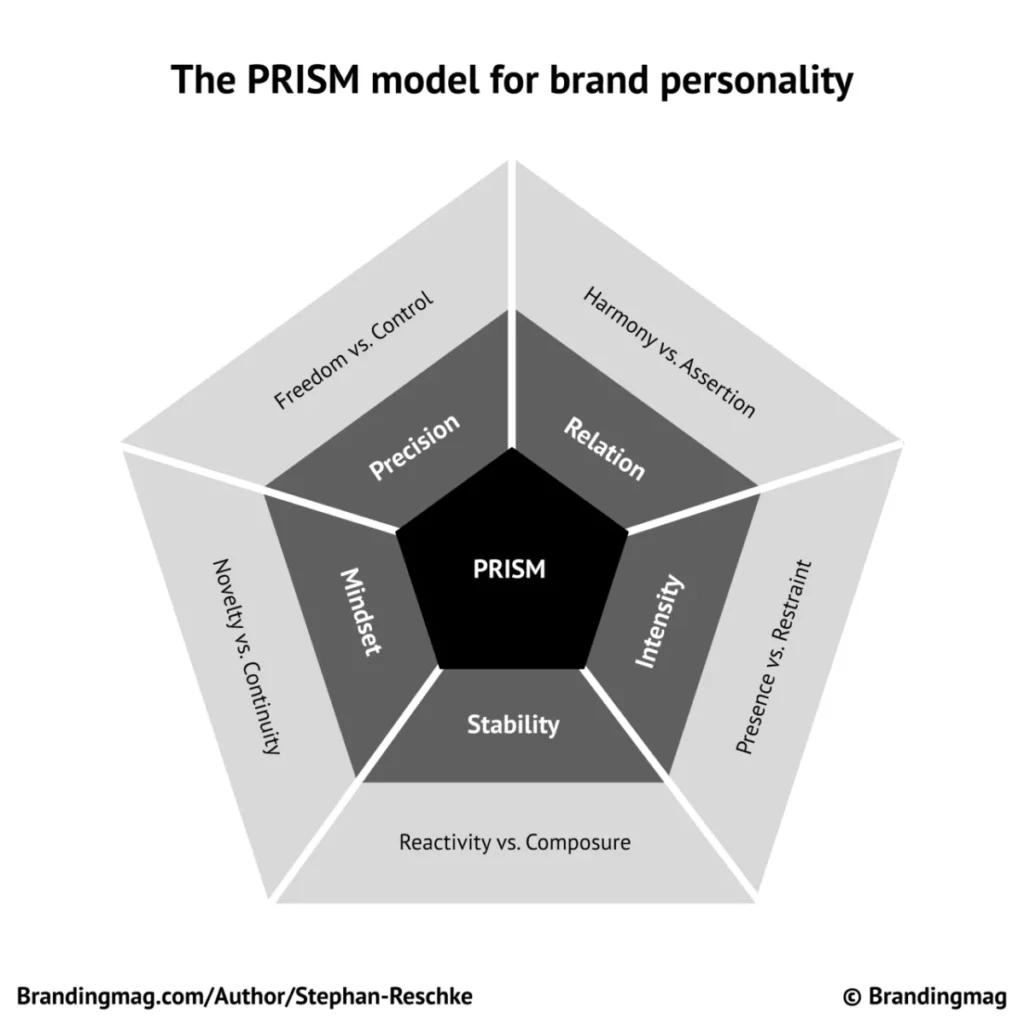
To bridge the gap between abstract brand concepts and rigorous machine execution, industry experts have formulated a novel diagnostic tool: the PRISM model. Adapted from the widely accepted "Big Five" human psychology model—commonly known as OCEAN (Openness, Conscientiousness, Extraversion, Agreeableness, and Neuroticism)—the PRISM model translates psychological traits into a structured digital architecture tailored specifically for corporate entities.
Unlike the rigid categories of traditional archetypes, the PRISM model evaluates a brand’s digital personality across five core behavioral domains:
- Perspective and Openness: Measures the brand’s intellectual curiosity, adaptability, and willingness to embrace novel concepts or disruptive industry trends.
- Responsibility and Conscientiousness: Evaluates the brand’s reliability, structural rigor, ethical transparency, and commitment to precision.
- Expression and Extraversion: Determines the brand’s social energy, assertiveness, vibrancy, and conversational dominance within digital spaces.
- Empathy and Agreeableness: Assesses the brand’s warmth, cooperative nature, customer-centric consideration, and conflict-resolution style.
- Stability and Emotional Resilience: Quantifies the brand’s composure, consistency under pressure, and steadfastness amid market volatility.
Rather than boxing an organization into a single, restrictive persona, each of the five PRISM domains comprises six distinct behavioral characteristics evaluated along a sliding scale. This multi-layered granularity provides the exact nuance required to govern complex, unpredictable, human-to-AI-to-brand interactions.
Operationalizing Brand Language Over Marketing Campaigns
As voice-activated computing and conversational interfaces supplant traditional visual displays, spoken and written language has instantly become the primary interface between humans and brands. Consumers are increasingly hearing and speaking to technology rather than clicking through graphical user interfaces. Consequently, organizations must transition their strategic focus from episodic advertising campaigns to continuous, systematic brand language.
Large language models do not consume traditional creative campaigns; they ingest massive volumes of data, analyze real-time context, and generate bespoke textual and verbal content on demand. This technical reality makes a formalized brand language indispensable.
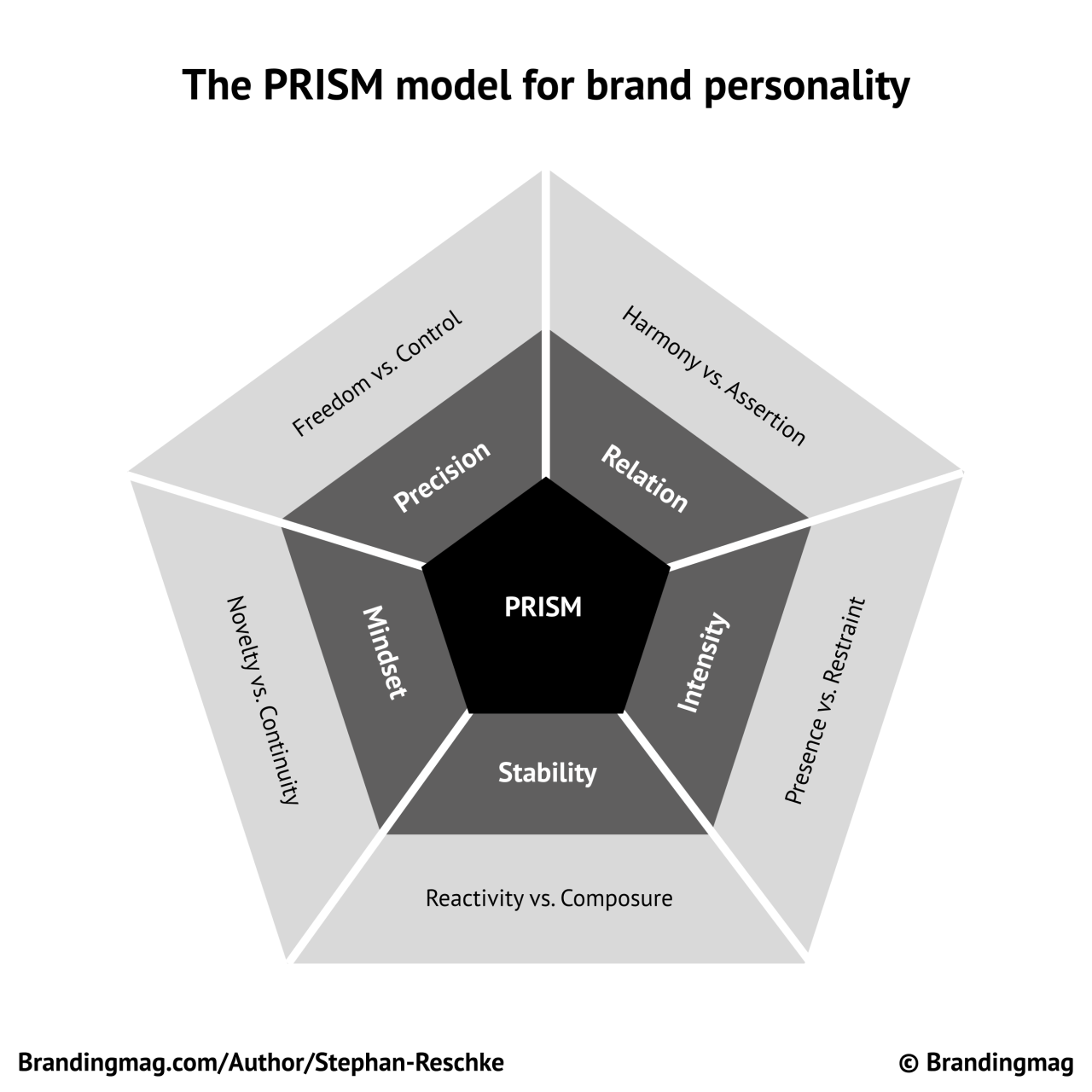
The PRISM model functions as the foundational lens through which a digital personality manifests into language. Rather than confining tone-of-voice guidelines to static PDF documents stored on corporate intranets, brand custodians can translate PRISM parameters directly into system prompts and fine-tuning datasets for LLMs. Once integrated into a company’s core web infrastructure and application programming interfaces (APIs), this dynamic framework empowers organizations to:
- Maintain absolute consistency in verbal delivery across thousands of simultaneous, individualized AI chat sessions.
- Dynamically adjust conversational empathy and assertiveness based on the emotional state of the human user.
- Ensure automated recommendations by third-party AI agents accurately reflect the brand’s core values and strategic positioning.
By embedding these psychological parameters directly into the machine’s operational layer, brands create a functional "digital soul." This technical execution forms a vital pillar of Marzano’s hypothesized "Experience Engine"—an automated system capable of delivering real-time, on-demand brand experiences orchestrated entirely by artificial intelligence.
Strategic Implications for the Future of Commerce
The rapid transition toward an agentic economy generates understandable anxiety among marketing professionals accustomed to traditional media channels. However, corporate history demonstrates that systemic technological disruption consistently rewards organizations that systematically analyze and adapt to new operating environments rather than resisting structural evolution.
The introduction of the PRISM model and the broader discourse surrounding Agentic Lovemarks signal a mature acknowledgment that digital transformation has moved past simple cloud migration and omnichannel marketing. As autonomous software agents increasingly mediate consumer choice, the battleground for brand loyalty has shifted from the human conscious mind to the machine’s processing logic.
Organizations that successfully decode the Legible-Lovable Law and operationalize their brand personalities through rigorous, scalable frameworks like PRISM will secure a decisive competitive advantage. In an era where every consumer interaction is mediated by intelligent algorithms, the brands that thrive will not simply be those that shout the loudest, but those that machines understand most profoundly and humans love most naturally. The conversational revolution has arrived, demanding that brand architects adapt their strategies to meet the intelligent agents shaping the future of commerce.