
The release of the Peak Design Pro Tripod series marks a significant expansion in the specialized camera support market, transitioning the brand from its travel-centric roots toward a more robust, professional-grade ecosystem. This new iteration, specifically the Pro Tall model, aims to reconcile the historically opposing forces of portability and absolute stability. While the original Peak Design Travel Tripod revolutionized the industry with its "no dead space" architecture, the Pro series scales that engineering philosophy to accommodate the rigorous demands of professional landscape, wildlife, and hybrid creators. Priced at approximately AU$1,799, the Pro Tall is positioned as a premium investment for photographers who require maximum height without sacrificing the compact footprint that has become Peak Design’s hallmark.
The Evolution of Peak Design’s Support Systems
To understand the significance of the Pro Tripod, one must look at the company’s trajectory within the photography industry. Founded in 2011 following a successful Kickstarter campaign for the "Capture" clip, Peak Design spent nearly a decade refining camera carry solutions before entering the tripod market in 2019. The original Travel Tripod was a disruptive force, raising over $12 million in crowdfunding by addressing a common grievance: the wasted space inherent in traditional tripod designs.
However, the original model was not without its critics. Professional users often noted that while the Travel Tripod was unparalleled for air travel and hiking, it lacked the vibration dampening and height required for heavy telephoto lenses or tall operators. The introduction of the Pro series—comprising the Pro, Pro Lite, and Pro Tall—is a direct response to this feedback. It represents a maturation of the brand, moving beyond the "travel" niche to compete with established high-end manufacturers like Gitzo and Really Right Stuff.
Technical Specifications and Engineering Precision
The Pro Tall model is defined by its substantial physical presence. Standing at a maximum height of 197.4 cm (approximately 77.7 inches), it offers a 30% increase in elevation over its predecessor. This height is particularly critical for ergonomic shooting, allowing even photographers standing over 6 feet tall to work at eye level without fully extending the center column—a move that traditionally introduces instability.
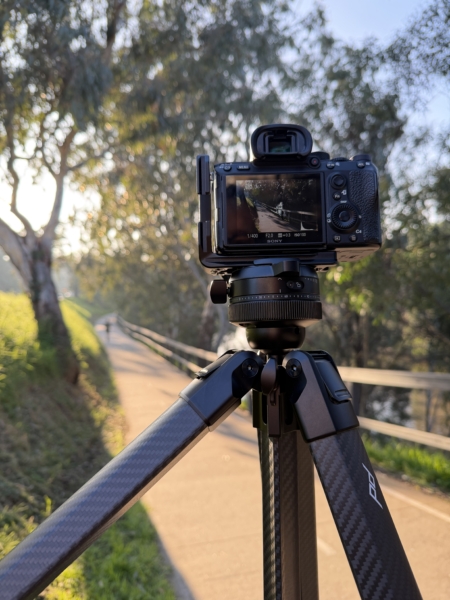
The construction utilizes 3K weave carbon fiber for the legs, a material chosen for its high strength-to-weight ratio and superior vibration-dampening properties. The metal components are crafted from 6061-T6 CNC-machined aluminum, ensuring that the joints and locking mechanisms remain precise under varying environmental conditions.

| Feature | Specification |
|---|---|
| Maximum Height | 197.4 cm (77.7 in) |
| Minimum Height | 17.3 cm (6.8 in) |
| Folded Length | 58.2 cm (22.9 in) |
| Weight | 2.04 kg (4.5 lb) |
| Load Capacity | 18.1 kg (40 lb) |
| Leg Sections | 4-section carbon fiber |
| Leg Locks | Machined aluminum flip locks |
| Head Type | Integrated Pro Ball Head with fluid panning |
| Warranty | Lifetime Guarantee |
The Pro Ball Head: A Redesign for Hybrid Workflows
One of the most significant upgrades in the Pro series is the redesigned ball head. In the original travel version, the head was optimized for size, which occasionally made fine adjustments difficult when using heavier camera bodies. The new Pro Ball Head introduces 360-degree fluid panning with an independent locking mechanism. This feature is a nod to the growing "hybrid" market—photographers who are increasingly required to capture high-quality video alongside still images.
The fluid panning allows for smooth horizontal movements, though it should be noted that for full vertical fluid motion, the company offers an optional "Tilt Mod" accessory. The quick-release system remains Arca-compatible, ensuring integration with a wide array of plates and L-brackets. A notable safety feature is the secondary lock toggle, which prevents accidental plate release—a critical safeguard when supporting equipment setups that can exceed $10,000 in value.
Structural Integrity and Real-World Performance
In field testing across varied environments—from coastal regions to urban transit—the Pro Tall demonstrates a level of rigidity that justifies its "Pro" moniker. The decision to retain flip-style leg locks rather than twist locks is a functional necessity born of the tripod’s non-circular leg profile. These locks provide a clear visual and tactile confirmation of security, a feature often preferred by professionals working in cold weather or high-pressure environments where speed is essential.

The tripod’s stability is rated for a payload of 18.1 kg (40 lb), effectively doubling the capacity of the original travel model. This allows for the use of heavy-duty setups, such as a full-frame mirrorless camera paired with a 600mm f/4 lens or a cinema rig equipped with monitors and external recorders. Even at its maximum height, the Pro Tall maintains a low center of gravity, aided by a center column hook that allows users to hang additional weight (such as a camera bag) for increased stability in high winds.
Comparative Analysis: Pro, Pro Lite, and Pro Tall
Peak Design has segmented the Pro lineup to cater to different user profiles. While the Pro Tall is the flagship for height and stability, the Pro Lite offers a more weight-conscious alternative for those who prioritize mobility without reverting to the smaller dimensions of the original Travel Tripod.
- The Pro Tall: Designed for maximum elevation and heavy gear. Ideal for studio work, architectural photography, and tall individuals.
- The Pro: The standard professional model, balancing height and weight for general-purpose professional use.
- The Pro Lite: Features a lighter build, targeted at outdoor photographers who need professional stability but are mindful of pack weight on long expeditions.
Economic Implications and Market Positioning
The AU$1,799 price point places the Peak Design Pro Tall firmly in the luxury tier of camera supports. For the casual enthusiast, this may represent an "over-engineered" solution. However, within the context of professional photography, where equipment failure can lead to lost revenue, the cost is often viewed through the lens of longevity and reliability.

The "buy well, buy once" philosophy is supported by Peak Design’s lifetime warranty. This commitment to durability is part of a broader corporate social responsibility strategy; the company is a certified B Corp and a member of 1% for the Planet. For many modern consumers, these ethical considerations add intangible value to the physical product, distinguishing the brand from competitors that may offer similar specs at a lower price point but without the same commitment to sustainability.
Potential Limitations and Areas for Improvement
Despite its high performance, the Pro Tall is not without minor drawbacks. The unique slim-fold design, while excellent for storage, means that the tripod legs do not have a standard circular diameter. This makes it incompatible with some third-party accessories, such as certain stone bags or leg wraps. Additionally, while the integrated ball head is a masterpiece of compact engineering, photographers who have a strong preference for specific specialized heads (such as gimbal heads for wildlife) will need to purchase the separate Universal Head Adapter, adding to the total cost of ownership.
Field reports have also noted that while the Arca-compatible plate works seamlessly with most gear, some oversized tripod feet on heavy telephoto lenses may require the use of the specific Peak Design plate to properly engage the safety lock. These are relatively minor friction points in an otherwise streamlined user experience, but they are factors a professional must consider before fully switching systems.

Broader Impact on the Photography Industry
The arrival of the Pro series signals a shift in how professional gear is designed. It moves away from the "bigger is better" mentality that dominated the industry for decades. By proving that a tripod can be both tall and incredibly thin when folded, Peak Design is forcing other manufacturers to reconsider their engineering priorities.
As camera sensors increase in resolution—reaching 60, 100, or even 150 megapixels—the margin for error regarding camera shake becomes non-existent. A tripod that was "stable enough" for a 20-megapixel camera a decade ago is often insufficient for today’s high-resolution sensors. The Pro Tall addresses this technological shift by providing a platform that can support the precision required for modern digital imaging.
Conclusion: A New Standard for Professional Support
The Peak Design Pro Tall Tripod is a sophisticated evolution of a design that was already highly regarded. By addressing the height and stability limitations of the original Travel Tripod, Peak Design has created a tool that bridges the gap between the portability needed for field work and the uncompromising rigidity required for professional results.

While the price remains a significant barrier to entry, the combination of premium materials, thoughtful ergonomics, and a lifetime guarantee positions the Pro Tall as a definitive solution for serious image-makers. It is not merely a travel accessory, but a core piece of professional infrastructure designed to withstand the rigors of a career in visual storytelling. For the photographer who has outgrown the limitations of entry-level supports, the Pro Tall represents the final step in the search for the perfect balance of form and function.