
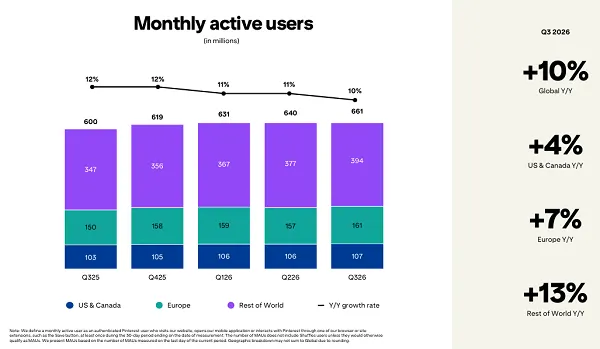
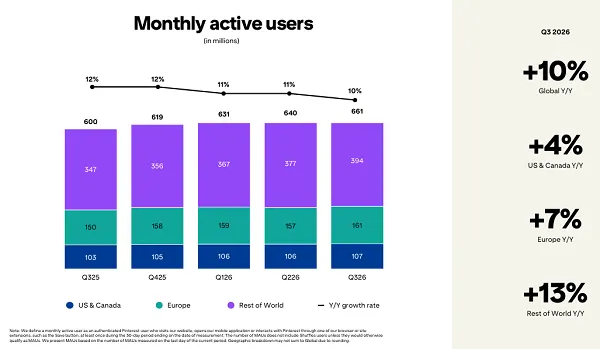
Pinterest has officially released its financial and operational performance metrics for the third quarter of 2026, revealing substantial audience expansion and steady revenue increases. Published on October 29, the Q3 2026 earnings report highlights a major milestone for the visual discovery and social commerce platform, which successfully added 21 million global monthly active users (MAUs) compared to the preceding quarter. This surge brings Pinterest’s total global monthly active user base to an impressive 661 million.
The latest financial disclosures underscore a period of strategic stabilization and technological integration for the company. As digital advertising landscapes shift toward predictive intelligence and automation, Pinterest has leaned heavily into artificial intelligence-driven targeting, refined programmatic solutions, and localized regional strategies. While the platform continues to register exceptional user acquisition figures across developing international markets, the most encouraging signal for investors in this reporting cycle is the clear resurgence of user growth within Europe—a territory that had previously experienced stagnation and minor declines throughout the preceding year.
Main Facts and Financial Performance
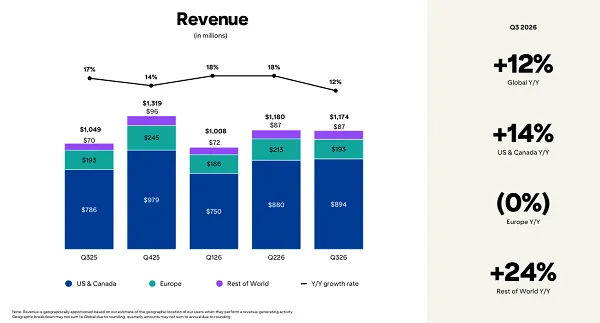
For the third quarter ending in late October 2026, Pinterest posted total revenue of $1.17 billion, translating to a 12% increase year-over-year. This top-line expansion demonstrates the company’s resilience in an increasingly competitive digital advertising ecosystem. Domestic performance remained a primary financial engine, with revenue generated in the United States and Canada growing by 14% compared to the same period in 2025.
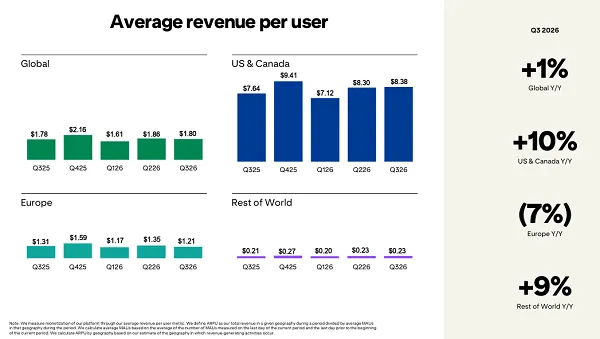
International revenue growth, however, faced distinct headwinds. European monetization was notably impacted by recent regulatory adjustments concerning cross-border digital commerce and data compliance within the European Union. Despite these regulatory frictions, the pivot toward renewed user retention and engagement in Europe remains critical. Because Pinterest generates a disproportionate share of its average revenue per user (ARPU) from Western markets compared to the Rest of the World (RoW) segment, European audience stabilization is essential for maintaining healthy profit margins.
Geographically, the vast majority of raw user acquisition continues to originate outside traditional Western strongholds. Pinterest reported that 17 million of the 21 million newly acquired users came from international territories categorized under the Rest of the World. Consequently, the platform’s demographic footprint is shifting, with Generation Z now accounting for an influential 57% of the total global audience. Engagement metrics further corroborated this youth-centric momentum; users in the United States and Canada demonstrated higher frequencies of active in-app behaviors, including granular search queries, customized board curation, and increased outbound click-through rates.
Chronology and Strategic Evolution
To fully understand Pinterest’s current market positioning, it is necessary to examine the chronological progression of its recent technological and commercial rollouts. Over the past twelve quarters, the company has methodically transformed from a passive digital scrapbook into an active, intent-driven shopping engine.
In early 2025, Pinterest initiated a comprehensive overhaul of its advertising infrastructure, heavily integrating machine learning models to improve ad relevance and content matching. By Q2 2026, these AI-driven signals began producing measurable performance improvements, laying the groundwork for the accelerated domestic growth witnessed in North America.
Building upon this technical foundation, the third quarter of 2026 marked the global rollout of Pinterest’s proprietary programmatic buying solution across all operating regions. This move was designed to streamline the media-buying process for enterprise-level advertisers, making automated campaign scaling simpler and more cost-effective. Concurrently, Pinterest expanded its ecosystem for digital creators through targeted content promotions, enabling brands to seamlessly sponsor high-performing creator Pins directly related to consumer product listings.
This creator-centric approach was further amplified by multi-channel media partnerships, including the continuation of Pinterest’s branded programming block on Roku TV, where prominent creators showcase items natively discovered within the application. Culminating this sequence of autumn updates, October 2026 saw the official launch of visual search ads. These advanced ad placements allow brands to position targeted promotions directly within active user search results and high-intent Pin close-up views, capitalizing on an environment where users execute upwards of 80 billion searches every month.
Supporting Data and Demographic Shifts
A granular analysis of the Q3 2026 data package reveals several underlying trends regarding audience composition and regional distribution:
- Total Monthly Active Users (MAUs): Reached 661 million globally, representing an increase of 21 million users quarter-over-quarter.
- Quarterly Revenue: Stood at $1.17 billion, marking a 12% year-over-year improvement.
- Regional Revenue Discrepancy: The U.S. and Canada region expanded at 14% year-over-year, outpacing international percentage growth due to European regulatory constraints on cross-border transactions.
- Audience Demographics: Generation Z represents 57% of Pinterest’s entire user base, cementing the platform’s relevance among younger digital consumers.
- Search Volume: User intent remains exceptionally high, with the platform facilitating more than 80 billion monthly searches.
- Geographic Growth Split: While 17 million new users came from the Rest of the World segment, the remaining 4 million were split across North America and a revitalized European market.
Official Responses and Strategic Intentions
Corporate communications accompanying the Q3 earnings release emphasized Pinterest’s distinct positioning within the social media and digital discovery sectors. Unlike competing platforms that prioritize maximum screen time through endless, algorithmic short-form video feeds, Pinterest has consciously marketed its utility as a bridge to real-world activities. Executive statements highlighted the platform’s unique value proposition: encouraging users to find inspiration digitally and subsequently step away from their screens to execute those ideas in the physical world.
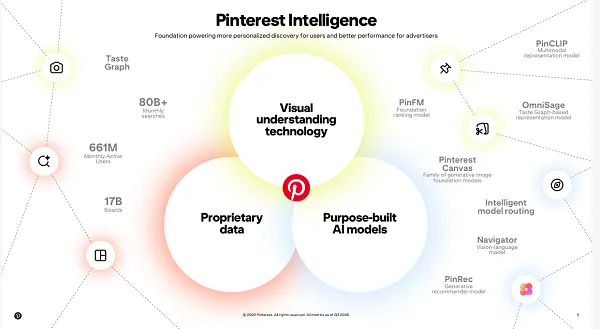
This measured strategy extends to Pinterest’s deployment of artificial intelligence. While generative AI tools have been systematically incorporated to refine ad targeting, expand search signals, and power creative features like AI Restyle, corporate leadership has deliberately avoided speculative or radical technological shifts that dilute the core discovery experience. By aligning AI capabilities strictly with user intent and product curation, Pinterest aims to preserve the utility and brand safety that advertisers prioritize.
Broader Industry Impact and Implications
The Q3 2026 results carry significant implications for the broader digital advertising and social commerce sectors. As privacy regulations tighten globally and traditional tracking mechanisms face continuous erosion, platforms that rely on first-party search intent and contextual relevance—such as Pinterest—possess a distinct competitive advantage.
However, the company’s ongoing trajectory is not without internal and external challenges. Similar to its industry peers, Pinterest is currently grappling with an influx of AI-generated content—colloquially termed "AI slop"—within user feeds. Numerous platform users have voiced concerns regarding the proliferation of synthetic, low-quality imagery crowding out authentic human curation. Because Pinterest functions fundamentally as a visual discovery engine, maintaining high aesthetic and informational standards is paramount. Industry analysts note that how Pinterest chooses to regulate or embrace synthetic media in future quarters will heavily influence user trust and retention, particularly among its core Gen Z demographic.
Looking forward, Pinterest plans to replicate the successful playbook utilized in North America across its recovering European markets and expanding international territories. By scaling its newly deployed programmatic buying solutions, deepening creator partnerships, and refining visual search monetization, the company aims to sustain its double-digit revenue growth through the end of the fiscal year and beyond.