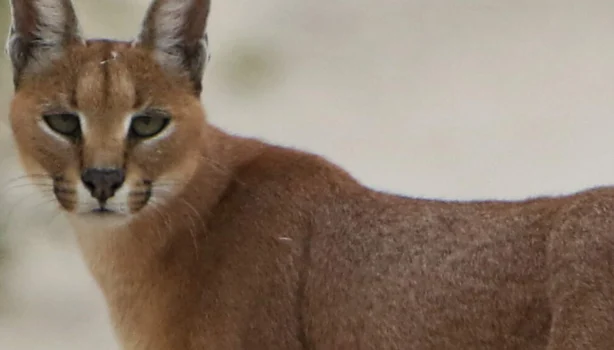

The recent activation of two camera traps in Madhya Pradesh’s Kuno National Park has provided a rare glimpse of one of India’s most elusive predators: the caracal. The footage, captured under the cover of darkness, reveals a lean, long-legged wildcat characterized by its distinctive black-tufted ears, moving stealthily through the scrubland. This sighting marks a significant moment for the Kuno landscape, which is currently the focal point of India’s ambitious cheetah reintroduction project. While the presence of the caracal—a species often described as a "ghost of the desert"—is a cause for celebration among conservationists, it also prompts a series of scientific questions regarding the stability of the population and the long-term health of the ecosystem.
The caracal (Caracal caracal schmitzi) is among the least-seen wild cats in the Indian subcontinent. Its discovery in Kuno, confirmed by reports from Mongabay India, provides a vital data point for researchers. However, wildlife experts and forest officials are maintaining a stance of cautious optimism. The record confirms the species exists within the park’s boundaries, but the scientific community warns that a solitary photographic capture is insufficient to declare the existence of a resident, breeding population.
The Scientific Nuance of a Single Sighting
Uttam Kumar Sharma, the Field Director of Kuno National Park, noted that this is the first confirmed record of the caracal during his four-year tenure at the park. In response to the discovery, the forest department has initiated a comprehensive review of historical files and previous camera trap data to determine if the species had been recorded in or around Kuno in the past. The goal is to ascertain whether this individual is a permanent resident or a transient visitor.
Shekhar Kolipaka, a prominent wildlife biologist who has specialized in caracal distribution and currently serves as a senior landscape developer at the Commonland Foundation, emphasized the need for scientific restraint. "A single camera-trap photograph confirms the presence of a caracal, but does not indicate the existence of a resident population," Kolipaka stated. He explained that young adult caracals, particularly males, are known to disperse over vast distances to establish their own territories. These journeys can take them across varied and often hostile landscapes, including rivers, agricultural fields, human settlements, and infrastructure like roads and railway lines.
According to Kolipaka, the true status of the caracal in Kuno can only be determined through continued, systematic monitoring. If the animal is photographed repeatedly in the same area over several months, it would suggest it has settled. Conversely, if it is never seen again, it was likely a "wanderer" passing through the corridor in search of a more suitable habitat or a mate.
The Role of Camera Trapping in Modern Conservation
The caracal’s shy, nocturnal nature makes it an exceptionally difficult subject for traditional field observation. Unlike larger predators like tigers or lions, which can often be tracked or spotted from vehicles in certain parks, caracals are masters of camouflage and avoidance. They typically avoid human presence and are active during the hours when visibility is lowest.
This is where camera trap technology has revolutionized wildlife biology. These motion-triggered devices allow researchers to monitor sensitive species without human interference. In the case of the caracal, where physical sightings are nearly non-existent, camera traps provide the "heavy lifting" for data collection. For many rare species in India, these digital "eyes" are the only proof of their continued survival in specific pockets of the country. The Kuno sighting underscores the importance of maintaining a high density of camera traps, especially in regions undergoing ecological restoration.
A Species on the Brink: Conservation Status and History
The caracal is currently protected under Schedule I of India’s Wildlife (Protection) Act, 1972. This is the highest level of legal protection afforded to wildlife in the country, placing it on the same legal footing as the Bengal tiger and the Asiatic elephant. While the International Union for Conservation of Nature (IUCN) lists the caracal as a species of "Least Concern" on a global scale—due to its relatively stable populations in parts of Africa and the Middle East—the Indian subspecies is in a far more precarious position.
In India, the caracal is treated as "Near Threatened" or even "Critically Endangered" in certain regional assessments. There is currently no official national population estimate, though figures of fewer than 50 individuals are frequently cited in conservation circles. However, these numbers remain largely unverified due to the lack of a formal census.
A landmark study conducted in 2020 revealed a staggering decline in the caracal’s range. The research found that the cat’s distribution in India had shrunk by approximately 96 percent compared to its estimated range prior to 1947. Historically, caracals were found across much of Northern and Central India. Today, they are largely restricted to fragmented pockets in the states of Rajasthan, Gujarat, and Madhya Pradesh. Recent sightings outside of these core areas have been rare and often incidental. For instance, a caracal was accidentally captured on tiger-monitoring cameras in Rajasthan’s Mukundra Hills, and other records have emerged from radio-collar studies near the India-Pakistan border in Jaisalmer.
Ecological Context: The Kuno Transformation
Kuno National Park has undergone significant changes over the last decade, accelerated by the arrival of cheetahs from Namibia and South Africa. The "Project Cheetah" initiative has necessitated large-scale habitat management, including the removal of invasive species, the restoration of grasslands, and the enhancement of water availability.
Field Director Uttam Kumar Sharma suggested a possible correlation between these habitat improvements and the caracal’s appearance. The restoration of the grassland-scrubland mosaic, which is the preferred habitat for both cheetahs and caracals, may be creating a more hospitable environment for smaller carnivores. Improved water management has also led to a rise in prey density, such as rodents, hares, and small birds, which form the bulk of the caracal’s diet.
Madhya Pradesh Chief Minister Mohan Yadav echoed this sentiment in a recent public statement. He argued that the cheetah project was never intended solely for the benefit of one species, but rather as a "flagship" project to protect the entire grassland ecosystem and the myriad of species that depend on it. From this perspective, the appearance of a caracal is seen as a biological indicator of a recovering landscape.
Implications and Future Outlook
The sighting in Kuno carries weight beyond mere curiosity; it has significant implications for Indian wildlife policy. For decades, India’s conservation focus has been heavily weighted toward "charismatic megafauna" like tigers and rhinos, often at the expense of "lesser" cats and grassland specialists. The caracal, which thrives in semi-arid tracts and scrub forests—landscapes often misclassified as "wastelands" in government records—has suffered from this lack of attention.
The discovery in Kuno may prompt a shift in how these landscapes are managed. If Kuno is indeed supporting a resident caracal population, it would reinforce the park’s status as a critical biodiversity hotspot for arid-zone species. However, there is also the question of inter-species competition. As cheetahs establish themselves as the apex predators of the Kuno grasslands, researchers will need to observe how they interact with mesopredators like caracals, leopards, and hyenas.
The immediate next steps for the Madhya Pradesh Forest Department involve a two-pronged approach. First, there will be an "archival audit," where years of uncatalogued camera trap footage will be re-examined specifically for caracal sightings that may have been overlooked. Second, the department plans to deploy additional cameras in the specific grid where the caracal was spotted to monitor for further activity.
If a resident population is confirmed, it could lead to Kuno being designated as a primary site for caracal conservation, potentially involving specialized breeding programs or habitat corridors to link Kuno with other caracal strongholds like the Ranthambore landscape in Rajasthan.
Conclusion
The lean, tufted-eared cat caught on a midnight camera in Kuno serves as a reminder of the hidden complexities of the Indian wilderness. While the cheetah project continues to dominate headlines, the survival of the caracal may ultimately be the truer test of whether India can successfully restore its vanishing grasslands. For now, the scientific community remains watchful, waiting for the next frame of film to reveal whether Kuno’s "ghost cat" is a permanent resident or merely a traveler passing through a changing world. Regardless of the outcome, the sighting has successfully placed the plight of the caracal back into the national conservation conversation, highlighting the urgent need to protect the fragile, semi-arid ecosystems of Central India.