


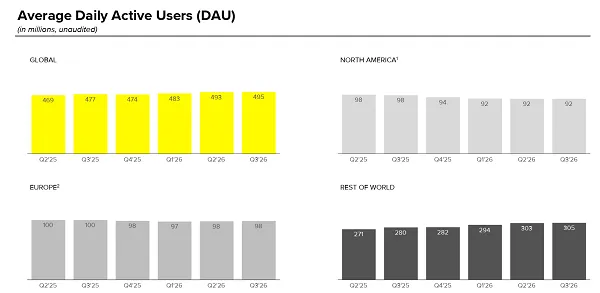
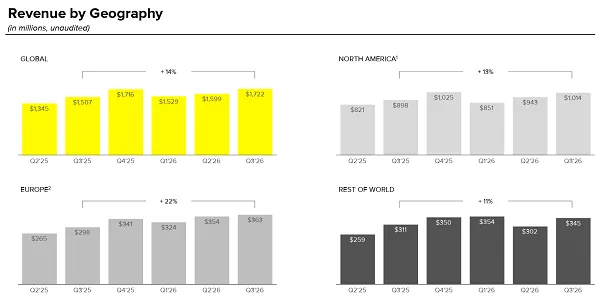
Snap Inc. released its financial results for the third quarter of 2026 on Wednesday, offering investors a complex portrait of a mature social media platform navigating stagnant user acquisition in lucrative Western territories, tightening regulatory landscapes, and high-stakes diversification efforts. While the company successfully expanded its total global daily active users (DAUs) to 495 million—up modestly from 493 million in the second quarter—the data underscores a growing reliance on lower-monetization regions to sustain user metrics. At the same time, Snap reported a solid 14% year-over-year increase in overall revenue, bolstered by resilient monetization in North America and Europe, strong subscription growth, and rising engagement in short-form video content.
Stalled User Growth in Western Markets and Regional Revenue Discrepancies
The most immediate concern highlighted in Snap’s Q3 2026 earnings report is the near-total deceleration of user growth across its most financially lucrative territories. The net addition of just 2 million daily active users globally quarter-over-quarter masks a stark geographical divide: Snapchat recorded zero net user growth in both North America and Europe during the period. Consequently, all of the platform’s user expansion stemmed entirely from its "Rest of World" segment.
This geographic imbalance poses a strategic hurdle for Snap’s financial model, given the vast disparity in average revenue per user (ARPU) across regions. In North America, Snapchat generated $11.07 per user in Q3, representing a healthy increase from $10.26 in the previous quarter. By contrast, the platform generated a mere $1.13 per user in the Rest of World segment. This means that while Snap is expanding its audience base, it is doing so almost exclusively in markets where ad-based revenue intake is roughly 90% lower than in Western economies.
Despite the lack of user growth in North America and Europe, Snap demonstrated an impressive ability to extract higher value from its existing user base. Overall third-quarter revenue rose to $1.72 billion, a 14% increase compared to the same period in the previous year. Regionally, North American revenue climbed 13% year-over-year to $1.01 billion, European revenue surged 22% to $363 million, and the Rest of World segment saw an 11% bump to $345 million. Analysts noted that successfully driving higher monetization without expanding the user pool points to improved ad targeting and platform efficiency, largely driven by artificial intelligence integration.

The Looming Threat of Global Teen Social Media Bans
Compounding the challenge of flat domestic and European user growth, Snap—like many of its peers in the social media sector—faces mounting regulatory pressures from emerging youth access restrictions. Expanded teen social media bans, which are being increasingly implemented or debated across multiple international jurisdictions, threaten to erode the platform’s core demographic base.
According to data published by Pew Research, approximately 55% of U.S. teens aged 13 to 17 use Snapchat, securing its position as the fourth most popular social platform among American youth, trailing only YouTube, TikTok, and Instagram. However, regulatory interventions are already impacting user numbers abroad. Following Australia’s implementation of strict social media usage restrictions for children under the age of 16 in December 2025, Snap disclosed that it locked or disabled more than 415,000 user accounts in the country. These actions were taken based on users openly declaring an age under 16 or through the application of the platform’s proprietary age-detection technology.
Given that Snap reported having over 8 million users in Australia as of August 2023, the enforcement of these age-restriction laws may have effectively cost the platform roughly 5% of its total user base in that market in a relatively short timeframe. While a 5% localized drop might appear manageable in isolation, industry analysts warn that a broader global wave of adolescent restrictions could significantly shrink Snapchat’s footprint, diminishing its primary value proposition as an essential communication tool for younger demographics and threatening long-term network effects.
Internal Engagement Metrics and AI Integration
Despite macroeconomic and regulatory headwinds, Snap leadership emphasized several bright spots in internal user engagement and technological modernization during their prepared remarks accompanying the earnings release.
CEO Evan Spiegel highlighted robust interpersonal communication trends within the app, noting that average daily messages sent increased by 8% year-over-year in Q3. Furthermore, the number of individuals engaging in two-way communication grew by 6% over the same timeframe, signaling that Snapchat’s foundational utility as a private messaging channel among friends remains resilient.
Simultaneously, the platform’s short-form video feature, Spotlight, experienced significant acceleration. The volume of content posted to Spotlight surged by 130% year-over-year, while daily active viewers grew by 40% compared to the previous year. This growth underscores the enduring appeal of algorithmic, snackable video content on the app, providing an increasingly vital inventory space for advertisers.
Spiegel also pointed to artificial intelligence as a transformative catalyst for the company. AI has been integrated to streamline internal team workflows and fundamentally upgrade Snap’s advertising platform, enabling more precise targeting and campaign optimization that helps explain the steady revenue per user growth in stable markets. In addition to core ad enhancements, Snap has diversified its business development efforts by refining creator partnership frameworks and launching targeted B2B advertising pitches to capture enterprise marketing budgets.
Subscription Momentum and the Augmented Reality Hardware Gamble
Beyond traditional advertising, Snap’s diversification strategy showed tangible progress through its subscription and digital goods ecosystem. The company’s "Other Revenue" stream—which encompasses offerings such as Snapchat+, Lens+, and Memories Storage—surged by 84% year-over-year. Collectively, Snap surpassed 30 million active subscribers across these premium tiers during the third quarter, creating a more predictable, recurring revenue buffer against the cyclical nature of digital advertising.
However, the company’s most ambitious long-term bet—its next-generation Augmented Reality (AR) Specs—has yet to make a measurable dent in its financial statements. Launched in September, the high-end $2,200 wearable device is currently available for pre-order in the United States, France, and the United Kingdom, though physical shipments to consumers have not yet commenced.
While Snap envisions the AR glasses as the cornerstone of its future ecosystem, fostering advanced digital connectivity via real-time visual overlays, initial financial disclosures suggest the product is still in its infancy. Neither Spiegel nor CFO Doug Hott mentioned specific pre-order volumes or revenue contributions from the hardware line during their Q3 earnings statements. Consequently, market observers remain cautious, unable to accurately gauge consumer appetite for the expensive hardware or predict when—or if—the AR initiative will begin contributing meaningfully to the company’s bottom line.
Fact-Based Market Analysis and Future Implications
Snap’s third-quarter 2026 performance illustrates a company caught between two distinct realities: steady operational maturation and mounting structural vulnerabilities. On one hand, management has proven adept at squeezing higher financial yield from stagnant user counts in North America and Europe, while simultaneously scaling high-margin subscription products and leveraging AI to boost advertising efficacy.
On the other hand, the complete lack of organic user acquisition in Western markets—coupled with the accelerating threat of international teen social media bans—presents a structural ceiling for ad-driven growth. If regulatory compliance forces the removal of millions of younger users globally, Snap may find it increasingly difficult to justify premium ad rates to brands seeking youth-heavy audiences.
Furthermore, while the high-end AR Specs represent an imaginative leap toward post-smartphone computing, their steep price point and unproven market demand mean they remain a speculative venture rather than an immediate financial stabilizer. Moving into the final quarters of 2026 and beyond, Snap Inc. will need to demonstrate that it can navigate regulatory compliance without sacrificing its core demographic, while successfully proving the commercial viability of its hardware ambitions to reassure skeptical investors.