
The intersection of visual and written communication represents a complex duality in the field of modern documentation, requiring practitioners to navigate the distinct demands of two disparate yet complementary mediums. For many professionals in the field, the choice between the precision of the written word and the spontaneity of the photographic lens is not a matter of preference, but a continuous negotiation with the mechanics of observation. While writing demands an internal, often exhaustive refinement of thought, photography requires an external engagement with the unpredictable variables of public space and light. This synthesis of disciplines is particularly evident when documenting high-stakes social movements, where the objective is to transform chaotic public events into structured, meaningful narratives that resonate beyond the immediate moment.
The Rome Demonstrations: A Case Study in Visual Order
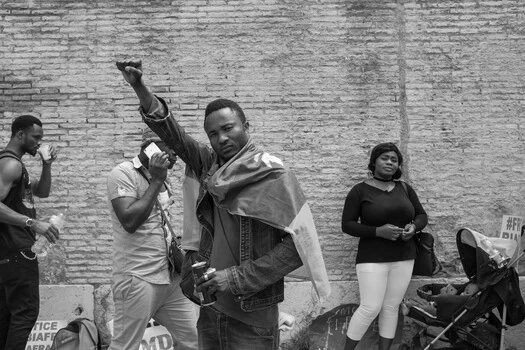
The practical application of this dual approach was recently exemplified during a significant demonstration held in Rome by members of the Biafran community. The event, characterized by thousands of participants, banners, and a heavy security presence, served as a platform for activists to demand international attention regarding decades of socio-political unrest in their home region. For the documentarian, such an event presents a challenge: how to capture the essence of a mass movement without succumbing to the visual noise of the crowd.
Observers noted that while many documented the event through standard news coverage—focusing on the speeches and the scale of the gathering—the more enduring records often came from those seeking quieter, more isolated moments. These "invisible" gestures, such as a specific facial expression or a composition that echoes classical art, provide a visual order that transcends the immediate political chaos. This method of documentation does not alter the truth of the event but rather distills it into a form that is more readily processed by an external audience.
Historical Context: The Biafran Struggle and Global Advocacy
To understand the weight of the Rome protests, it is necessary to examine the historical trajectory of the Biafran movement. The conflict has its roots in the late 1960s, a period marked by one of the most significant humanitarian crises in modern African history.
- 1967–1970: The Nigerian Civil War, also known as the Biafran War, broke out when the Eastern Region of Nigeria declared independence as the Republic of Biafra. The ensuing conflict and blockade led to a famine that resulted in the deaths of an estimated one to three million people.
- Post-War Integration: Following the surrender of Biafran forces in 1970, the region was reintegrated into Nigeria, but underlying tensions regarding marginalization and resource control persisted for decades.
- Resurgence in the 21st Century: The movement for Biafran self-determination saw a significant revival in the 2010s, led largely by groups such as the Indigenous People of Biafra (IPOB). This resurgence has been met with varied responses from the Nigerian federal government, ranging from legal battles to security crackdowns.
- Internationalization of the Cause: Members of the Biafran diaspora, particularly in Europe and North America, have increasingly utilized public spaces in major cities like Rome, London, and Brussels to lobby international bodies and the Vatican for diplomatic intervention.
The Rome demonstration serves as a modern chapter in this timeline, reflecting the diaspora’s strategy of using visual presence in the West to highlight tragedies that have unfolded over half a century.
The Mechanics of Street Photography and the Element of Chance
Unlike studio photography, street photography—the primary medium used to document public demonstrations—is governed by uncertainty. Professionals in the field emphasize that while one can plan the location, the timing (such as sunrise versus noon), and the general movement of the crowd, the final image is largely a product of chance.
The street acts as a reminder of the documentarian’s lack of control. Factors such as the fall of natural light, the intersection of strangers, and the sudden emergence of a poignant gesture are variables that cannot be manufactured. This unpredictability is what distinguishes the medium from writing. In photography, one arrives and accepts what the environment offers; in writing, one constructs the environment from the ground up.
Educational resources, such as the curriculum found in "The Well-Rounded Photographer," suggest that mastering this range requires a deep understanding of eight distinct genres of photography. By learning how people move through public spaces and how light interacts with urban architecture, a photographer can better position themselves to capture the "fraction of a second" that defines a movement.
The Cognitive Demand of Narrative Construction
While photography is an act of external observation, writing is an internal struggle. The process of producing a single page of narrative can often take hours of meticulous adjustment. Journalistic professionals frequently describe this as a form of "arguing with oneself," where the placement of a single comma can change the cadence and implication of a report.
This mental exhaustion is distinct from physical tiredness. It is the result of attempting to bridge the distance between the experience as it happened and the language used to describe it. In the context of reporting on events like the Biafran protests, the writer must not only relay the facts—the who, what, and where—but also the "why." This requires a return to the experience after the dust has settled, sitting with the world to understand its deeper significance.
The Synthesis of Influences and the Question of Originality
A critical aspect of both photography and writing is the role of subconscious influence. No observer enters a space with "empty eyes." Every previous photograph, film, or literary work an individual has consumed acts as a filter through which they view current events.
Originality in reportage is often misunderstood as the absence of influence. However, in professional practice, originality begins when these external influences become inseparable from the observer’s own experience. Eventually, the styles of others stop being imitations and become part of the practitioner’s inherent way of seeing. This evolution is vital for journalists who must develop a unique "voice" or "eye" to distinguish their work in a saturated media landscape.
Every frame captured and every sentence written serves as a "small confession" of what the creator notices. This selectivity is what gives a report its weight; what a journalist chooses to ignore is often as telling as what they choose to highlight.
Official Responses and Public Perception
The impact of such integrated documentation is measurable in the way the public and official bodies respond to social movements. In the case of the Biafran demonstrations in Rome, the visual record serves several purposes:
- Diplomatic Pressure: High-quality visual documentation provides evidence for international human rights organizations to present to the United Nations or the European Union.
- Public Awareness: Narrative articles that accompany these images help the general public connect the historical context of the 1960s with the modern-day protests.
- Archival Value: These records ensure that the specific nuances of the protest—the individual faces and the peaceful nature of the assembly—are preserved against potential misinformation.
While official responses from the Nigerian government often emphasize national unity and the illegality of secessionist movements, the international community’s response is frequently shaped by the quality and reach of the documentation coming out of the diaspora.
Broader Implications: The Future of Documentary Arts
The relationship between writing and photography is evolving as digital media continues to blur the lines between different forms of content. The modern journalist is increasingly expected to be proficient in both, using photography to catch the world while it is moving and writing to sit with it afterward.
This dual approach is less about maintaining two separate professions and more about a singular way of paying attention. By combining the two, documentarians can provide a form of "staying power" to moments that would otherwise be lost to time. When a photograph reveals something that existed for less than a second, and a paragraph reminds a reader of a forgotten truth about themselves, the documentation has achieved its highest purpose.
In conclusion, the effort to understand why certain moments refuse to let go of the collective consciousness is the driving force behind modern reportage. Whether through the lens of a camera in a crowded Roman street or the deliberate construction of a sentence in a quiet room, the goal remains the same: to give form to the ephemeral and to ensure that tragedies and triumphs alike are given a shape that might stay with the world. The Biafran community’s presence in Rome, documented through this lens of uncertainty and search for order, stands as a testament to the power of integrated narrative in the pursuit of global visibility.