
Jim Parkinson, the esteemed lettering artist, type designer, and painter whose work shaped the visual identity of American media for over half a century, passed away on June 26, 2025, at his home in Oakland, California. His death concludes a prolonged struggle with Alzheimer’s disease. Parkinson, 83, leaves behind an indelible mark on the landscape of graphic design, having served as a bridge between the analog craftsmanship of the mid-20th century and the digital revolution of the modern era. He is survived by his wife, the book artist Dorothy A. Yule, who provided dedicated care throughout the later years of his illness.
A Foundational Fascination
Born in Oakland on October 23, 1941, Parkinson’s trajectory as an artist began in his own neighborhood. His early environment was influential; he lived across the street from Abraham Lincoln Paulsen, a local artisan known as the "Wizard Penman." Paulsen’s ability to execute complex calligraphic feats—such as writing the Gettysburg Address in reverse—ignited a fascination in young Parkinson that would dictate his professional life.
Parkinson’s formal education took place at the California College of Arts and Crafts (CCAC), where he honed his skills in painting and design, graduating in 1963. Shortly thereafter, he relocated to Kansas City, Missouri, to join the creative team at Hallmark Cards. It was during his tenure at Hallmark that Parkinson realized his true aptitude lay not in illustration, but in the structural integrity and aesthetic precision of typography. His transition from general design to the dedicated lettering department marked the beginning of a specialized career that would eventually define his status as one of the most prolific lettering artists in the United States.
Professional Chronology and Key Milestones
Parkinson’s return to the San Francisco Bay Area in the late 1960s launched a freelance career that spanned more than five decades. His professional timeline is a reflection of the evolving media landscape in America:

- 1963: Graduates from the California College of Arts and Crafts.
- 1963–1960s: Joins Hallmark Cards; shifts focus from illustration to specialized lettering.
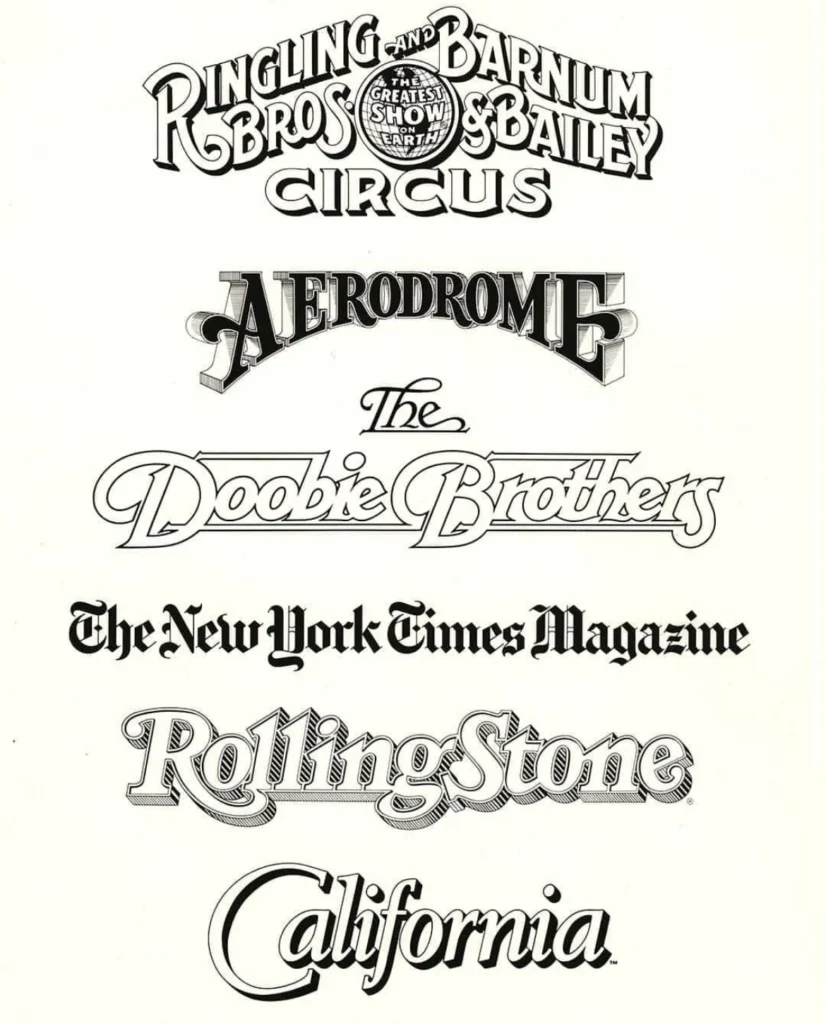
- 1970s–1980s: Becomes a go-to designer for magazine and newspaper nameplates, including Rolling Stone and the Los Angeles Times.
- 1990s: Adapts his hand-lettering mastery to the digital medium, developing both custom and retail fonts.
- 2000s–2020s: Continues extensive work on brand identity, including iconic logos for the Ringling Bros. and Barnum & Bailey Circus and the rock band The Doobie Brothers.
- 2025: Passes away in Oakland, leaving behind a vast catalog of work held in institutions like the Letterform Archive.
Data and Impact: The Prolific Nature of the Work
Parkinson’s influence is best measured by his ubiquity. In the publishing industry, he served as a primary consultant for art directors seeking to revitalize publication mastheads. His work was not merely decorative; it was functional. By re-drawing title treatments, he ensured that major publications maintained visual relevance in an increasingly competitive newsstand market.
His portfolio included hundreds of custom typefaces and nameplates, many of which remain in active use today. Analysts in the field of graphic design often cite Parkinson as a "transitional master"—an artist who understood the physical nuance of ink on paper as well as the mathematical precision required for digital font files. His ability to interpret historical styles and adapt them for modern commercial use was a defining characteristic of his career.
Artistic Evolution: From Type to Neon
In his later years, Parkinson expanded his creative output into the realm of fine art, focusing on the documentation of vintage American signage. His paintings, which captured the decay and aesthetic character of neon lights across the American West, served as a poignant counterpoint to his highly controlled, clean commercial lettering. These works are recognized not only for their technical execution but for their role as historical records of a vanishing American landscape.
Institutional Recognition and Future Publications
Parkinson’s professional archives have been extensively documented by the Letterform Archive, an organization dedicated to the preservation of graphic design history. Recognizing the significance of his life story, the Archive has confirmed that a memoir penned by Parkinson is scheduled for publication in 2026. This forthcoming work is expected to provide scholars and design enthusiasts with deep insights into the methodologies and technical philosophies that guided his long career.
Stephen Coles, a colleague and friend who knew Parkinson for over two decades, highlighted the artist’s humility, noting that he lived by the mantra, "Take your work seriously, but never yourself." This sentiment was echoed by many in the design community who frequented his Oakland studio, where Parkinson regularly hosted visitors to view his expansive collection of ephemera and original artwork.

Broader Implications for the Design Community
The passing of Jim Parkinson marks the end of a specific era in American design. His career spanned the transition from manual typesetting and hand-drawn logos to the accessibility of computer-aided design. His legacy lies in his refusal to prioritize software over skill; he remained a proponent of the "hand-drawn" aesthetic even as the industry moved toward total automation.
His contributions to typography have broader implications for the field of visual branding. By proving that a bespoke, hand-crafted approach could be scaled for mass-market media—such as major newspapers and national magazines—Parkinson helped maintain a high standard of visual literacy in American journalism. His work serves as a reminder of the strategic value of custom typography in establishing brand identity.
Memorial and Contributions
A memorial service for Parkinson is planned for the autumn of 2025, with details to be announced by his family. In a reflection of the challenges he faced in his final years, the family has requested that in lieu of flowers, donations be made to the Alzheimer’s Association.
As the design community processes his loss, the consensus remains that Parkinson’s work is not merely a collection of fonts and logos, but a vital part of the American visual vernacular. Whether through the bold, recognizable headlines of a national newspaper or the subtle, hand-lettered details of a band logo, Jim Parkinson’s influence will continue to be visible to the public for generations to come. The upcoming publication of his memoir will further secure his place in history, ensuring that the man behind the letters is remembered as clearly as the letters themselves.