
Technology has fundamentally shifted from a tool that humans operate to an immersive, living environment in which we exist. Driven by artificial intelligence, modern interactions have transitioned from rigid, transactional exchanges into dynamic, conversational dialogues. Instead of merely displaying static information, contemporary systems generate new contexts and custom content in real time.
This evolution has made technological interactions increasingly human-like. In an era where communication between consumers and corporations relies heavily on autonomous systems, this paradigm shift represents a transformative challenge and opportunity for global brands and marketing strategists.
The Evolution of Brand Connection: From Lovemarks to Agentic AI
To understand this transition, industry experts are looking back at foundational marketing concepts and adapting them for the digital age. Arjan Kapteijns, the former CEO of Saatchi & Saatchi Netherlands, recently reexamined Kevin Roberts’ legendary concept of a "Lovemark" through an AI-infused lens. In this emerging paradigm, earning consumer love and respect is no longer directed exclusively at human entities, but increasingly at their digital agents.
Kapteijns defines these as "Agentic Lovemarks," providing marketers with a blueprint for future brand building. While the core objective remains unchanged—establishing a deep emotional connection—the orchestration of that connection is now managed by machines.
Since psychology first intersected with marketing in the early 20th century, industry professionals have utilized emotional triggers to connect brands with consumers. What began as basic emotional persuasion in print and broadcast advertising eventually evolved into a more sophisticated understanding: a profound emotional bond with a corporate identity drives long-term brand loyalty and recurring transactions. However, for humans to forge emotional attachments to inanimate objects or digital constructs, those entities needed to become relatable and humanized.

The Limitations of Traditional Brand Archetypes
This humanization historically relied on archetypes. Twenty-five years ago, Margaret Mark and Carol Pearson published The Hero and the Outlaw, introducing a 12-brand archetype model that permanently revolutionized modern brand strategy. This framework gave marketers a tangible, rational guide to navigating consumer behavior by establishing a human-inspired personality framework that dictated how a brand looked, spoke, and behaved.
Yet, as the marketing landscape pivots toward artificial intelligence, industry leaders argue that these traditional frameworks are no longer sufficient. Thomas Marzano, former brand leader at Philips and ASML, outlines in his strategic manifesto Brand Constitutions that standard archetypes leave too much room for subjective interpretation.
If a large language model (LLM) is left to interpret a brand based solely on a broad archetype, the resulting customer experience will be inconsistent, effectively generating a randomized interaction every time a consumer engages with the brand. In an agentic economy where autonomous software agents communicate on behalf of both people and corporations, brands face two critical mandates: they must remain legible to artificial intelligence systems so algorithms can accurately recognize and recommend them, and they must remain lovable to human consumers to influence decision-making effectively.
Introducing the PRISM Model
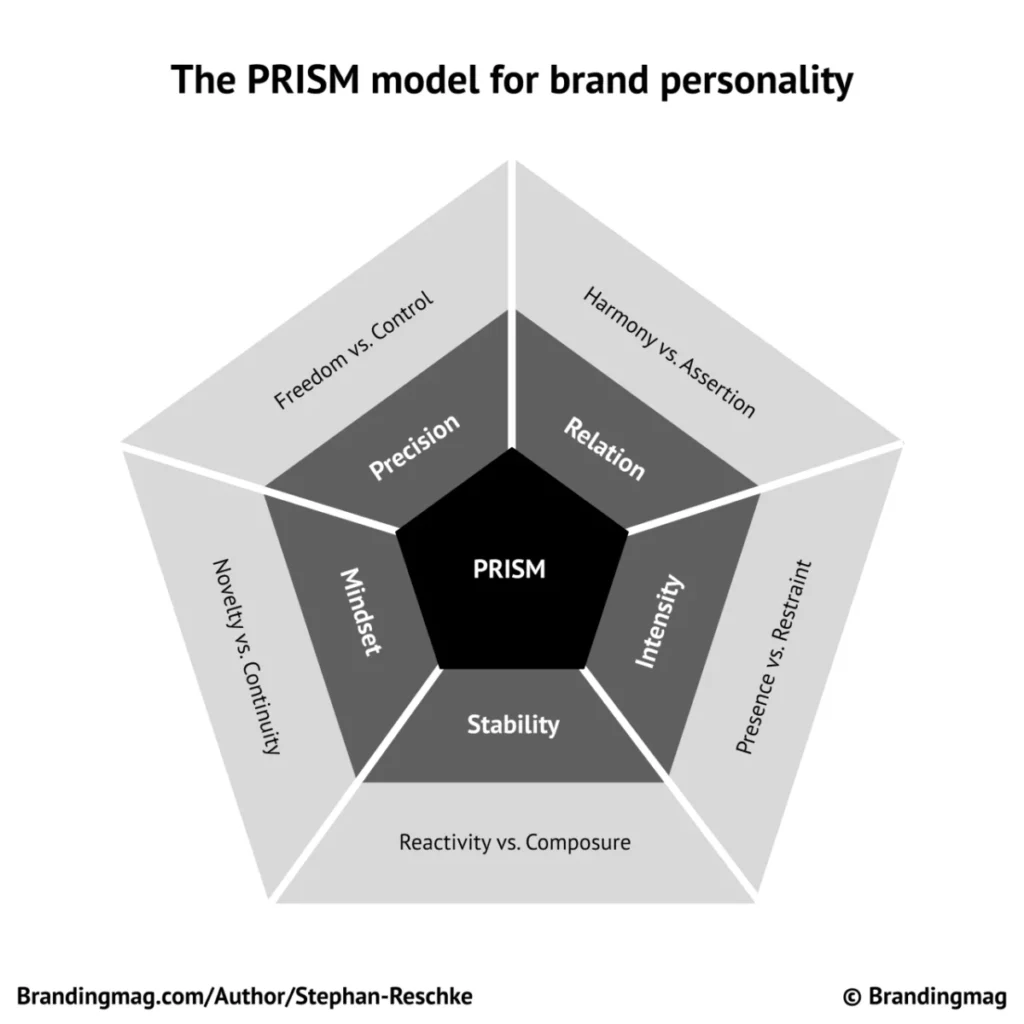
To address these complex demands, marketing theorists have introduced the PRISM model. Designed to replace vague interpretive guidelines with a precise technical framework, the PRISM model adapts the widely accepted psychological framework known as the OCEAN model, or the "Big Five" personality traits, specifically for corporate identities.
The PRISM framework classifies a brand’s digital personality across five core behavioral and cognitive domains:
- Openness to experience and innovation
- Conscientiousness and operational reliability
- Extraversion in communication style
- Agreeableness in customer interactions
- Neuroticism, evaluated as emotional stability and resilience under pressure
Each of these core domains is further broken down into six granular characteristics, which are evaluated along precise statistical scales. This rigorous methodology allows the PRISM model to capture the complex nuances of human personality, translating them into actionable data structures.
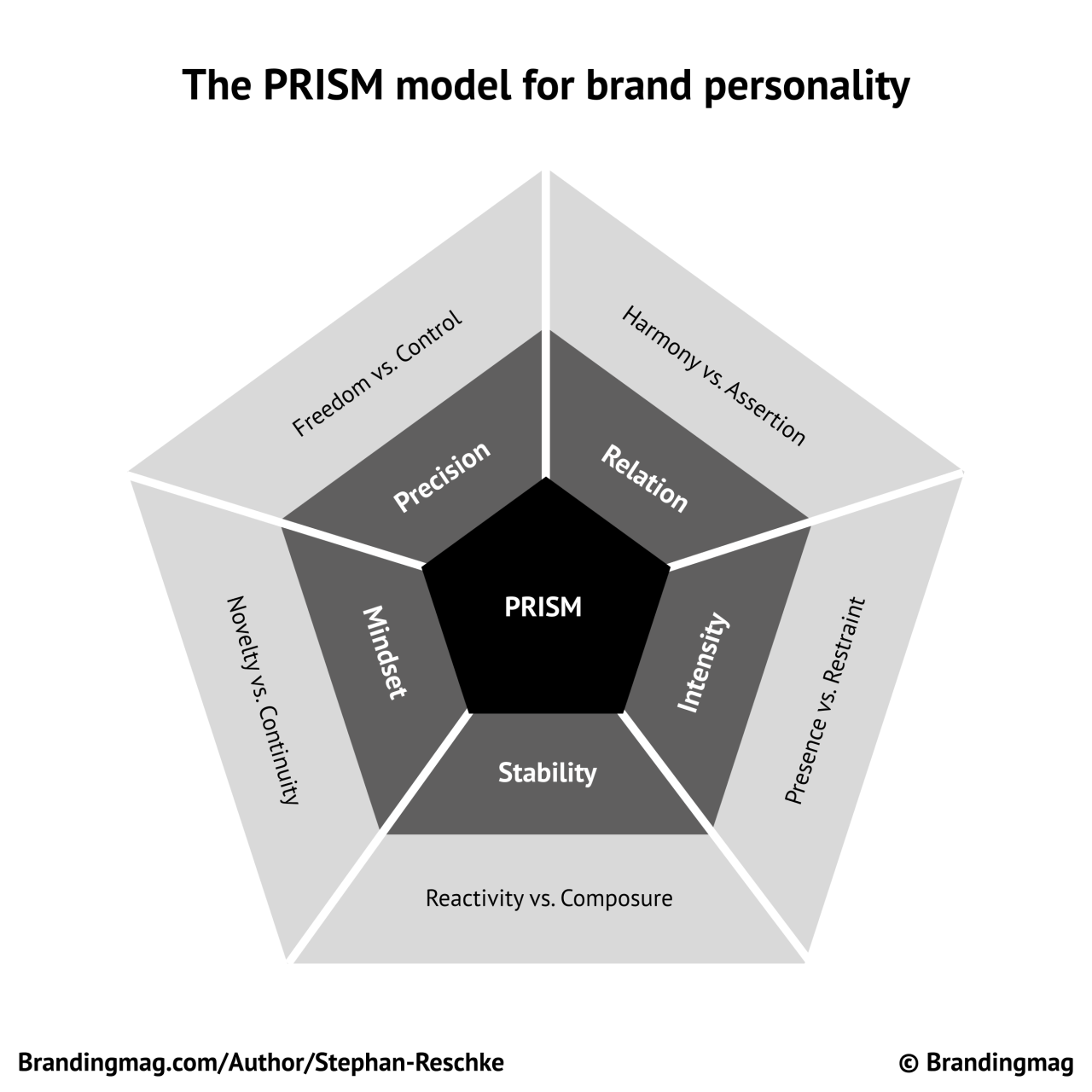
Rather than functioning as an exclusive, rigid system like traditional archetypes, PRISM provides a comprehensive compilation of attitudes, cognitive processes, and operational mindsets. This ensures that every brand can establish a distinct, recognizable digital footprint.
Operationalizing Brand Language in the Age of LLMs
As human-computer interaction increasingly shifts toward voice-driven, auditory interfaces rather than visual screens, language has emerged as the primary touchpoint between consumers and brands. Consequently, organizations must develop rigorous frameworks governing their verbal identity—including precise vocabulary, grammatical structures, tone of voice, and conversational cadence.
Large language models do not read traditional advertising campaigns; they consume vast datasets, analyze contextual variables, and synthesize original content. Therefore, establishing a codified brand language is indispensable.
The PRISM model functions as the operational lens through which a brand manifests its digital personality, laying the groundwork for generative language protocols. Rather than existing merely as static PDF guidelines stored in corporate archives, these parameters can be embedded directly into system prompts utilized by LLMs. This technical integration allows brands to maintain strict communicative consistency, dynamically adapt their messaging across decentralized platforms, and construct a stable digital persona that algorithms can reliably parse and render.
Strategic Implications and Industry Outlook
The transition toward an agentic economy generates both excitement and apprehension across boardrooms worldwide. Industry analysts emphasize that much of this corporate anxiety stems from uncertainty regarding rapidly evolving technological standards.
Navigating this uncharted territory requires proactive exploration, continuous experimentation, and cross-disciplinary collaboration among brand architects, data scientists, and consumer psychologists. By adopting structured frameworks like the PRISM model, organizations can demystify the agentic landscape, ensuring that their brand equity remains resilient, recognizable, and deeply engaging as human-AI interactions redefine the future of commerce.