
The landscape of web development has recently undergone a significant transformation with the introduction of two groundbreaking CSS functions, sibling-index() and sibling-count(). These new additions, part of the CSS Values and Units Module Level 5 specification, promise to simplify the creation of complex, dynamic user interfaces by allowing CSS to directly query an element’s position and the total number of its siblings within the Document Object Model (DOM). This capability effectively eliminates the long-standing need for cumbersome :nth-child() rule proliferation or JavaScript workarounds for common design patterns like staggered animations, adaptive grids, and circular layouts.
Addressing a Decades-Old Development Challenge
For years, developers have grappled with a fundamental limitation in CSS when attempting to implement visually appealing "staggered cascade" effects, where elements appear or animate sequentially. The traditional approaches, while functional, were often described as "fundamentally stupid" due to their inherent inefficiencies and maintenance overhead.
One prevalent method involved generating a multitude of :nth-child() rules, often using preprocessors like Sass. For a list of ten items requiring staggered animation delays, this meant writing ten individual rules, each hardcoding an --index variable for a specific position:
/* One rule per item. Hope the list never grows. */
li:nth-child(1)  --idx: 1;
li:nth-child(2)  --idx: 2;
li:nth-child(3)  --idx: 3;
/* ... eight more of these ... */
li:nth-child(10)  --idx: 10;

li
  animation-delay: calc(var(--idx) * 100ms);
This approach quickly became unmanageable for larger lists. Scaling to 50 items necessitated 50 distinct rules, leading to significant CSS bloat and a rigid structure that broke down if the number of items changed dynamically. While advanced techniques, such as those proposed by engineers like Roman Komarov, offered more efficient O(√N) strategies to cover a greater number of elements with fewer rules, they still resulted in a substantial number of selectors (e.g., 63 rules for 1,023 elements), introducing complexity and build-time overhead.
The alternative involved JavaScript. Developers would loop through DOM elements, programmatically setting inline styles like style="--index: 3". While offering dynamic flexibility, this blurred the lines between presentation and behavior, scattering layout concerns across scripts and creating potential maintenance nightmares. Such JavaScript-injected variables could silently break component refactors if the underlying CSS dependency wasn’t recognized. Both methods shared a common flaw: they compelled developers to explicitly tell the browser information it already possessed. The browser constructs the DOM tree and inherently knows the position of each element; the challenge was that CSS lacked the direct means to access this intrinsic data.
The Arrival of Native Tree-Counting in CSS
The advent of sibling-index() and sibling-count() directly addresses this fundamental disconnect. Now, a complex staggered animation can be achieved with a single line of CSS:
li
  animation-delay: calc(sibling-index() * 100ms);
This elegant solution works seamlessly whether there are 5 items or 5,000, without requiring event listeners, mutation observers, or costly re-renders. These functions, which take no arguments, resolve to an actual <integer> value, not a string. This crucial detail allows them to be directly integrated into calc(), min(), max(), round(), mod(), and even trigonometric functions like sin() and cos(). Unlike the counter() function, which returns a string and is primarily confined to the content property of pseudo-elements, sibling-index() and sibling-count() provide numeric values that CSS can perform mathematical operations with, enabling truly dynamic and responsive styling.
It is important to differentiate these new functions from the :nth-child() selector. While :nth-child() selects elements based on their position, it does not produce a calculable value. Attempts to use it within calc() (e.g., calc(:nth-child() * 10px)) are invalid CSS. sibling-index() and sibling-count(), conversely, are designed to provide numerical data within declarations, solving a distinct problem that :nth-child() was never intended to address.
Practical Applications and Transformative Use Cases
The ability to directly query sibling count and index unlocks a plethora of innovative design patterns, significantly reducing the need for JavaScript or complex preprocessor logic:
-
Reverse Staggered Animations: To animate elements from last to first, a simple subtraction reverses the order:
.card
  animation: fade-in 0.4s ease both;
  animation-delay: calc((sibling-count() - sibling-index()) * 80ms);
Here, the last child (where
sibling-index()equalssibling-count()) receives a0msdelay, animating instantly, while the first child receives the longest delay. -
Automatic Equal Widths: Responsive layouts that require items to proportionally fill available space can now be managed entirely in CSS:
.tab
  width: calc(100% / sibling-count());
This ensures that five tabs automatically take 20% width each, six tabs take 16.66%, and so on, without any JavaScript or media queries. While powerful, developers should consider fallback strategies (e.g., Flexbox wrapping) for scenarios where too many items might lead to unreadably narrow elements.
-
Dynamic Hue Distribution: Designers can now evenly spread colors across the color wheel based on the number of elements:
.swatch
  background-color: hsl(
    calc((360deg / sibling-count()) * sibling-index()) 70% 50%
  );
This automatically generates a visually harmonious palette that adapts to the number of items in the DOM, a task previously requiring JavaScript color libraries.
-
Pure CSS Radial Layouts: The combination of
sibling-index(),sibling-count(), and native CSS trigonometric functions (sin(),cos()) revolutionizes circular layouts:.radial-item --angle: calc((360deg / sibling-count()) * sibling-index()); --radius: 120px; position: absolute; left: calc(50% + var(--radius) * cos(var(--angle))); top: calc(50% + var(--radius) * sin(var(--angle))); transform: rotate(calc(var(--angle) * -1));This allows for items to arrange themselves into perfect hexagons (six items), octagons (eight items), or any polygonal shape, recalculating dynamically as elements are added or removed, entirely without JavaScript-computed coordinates.
-
Simplified Z-Index Stacking: Creating card fan effects or layered elements is reduced to a single line:
.card
  z-index: calc(sibling-count() - sibling-index());
This sets the first card to stack highest, with subsequent cards layering beneath, or vice-versa with a minor adjustment to the math.
Important Considerations and "Gotchas"
While incredibly powerful, developers must be aware of several nuances when implementing sibling-index() and sibling-count():
- Shadow DOM Scoping: These functions operate strictly on the DOM tree, not the flattened visual tree. Within a Web Component’s Shadow DOM,
sibling-index()andsibling-count()will only count siblings within that Shadow DOM, ignoring any projected content from the Light DOM via<slot>. For instance, if a component’s Shadow DOM has a<slot>and an internaldiv.internal,div.internalwill consistently return ansibling-index()of2, regardless of how many elements are projected into the slot. Furthermore, for security reasons, light DOM stylesheets attempting to use these functions via::part()to probe a component’s internal structure will receive a0value. - Pseudo-Elements Exclusion:
::beforeand::afterpseudo-elements are not considered siblings. They do not contribute tosibling-count()nor do they possess their ownsibling-index(). However, these functions can be used within pseudo-element declarations. In such cases, thesibling-index()orsibling-count()value is evaluated against the originating element (the one to which the pseudo-element is attached), not the pseudo-element itself, as pseudo-elements are not actual DOM nodes. display: noneElements Still Count: A critical distinction to remember is thatsibling-index()andsibling-count()read the DOM tree, not the rendered layout tree. Elements styled withdisplay: noneare visually absent and occupy no layout space, but they remain in the DOM structure. Consequently, they are still counted by these functions. If a list contains adisplay: noneitem, subsequent visible items will retain their original, non-sequential indexes. For layouts requiring continuous numbering (e.g., radial menus, proportional widths), filtered elements must be removed from the DOM rather than merely hidden, or a JavaScript-managed index fallback should be considered.visibility: hiddenandopacity: 0elements also count, which is generally more intuitive as they still reserve space in the layout.- Custom Properties Evaluate Immediately: When attempting to centralize
sibling-index()on a parent element via a custom property (e.g.,.parent --idx: sibling-index();), the--idxvariable resolves immediately to the parent’s own sibling index. This single, fixed value is then inherited by all children, leading to unintended uniform application. The correct approach is to apply the function directly to the elements that require their individual index:.child --idx: sibling-index(); animation-delay: calc(var(--idx) * 100ms);. While the CSS Working Group has discussedinherits: declarationfor@propertyto address such scenarios, it remains a proposal and is not currently available. - Performance at Scale: While significantly more efficient than JavaScript-based DOM manipulation, changing the DOM (adding, removing, or reordering children) will trigger style recalculations for affected siblings. This occurs during the browser’s cascade phase, preceding layout and paint, making it generally fast for typical UI components like navigation or card grids. However, in highly dynamic scenarios with thousands of constantly churning nodes, such as live stock tickers or infinite-scroll feeds, the cost of recalculating 10,000 sibling indexes upon an insertion at the beginning of the list can become noticeable. For such extreme cases, JavaScript-managed indexes within a virtualization window may still be the optimal solution. These functions are fast, but not entirely zero-cost.
Browser Support and Progressive Enhancement

As of June 2025, sibling-index() and sibling-count() have been shipped in stable releases of Chrome/Edge 138 and Safari 26.2. This represents a substantial majority of global browser traffic, typically ranging from 75% to 80%. Firefox has not yet shipped these functions in stable versions, though Mozilla’s official standards position is positive, and active implementation work is underway (tracked under Bugzilla issue #1953973). Developers should consult caniuse.com/wf-sibling-count for the most up-to-date compatibility information.
For production deployments today, a progressive enhancement strategy using @supports is highly recommended:
/* Baseline that works everywhere */
.item
  width: 25%; /* Default static width */
  animation-delay: 0ms; /* No stagger by default */


/* Progressively enhance where supported */
@supports (z-index: sibling-index())  /* Feature detection for sibling-index() */
  .item
    width: calc(100% / sibling-count()); /* Dynamic width */
    animation-delay: calc(sibling-index() * 80ms); /* Staggered animation */
This ensures a robust user experience: browsers without native support receive a functional, if less dynamic, baseline layout and animation (e.g., fixed widths, no staggered animation), while supported browsers benefit from the full, mathematical power of the new CSS functions. For scenarios demanding more sophisticated fallbacks than a static design, approaches outlined by experts like Juan Diego Rodríguez leverage existing CSS techniques (e.g., Roman Komarov’s counting hacks) as a bridge, rather than resorting to full JavaScript polyfills that would negate the core benefit of these functions.
Accessibility Notes and Semantic Integrity
It is paramount to remember that sibling-index() and sibling-count() are purely visual tools. They influence how elements are perceived visually, but they do not alter their underlying semantic meaning or their position within the DOM’s source order. If these functions are used to visually reorder a list (e.g., via order in Flexbox or Grid placement), screen readers will still interpret the content based on the original DOM source order. Similarly, keyboard navigation (tab order) will follow the DOM. Any discrepancy between visual layout and semantic structure constitutes an accessibility failure.
For interactive components like data grids, radial menus, or custom listboxes that rely on tree-counting for their visual arrangement, JavaScript remains essential for synchronizing ARIA attributes. Properties like aria-posinset and aria-setsize must accurately reflect the user’s perceived position and total count, independent of CSS calculations. If CSS indicates "visually item 3 of 7" but ARIA conveys different information (or none at all), users of assistive technologies will encounter a broken experience.
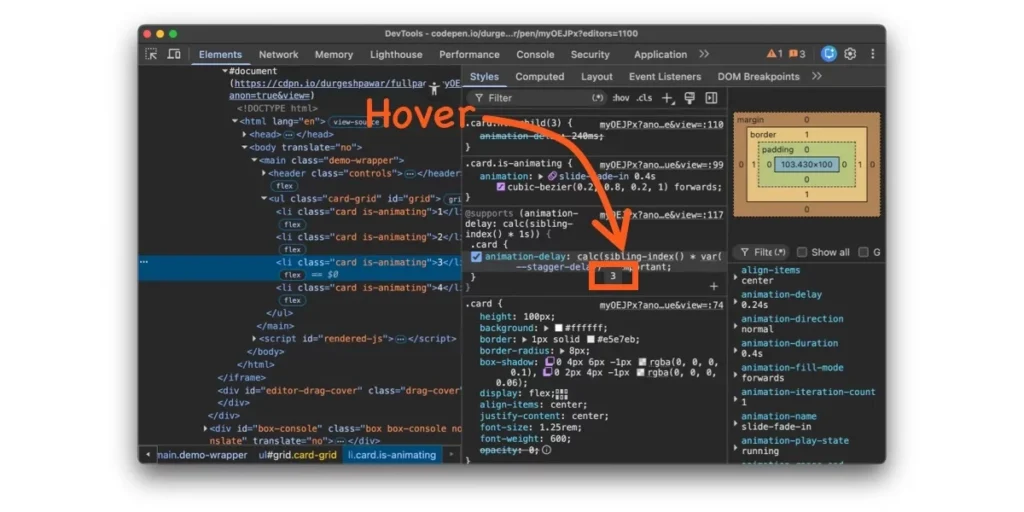
Debugging these new functions is facilitated by modern browser developer tools. Recent versions of Chrome DevTools, for instance, allow developers to inspect the computed values of sibling-index() and sibling-count() directly within the Elements panel, aiding in troubleshooting when calculations do not yield the expected results.
The Road Ahead: Expanding Tree-Counting Capabilities
The current implementation of sibling-index() and sibling-count() focuses on counting all element siblings. However, the CSS Working Group has already outlined planned extensions to enhance their utility. Issue #9572 proposes an of <selector> argument, mirroring the functionality of :nth-child(). This would enable counting only siblings that match a specific selector, such as sibling-index(of .active). An element that is the eighth child overall but the third .active child would then return 3. This feature would be invaluable for dynamic UIs that involve filtering or toggling visibility, allowing the index to remain sequential without requiring DOM manipulation.
Further discussions within the CSSWG revolve around children-count() (issue #11068) and descendant-count() (issue #11069) functions. children-count() would report the number of direct children an element possesses, beneficial for parent-driven layouts. descendant-count() would recursively count all descendants. While still in the proposal stage, these functions would complete the tree-counting paradigm: sibling-index() and sibling-count() provide a horizontal view ("Where am I among my peers?"), while children-count() and descendant-count() would offer a vertical perspective ("What’s below me?").
The introduction of sibling-index() and sibling-count() marks a significant milestone in the evolution of CSS, empowering developers to create more dynamic, maintainable, and efficient web interfaces with less reliance on JavaScript. That lingering feeling of performing "fundamentally stupid" workarounds for common staggered animations has finally been addressed, as the obvious solution – direct access to DOM tree data – has arrived.