

The digital landscape is undergoing a profound transformation, fundamentally reshaping how users interact with information and how businesses achieve online visibility. The era of traditional search engine results, dominated by a list of ten blue links, is rapidly evolving into a new paradigm driven by artificial intelligence. As AI Overviews, ChatGPT, and Perplexity increasingly deliver synthesized, direct answers to user queries, marketers are compelled to rethink their strategies, moving beyond mere ranking to mastering the art of Answer Engine Optimization (AEO). This shift is not merely an incremental change but a foundational reorientation of digital content strategy, demanding a meticulous focus on structure, authority, and machine readability.
The Paradigm Shift: From Links to Answers
For decades, Search Engine Optimization (SEO) focused on optimizing content to appear high in a list of web pages. Success was measured by click-through rates to a website. However, the advent of sophisticated large language models (LLMs) and generative AI has introduced a new user expectation: immediate, concise answers without the need to navigate multiple links. Google’s AI Overviews, along with independent platforms like ChatGPT and Perplexity, now aim to provide a single, definitive response, often citing the source directly within the AI-generated summary.
This fundamental change means that visibility is no longer solely about occupying a top spot in a search results page. Instead, it hinges on whether an answer engine can efficiently extract a clear, self-contained passage from a webpage and confidently attribute it to the originating brand. This "parse-then-cite" pipeline is the new battleground for digital visibility. The urgency of this transition is reflected in recent industry data: HubSpot’s 2026 State of AEO Report indicates that a significant 58% of marketers are already actively optimizing their content for answer engines, signaling AEO’s rapid ascent from a niche experiment to a mainstream marketing imperative.
Defining Answer Engine Optimization (AEO)
Answer Engine Optimization (AEO) is the strategic practice of structuring and enriching content to enable AI-powered answer engines to extract, comprehend, and confidently cite information. Unlike traditional SEO, which prioritizes keywords and backlinks for ranking, AEO focuses on creating content that is inherently digestible and verifiable by AI systems. This involves a multi-faceted approach, encompassing not just what the content says, but how it says it, and how its underlying data is presented to machines.
The content most likely to be cited by AI shares a handful of recognizable traits, primarily centered on meticulous structure. These characteristics include question-led headings, direct-answer summaries, robust structured data implementation, strong authoritative signals, strategic internal linking, and passage-level optimization for seamless extraction. Mastering these elements is crucial for any organization aiming to maintain and grow its digital footprint in the AI search era.
I. Crafting Content for Direct Answers: Question-Led Headings and Summaries
One of the most impactful structural adjustments for AEO is the adoption of question-led headings and direct-answer summaries. These formats are designed to directly map a passage to a potential user query, providing an immediate, extractable answer. According to AirOps’ 2026 State of AI Search Report, sequential heading structures that directly address questions can increase citation odds by a remarkable 2.8 times.
- Question-Led Headings: These headings mirror the exact phrasing a user, or an AI engine, might use when posing a question. For example, instead of a heading like "Marketing Strategies," an AEO-optimized heading would be "What are the most effective digital marketing strategies for B2B?" This explicit question-and-answer format makes it exceptionally easy for AI to identify and extract the relevant information.
- Direct-Answer Summaries (TL;DR): Positioned immediately after a question-led heading, a direct-answer summary provides the core answer in one or two concise sentences, preceding any further context or elaboration. This "Too Long; Didn’t Read" (TL;DR) approach ensures that the most critical information is presented upfront, making it highly citable.
- Q&A Blocks: The combination of an explicit question and a tight, self-contained answer within a dedicated block is a powerful AEO tactic. These blocks should be formatted for maximum clarity, often using bolding for the question and a distinct paragraph for the answer, making them highly scannable and extractable for AI.
The implication for content creators is a shift towards a more direct, question-and-answer style of writing. Every section should aim to answer a specific query clearly and succinctly, anticipating the user’s information need and fulfilling it immediately.
II. The Machine-Readable Layer: Semantic Schema and Entity Modeling

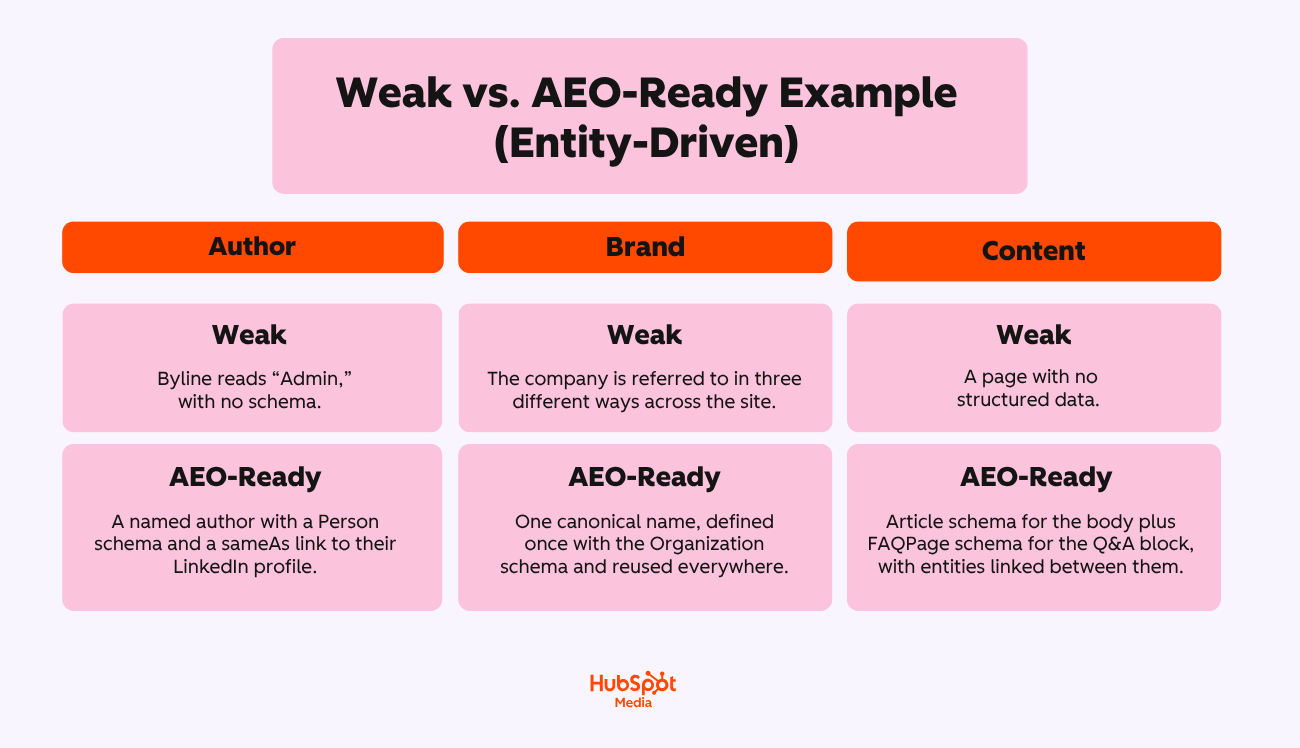
Beyond human-readable text, AEO heavily relies on the machine-readable layer of a website: semantic schema and entity modeling. These technical elements provide explicit facts about a page, its author, and the brand behind it, enabling answer engines to identify sources with confidence and close the "weak-schema" gap that can hinder citations.
- Schema Types for Citations: Structured data, or schema markup, labels parts of a page so an engine doesn’t have to infer their meaning. Key schema types include:
Articleschema: Provides details about the article, such as publication date, author, and main entity.Organizationschema: Defines the brand or company, including its official name, logo, and contact information.Personschema: Identifies the author or expert, linking them to their professional profile and expertise.ProductorServiceschema: Describes specific offerings, enhancing understanding of the page’s commercial context.
Properly implemented schema helps answer engines understand the context, credibility, and relationships of the content.
- Entity Modeling for Recognition and Citation: Entity modeling involves defining people, brands, and products on a site as consistent, interconnected entities rather than isolated words. This deliberate process strengthens entity consistency, clarifies brand and product relationships, and establishes author authority. By explicitly linking entities (e.g., an author to their
Personschema, a product to itsProductschema, and both to theOrganizationschema), engines build confidence in the source over time, making it more likely to be cited. - Measuring Schema and Entities: To gauge progress, marketers should track:
- Citation Rate: The frequency with which content is cited by answer engines.
- Answer Engine Mentions: The overall volume of references to the brand or its content in AI-generated answers.
- Entity Recognition Score: A measure of how well AI systems understand and attribute specific entities (brand, product, author) from the content. Tools like HubSpot’s AEO Grader can benchmark existing entity signals.
III. Building Trust and Authority: Authoritative Signals and Trust Markers
Answer engines do not cite content indiscriminately; they prioritize trustworthy sources. Two pages might answer a question equally well, but the engine will favor the one it can verify as authoritative. These signals of trustworthiness are paramount for earning citations.
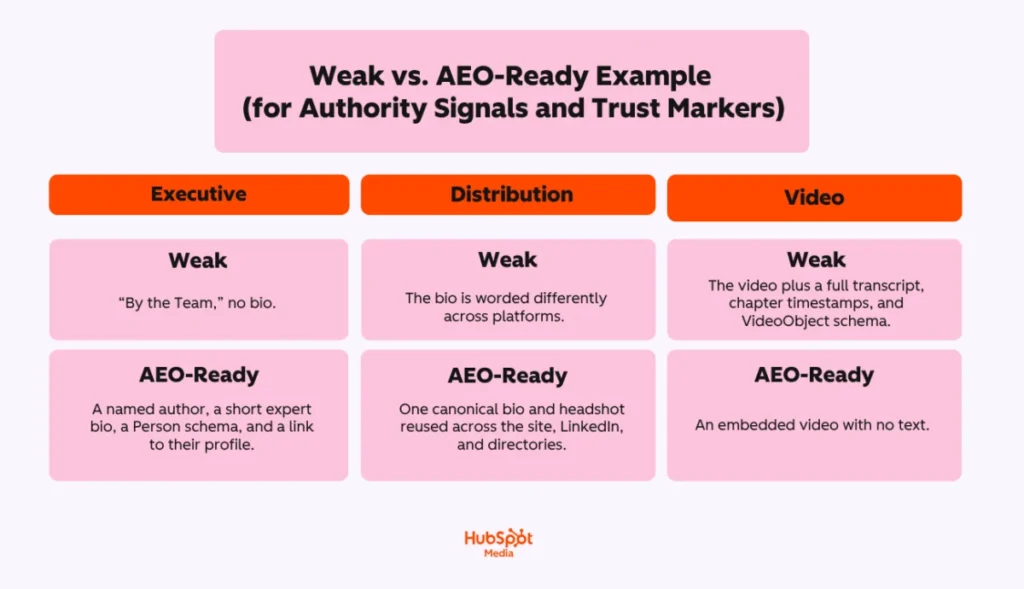
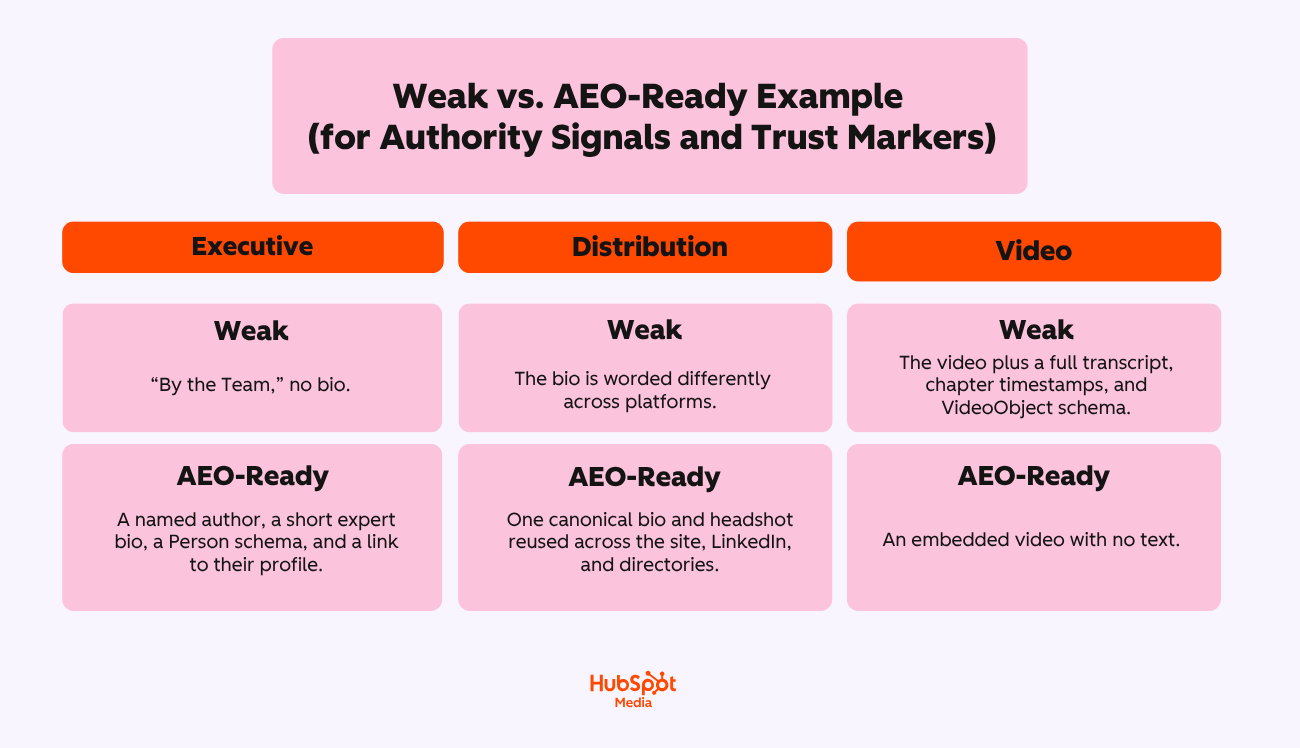
- Authoritative Brand, Executive, and Product Profiles: Strong, well-described entity profiles are crucial. This means providing comprehensive and verifiable information about the brand, its key executives, and its products or services. For instance, detailed "About Us" pages, executive bios with linked professional profiles (e.g., LinkedIn), and clear product descriptions with associated specifications all contribute to building a recognizable and trustworthy entity.
- Distribution Across Trusted Ecosystems: Where content and entities appear beyond a brand’s own site significantly impacts perceived authority. Mentions, citations, and features on reputable third-party sites, industry publications, news outlets, and academic sources serve as powerful corroboration signals for answer engines. This broad distribution validates expertise and reinforces trustworthiness.
- Video Transcripts, Timestamps, and VideoObject Schema: While video content is highly engaging, it remains challenging for AI engines to parse directly. To make video content citable, it must be accompanied by text-readable formats:
- Full Transcripts: Provide a complete text version of all spoken content.
- Timestamps: Mark key moments in the video, allowing AI to pinpoint specific segments relevant to a query.
- VideoObject Schema: Use structured data to describe the video’s content, title, description, and upload date.
These additions enable AI to understand, categorize, and potentially cite information contained within video assets.
The emphasis on authority and trust aligns directly with Google’s E-E-A-T (Experience, Expertise, Authoritativeness, Trustworthiness) guidelines, underscoring that content quality and verifiable credentials are non-negotiable prerequisites for AEO success.
IV. Strategic Internal Linking Architecture
Internal linking, often overlooked, is the site-level expression of content structure and plays a critical role in AEO. A robust internal linking strategy helps answer engines crawl, group, and understand related content, thereby strengthening topical authority and discoverability. Weak or random linking can leave valuable answers isolated and difficult for AI to associate with broader topics.
- Hub-and-Spoke Structure, Glossary Pages, and Sibling Links:
- Hub-and-Spoke Model: Organizes a topic around a central, authoritative "pillar" page that links to more focused "spoke" pages. This structure clearly signals to AI the main topic and its supporting sub-topics.
- Glossary Pages: Dedicated pages defining key industry terms or concepts, internally linking to their usage across the site, enhance understanding and topical breadth for AI.
- Sibling Links: Links between related pages at the same hierarchical level further reinforce thematic connections.
This architectural approach helps AI build a comprehensive understanding of a site’s expertise on a given subject.
- Clear Anchor Text and Early Link Placement:
- Descriptive Anchor Text: The visible, clickable text of a link should be clear and descriptive, accurately reflecting the content of the destination page. This helps AI understand the context and relevance of the linked resource.
- Early Link Placement: Placing important internal links higher up in the content signals their significance to both users and AI engines.
- Internal Links to Topic Clusters: Topic clusters, groups of interlinked pages that comprehensively cover a subject, are foundational for AEO. By linking extensively within these clusters, brands demonstrate deep expertise, allowing AI to confidently extract detailed information and cite the site as a comprehensive resource.
V. Passage-Level Optimization for Extraction
The most granular level of AEO involves optimizing individual passages for extraction. This "passage-first" mindset means writing each paragraph, list, or table so it can be lifted and cited independently, without reliance on surrounding text for context.
- Stand-Alone Paragraphs Answering One Question: Each paragraph should be self-contained, addressing a single question or concept. It should open with the answer plainly stated, followed by supporting details. Content creators must avoid pronouns (e.g., "this," "that approach") that refer to previous paragraphs, as these break the passage’s meaning when extracted.
- Lists, Tables, and Definition Boxes: Structured formats are highly snippet-friendly and easily extractable by AI.
- Numbered and Bulleted Lists: Break down complex information into easily digestible points.
- Tables: Present comparative data or structured information clearly.
- Definition Boxes: Explicitly define terms, making them prime candidates for direct answers.
- Concise, Extractable Sentences: Sentence length and clarity directly influence how cleanly an engine can quote content. Sentences should be direct, avoid jargon where possible, and convey a single idea. Shorter, clearer sentences are less ambiguous and more readily processed by AI models.
When content is optimized passage by passage, it provides AI engines with clean, attributable units of information, maximizing citation potential.
Aligning AEO with Google’s Quality Guidelines and Ethical AI
Structural optimization for AEO is only effective when the underlying content is genuinely helpful and high-quality. Google’s overarching goal remains to reward "people-first" content. Any AEO tactics designed solely to "game the system" while ignoring quality are likely to backfire. The structural themes that correlate with citations—clear headings, direct answers, robust schema—are amplifiers of quality, not substitutes for it.
- Accuracy, Quality, Relevance, and User Context: These are the foundational prerequisites for any AEO work. Content must be factually accurate, well-written, highly relevant to the target audience, and deeply understand the user’s intent. Before optimizing structure, content creators must first ensure the substance itself would satisfy a searcher, even without AI summarization.
- Disclosure When Automation Assists: Google considers AI-assisted content acceptable when it is helpful and not primarily produced to manipulate rankings. Transparency is key. For AI-assisted drafts, adding an editor’s note, such as "Reviewed and fact-checked by [Name], [Title]," signals accountability and builds trust with both readers and search engines.
- Do’s and Do-Nots for Helpful Content: Establishing clear guardrails ensures consistency and quality across a content team.
- Do: Prioritize user value, provide clear answers, demonstrate expertise, and ensure accuracy.
- Do Not: Produce content for search engines first, keyword stuff, plagiarize, or create low-quality, unverified content.
These guidelines ensure that structural work reinforces Google’s quality standards rather than conflicting with them, forming the bedrock of durable AEO.
Measuring Citation Performance and Structural Impact
Proving the efficacy of AEO is crucial. It moves AEO from a theoretical exercise to a data-backed strategy. Measuring structural impact means tying specific content changes to measurable citation outcomes.
- The Three Key Performance Indicators (KPIs):
- Citation Rate: The percentage of content pieces that receive at least one citation from an answer engine. This indicates the effectiveness of overall AEO efforts.
- Answer Engine Mentions: The total number of times a brand or its content is referenced in AI-generated answers, providing a volume metric.
- Entity Recognition Score: Quantifies how consistently and accurately AI engines recognize and attribute the brand, its products, and its authors.
- The Measurement Loop: Diagnose, Test, Measure, Iterate: AEO should be approached as a continuous improvement process.
- Diagnose: Identify areas where content lacks optimal structure or authority.
- Test: Implement specific AEO changes (e.g., adding Q&A blocks, updating schema).
- Measure: Track the KPIs to observe the impact of the changes.
- Iterate: Refine strategies based on measured results, continuously optimizing content for better performance.
Operationalizing High-Citation Content Themes
For AEO to deliver sustained advantages, winning structural themes must be systematized into repeatable workflows. Operationalizing AEO ensures that every piece of content ships with the same citation-ready structure, regardless of the individual creator.
- Role-Based Checklists: Assigning clear ownership for each part of the AEO process prevents gaps. Content writers focus on direct answers, editors ensure structural compliance, SEO specialists handle schema and internal linking, and technical teams ensure site architecture supports crawlability and machine readability.
- Templates in Content Management Systems (CMS): Reusable content templates, built within a CMS (such as HubSpot’s Content Hub), embed structural themes as defaults. These templates can include predefined sections for question-led headings, direct-answer summaries, and prompts for structured data, removing guesswork for writers. AI-powered drafting tools, like Breeze AI, can further accelerate content creation by generating initial AEO-optimized blocks, which are then refined by human editors to meet quality guardrails.
Conclusion
The transition to the AI search era, while daunting, is fundamentally a challenge of discipline and structure. Winning in this new landscape does not require reinventing content from scratch but rather making existing content’s best answers easy for AI to find, lift, and attribute. By focusing on learnable principles such as question-led headings, semantic schema, authoritative signals, strategic internal linking, and passage-level optimization, organizations can systematically build a durable advantage.
The shift towards AEO is a strategic imperative that connects content visibility directly to revenue pipelines. As AI continues to evolve, consistent application of these structural themes, supported by robust measurement and operationalized workflows, will be the differentiator for brands seeking to dominate the answer engine landscape. The fastest path to success begins with understanding one’s current standing and then embarking on a systematic journey of optimization.