
Roughly 58% of consumers now engage with AI answer engines for product research weekly, a figure projected to surge as platforms like ChatGPT, Perplexity, and Google AI Overviews become central discovery hubs. This seismic shift prompts a critical question for content and SEO professionals: Is the traditional authority playbook, heavily reliant on backlinks, still relevant, or must it be entirely reimagined for the era of Answer Engine Optimization (AEO)? The short answer is nuanced: contextually relevant backlinks retain significant value, yet they no longer represent the sole arbiter of digital authority. AEO demands a broader, more sophisticated approach that integrates traditional SEO strengths with new signals prioritized by artificial intelligence.
The Emergence of AI Answer Engines and AEO
The digital landscape has undergone a profound transformation with the mainstream adoption of AI-powered answer engines. While traditional search engines primarily function as sophisticated indexing and ranking systems, presenting users with a list of links to relevant pages, AI answer engines aim to provide direct, synthesized answers to complex queries. This shift, largely propelled by advancements in large language models (LLMs) and the public release of tools like ChatGPT in late 2022, has rapidly reshaped user expectations and discovery patterns. Google’s integration of AI Overviews into its search results further solidifies this trend, signaling a future where direct answers often precede or even replace organic listings.
This fundamental change from "ranking" to "answering" introduces Answer Engine Optimization (AEO) as a distinct, albeit complementary, discipline to Search Engine Optimization (SEO). While SEO focuses on optimizing content for visibility in search results and driving clicks, AEO’s primary objective is to make a brand’s content the trusted source an AI system selects to quote, paraphrase, or cite in its generated responses. This means the underlying mechanisms of authority and relevance are being re-evaluated by algorithms designed for semantic understanding and factual grounding, rather than solely link graphs.
The Evolving Role of Backlinks in the AI Era
Historically, backlinks have served as the cornerstone of traditional SEO. A link from a reputable domain to a webpage was interpreted as a "vote of confidence," with its weight influenced by the linking domain’s authority, the contextual relevance of the link, and the anchor text used. This foundational logic of off-page SEO has not been entirely abandoned by AI answer engines. However, these new systems layer a significant amount of additional criteria on top.
When an AI answer engine constructs a response, it doesn’t merely count backlinks to determine a page’s rank. Instead, it seeks out sources that can reliably "ground" its answer, ensuring accuracy and trustworthiness. This means that while a robust backlink profile remains a necessary condition for initial discovery and credibility, it is no longer sufficient for guaranteed AI visibility. Nathaniel Miller, Head of Marketing at Ashbrook Technologies, emphasized this shift in a recorded interview for the Found in AI podcast: "The companies ranking highest across AI platforms tend to be the ones with both strong authority and strong backlink profiles." He further clarified, "if you’re not getting qualified traffic from that link, it’s basically a logo slap. The real value is in relevance and authority – not just size."
This distinction highlights that the quality and context of backlinks now outweigh sheer volume. A high-domain-authority (DA) link from an irrelevant source provides minimal semantic signal to an AI. Conversely, a high-DA, high-relevance link, particularly from an industry publication recognized as a grounding source for AI, carries very high influence. Even niche blog links with strong topical depth, while offering moderate classic SEO influence, can wield high AEO influence by reinforcing semantic adjacency and entity authority. Links from directories or aggregators, once a common link-building tactic, now provide minimal AEO benefit, underscoring the AI’s preference for meaningful, contextual connections.
Beyond the Link: Key Authority Signals for AEO
The AEO landscape introduces several critical authority signals that extend beyond traditional backlinks, often proving equally, if not more, influential in securing AI citations. These include unlinked brand mentions, co-citations, entity clarity, and the symbiotic interplay of these factors with a strong backlink profile.
-
Unlinked Brand Mentions: Every instance where a brand name appears in a credible source without an accompanying hyperlink registers as a potent mention signal for AI systems. These mentions help AI map brands to specific topic clusters, building "entity authority" – a broad recognition that positions a brand as an obvious citation choice within its domain. This signal indicates genuine relevance and trust within the broader information ecosystem, even without a direct clickable link.
-
Co-citations: A powerful, yet often underutilized, AEO tactic involves co-citations, where a brand is mentioned alongside other recognized authorities or sources within the same content. For AI answer engines, co-citations act as a strong semantic signal, suggesting that a brand belongs in the same authoritative company as its peers. Consistently being co-cited with established experts or reputable publications within a category significantly enhances a brand’s perceived authority by AI. Charlie Graham, founder of RivalSee, highlighted the prevalence of unlinked mentions in AI responses on the Found in AI podcast, noting that approximately 85% of brands mentioned in ChatGPT responses receive no direct citation link. This underscores the downstream effect where users, seeing a brand name, remember it and initiate a direct search, an authority signal that traditional analytics often miss.
-
Entity Clarity: An "entity" in AI search refers to a clearly defined, consistently described concept, brand, or person. As Lars Lofgren, SEO consultant, explained on the Found in AI podcast, AI engines are essentially mapping relationships among everything they can crawl, and a brand’s primary entity is paramount. AI systems are far more likely to cite brands demonstrating strong entity clarity, characterized by consistent naming across all channels, the use of structured data (e.g., Organization/Person/sameAs schema), and a well-defined area of expertise. Ambiguity or inconsistency in a brand’s identity or messaging can lead to "entity confusion," a silent AEO killer, as AI systems will hesitate to cite a brand they cannot confidently identify and verify.
-
Interplay with Backlinks and Quality Content: No single signal operates in isolation. The most successful AEO strategies see all four signals – authoritative links, consistent mentions, strong co-citation associations, and clear entity definition – working in concert. A robust entity with numerous mentions but a weak backlink profile may struggle with verification, while a strong backlink profile without entity clarity or mention frequency will underperform in AI citation environments. Crucially, as Nathaniel Miller succinctly put it, "If your content isn’t great, no number of backlinks will help." High-quality, genuinely useful, clear, and well-structured content remains the fundamental prerequisite for any authority signal to be effective.
Practical Implications for Content Strategy
Adapting content strategy for AEO involves structuring information in a way that is easily digestible and extractable by large language models, while simultaneously building traditional authority.
-
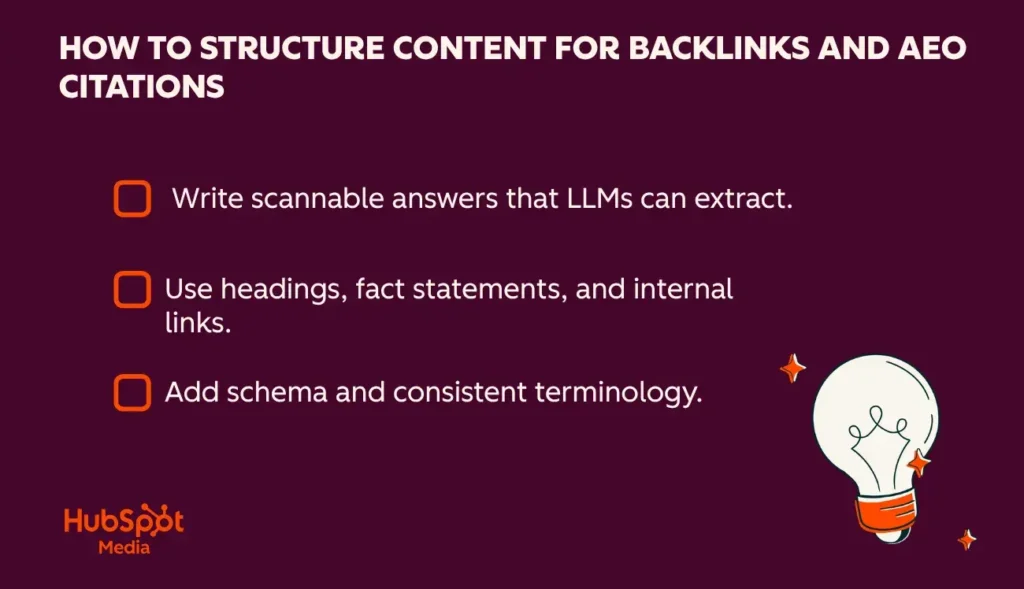
Write Scannable Answers for LLMs: AI systems thrive on content that is easy to parse. Each major section of a page should ideally begin with a direct, self-contained answer to the question implied by its heading. Leading with the answer, then supporting it with context, data, or examples, significantly increases the likelihood of LLM extraction and citation. This "Answer first, evidence second" structure also benefits traditional featured snippets and improves overall user experience. This means using concise language, avoiding jargon, and presenting information in easily digestible formats like bullet points, numbered lists, and short paragraphs.
-
Utilize Headings, Fact Statements, and Internal Links: Clear hierarchical headings (H1, H2, H3) provide structural clues to AI systems about content organization and key topics. Explicit fact statements (e.g., "The average growth rate is 15% annually") are highly extractable. A dense and logical internal linking structure around a topic cluster signals topical depth and authority, guiding AI systems through a brand’s comprehensive knowledge base.
-
Implement Schema Markup and Consistent Terminology: Schema markup, machine-readable metadata, explicitly clarifies the purpose and structure of a page to both search and AI systems. Valuable schema types for AEO include Organization, Person, FAQPage, HowTo, and FactCheck. Equally important is consistent terminology. Using a canonical term for each concept across all content, social profiles, and external mentions helps AI systems build a clear, unambiguous entity association for the brand, preventing entity confusion.
Building a Holistic Authority Profile: Links and AEO-Salient Mentions
Effective AEO strategies integrate link building and mention building into a single, cohesive effort, where every outreach action is designed to generate both structural link signals and brand mentions that AI systems can index.

-
Prioritize Formats AI Engines Love: Certain content formats are disproportionately favored by AI for citation. These include data-rich articles, research reports, comprehensive guides, definitive explainers, and well-structured FAQ sections. When publishing original research, including a standalone "Key Findings" section with three to five clearly labeled statistics dramatically increases extractability and citation likelihood.
-
Earn Relevant Links and Co-citations with Original Research and Digital PR: Original research is arguably the most efficient way to simultaneously earn high-quality backlinks and co-citations. A well-executed study or data report provides other publishers with a compelling reason to link to a brand as a primary source. The subsequent media coverage often mentions the brand alongside other respected voices in the field, generating valuable co-citation signals. Beyond research, digital PR – securing earned media placements, expert commentary in industry publications, and podcast appearances – is an excellent backlink strategy that naturally produces both link authority and authentic brand mentions. As Miller notes, "Digital PR is the fastest way to start building momentum," capable of generating a backlink, a brand mention, and a co-citation with recognized experts from a single placement. This strategy is particularly effective for brands in competitive categories where generic content and link volume alone have ceased to move the needle.
-
Participate Where Answers Form: AI systems do not exclusively index brand-owned content; they also draw from authoritative conversations happening across various platforms. Active participation in these channels expands a brand’s footprint across sources AI systems are trained to trust. This includes contributing expert commentary on Q&A sites like Quora or Reddit, publishing thought leadership on LinkedIn, engaging in relevant industry forums, and appearing as a guest on podcasts. Building relationships within these communities often leads to others seeking out a brand’s input, generating organic third-party mentions. Tools like Qwoted and HARO are invaluable for connecting with journalists and content creators seeking expert sources, directly fostering both links and AEO-salient mentions.
Measuring Backlinks and AEO Impact with a Repeatable Loop
Optimization in the AEO era demands aggressive experimentation coupled with robust measurement. Without a clear feedback loop linking content publication, changes in authority signals, and actual AI citations, optimization remains guesswork. HubSpot’s Loop Marketing framework provides a useful lens, advocating that every content and outreach action should feed data back into the next iteration. This applies directly to AEO measurement, which can be broken into three stages: benchmark, tie changes to activity, and report what to scale.
-
Benchmark AI Visibility and Citations: Before any optimization, establishing a baseline is crucial. This involves identifying which of your pages are currently being cited by AI answer engines, understanding the types of queries your brand is grounding, and monitoring the frequency of these citations. Tools like HubSpot AEO are designed to help marketing teams benchmark and track AI visibility alongside traditional search performance, providing a unified view of citation frequency, grounding query coverage, and page-level citation activity.
-
Tie Changes to Content and Outreach Activity: For measurement to be truly useful, observed changes in AI visibility must be directly attributable to specific content or outreach actions. This requires disciplined logging of activities, such as when new content is published, significant content updates are made, backlinks are acquired, or brand mentions/co-citations occur. Over time, this meticulous tracking will reveal patterns, indicating which content types, link-building strategies, or outreach efforts are most effective in driving AI citations.
-
Report What to Scale and What to Stop: The final stage of the loop involves translating measurement data into actionable prioritization decisions. On a regular cadence, marketing teams should analyze which content types are most frequently cited, which authority signals (links, mentions, co-citations) correlate with increased AI visibility, and which specific campaigns or initiatives are yielding the highest AEO return on investment. This iterative process transforms AEO from a one-time project into a compounding strategy, where each measurement cycle refines inputs for the next, leading to continuous improvement and efficiency gains.
Conclusion: Backlinks Still Have Their Place
The future of digital authority does not pit backlinks against AEO as opposing forces; rather, they represent different, yet integrated, layers of the same authority infrastructure. Backlinks continue to provide the fundamental structural credibility that ensures content is indexed, trusted, and considered a reliable grounding source by AI systems. Concurrently, brand mentions, co-citations, clear entity definition, and optimized content structure build the broader semantic signal that communicates to an AI system that a brand is a legitimate and authoritative voice on a given topic, deserving of citation.
Content teams currently making measurable progress in AI visibility are those that have not abandoned their foundational SEO programs. Instead, they have evolved them, making their strategies more precise, more entity-aware, and their content more consistently structured and semantically rich. By embracing a holistic approach that values both traditional link equity and the emerging signals of AI trust, brands can effectively navigate the evolving digital landscape and secure their place as authoritative sources in the age of intelligent answers. For those seeking to measure their current standing and identify pathways for optimization, specialized tools like HubSpot AEO offer the critical visibility data needed to move from strategic guesswork to data-driven iteration.