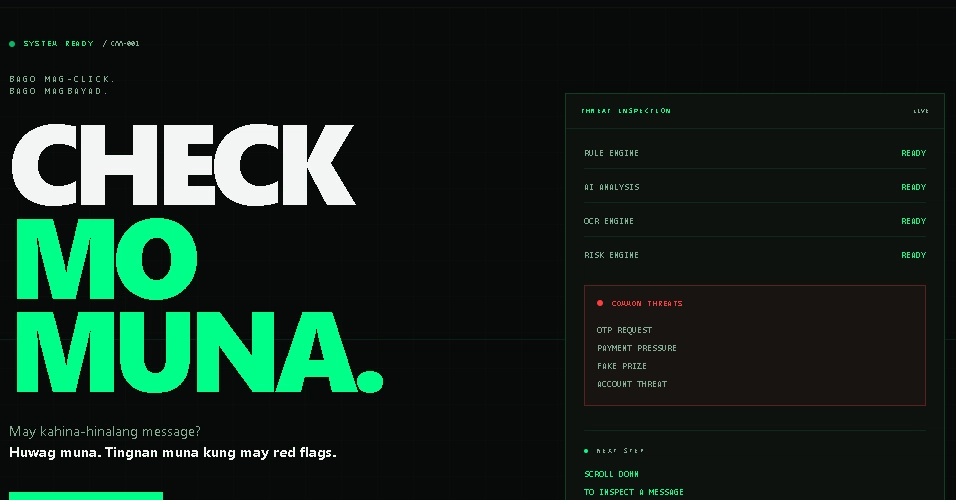

Fraudulent digital communications have reached epidemic proportions across Southeast Asia, with the Philippines emerging as a primary target for sophisticated cybercriminal syndicates. In response to the exponential surge in deceptive SMS broadcasts, malicious phishing links, and social engineering attacks, software engineer and cybersecurity professional Samuel Mallo has developed a localized countermeasure: "Check Mo Muna." This innovative, free-to-use digital utility combines optical character recognition, rigid deterministic security parameters, and contextual artificial intelligence to evaluate suspicious messages before everyday citizens fall victim to financial exploitation. The tool operates on a hybrid architecture designed to maximize analytical precision while mitigating the erratic tendencies historically associated with standalone generative models.
The genesis of Check Mo Muna arrives against a backdrop of aggressive digitalization and financial inclusion initiatives in the Philippines. While the rapid adoption of digital wallets, mobile banking applications, and e-commerce platforms has modernized the national economy, it has concurrently provided malicious actors with a vast threat surface. Cybercriminals routinely deploy deceptive messaging campaigns impersonating major commercial banks, government agencies, logistics providers, and utility companies. These messages typically manufacture false urgency—threatening account suspension, unclaimed parcels, or fabricated monetary rewards—to manipulate victims into disclosing One-Time Passwords (OTPs), personal identification numbers, or confidential login credentials.
Traditional cybersecurity awareness campaigns, while valuable, often fail to keep pace with the linguistic evolution of these threats. Scammers frequently utilize localized vernacular, informal phrasing, and rapidly shifting terminology to bypass automated filters deployed by telecommunication operators. Recognizing that standard keyword blacklists are insufficient, Mallo sought to engineer a dynamic evaluation environment tailored specifically to the linguistic and cultural nuances of Filipino digital communication. The resulting Minimum Viable Product (MVP) bridges the gap between raw technological capability and accessible consumer protection.
A Multilayered Analytical Pipeline
The functional architecture of Check Mo Muna is structured around a rigorous, sequential analysis pipeline engineered to process user-submitted data accurately. When an individual encounters a suspicious text message, email, or digital notice, they are presented with two primary ingestion methods: direct text pasting or screenshot uploads.
For image-based submissions, the system initiates optical character recognition (OCR) protocols to extract embedded text from the graphic file. Once the raw text is successfully isolated, it undergoes a dual-pronged evaluation process. The extracted data is simultaneously funneled through hardcoded, deterministic cybersecurity rules and advanced contextual artificial intelligence modules. This bifurcated approach ensures that the system evaluates both structural threat indicators and subtle psychological manipulation tactics.

Rather than relying entirely on probabilistic machine learning models—which remain susceptible to hallucinations or misinterpretations of nuance—Check Mo Muna routes the analytical outputs into a specialized risk assessment engine. The foundational design philosophy of this engine prioritizes objective, verifiable safety parameters over speculative AI interpretations. Consequently, the scoring algorithm applies a weighted distribution heavily favoring established security logic:
70% Deterministic Rules + 30% Artificial Intelligence
This deliberate configuration guarantees systemic predictability. While the deterministic rules efficiently catch known phishing patterns, URL irregularities, and specific keyword combinations indicative of fraud, the secondary AI layer provides crucial contextual awareness. The AI analyzes the broader intent of the message, identifying sophisticated social engineering tropes that might evade rigid syntax-based filters.
Mitigating False Positives and Calibration Challenges
A significant technical hurdle encountered during the development of Check Mo Muna involved the calibration of the detection engine to minimize false positives. Legitimate financial institutions, telecommunication companies, and corporate entities frequently transmit automated notifications containing high-risk vocabulary terms such as "OTP," "PIN," "password," "account update," or "urgent verification."
An improperly calibrated analytical tool would inevitably flag every legitimate bank alert as a malicious phishing attempt, rapidly eroding user trust. To counteract this vulnerability, Mallo dedicated extensive testing phases to refine the deterministic ruleset and contextual training parameters. By introducing sophisticated baseline checks that cross-reference sender signatures, structural formatting, and standard enterprise notification protocols, the system successfully differentiates between authorized security alerts and fraudulent impersonation attempts.
Furthermore, the operational philosophy of Check Mo Muna deliberately avoids definitive, authoritarian assertions. The platform is intentionally programmed to refrain from declaring, "This person is definitely a scammer." Such absolute determinations expose developers to liability and fail to educate the user. Instead, the utility adopts an advisory stance, structured around three core deliverables: identifying specific warning signs, quantifying the overall risk profile through a transparent score, and providing actionable recommendations for safe user behavior.

The Broader Socio-Economic Impact of Digital Fraud
The launch of Check Mo Muna addresses a critical structural vulnerability within the Philippine digital ecosystem. According to data compiled by cybersecurity firms and regulatory bodies, financial fraud and cybercrime incidents have inflicted billions of pesos in losses upon consumers over recent years. The proliferation of subscriber identity module (SIM) card registration mandates—while intended to curb anonymous messaging—has failed to completely eradicate malicious broadcasts, as criminals continuously exploit identity theft loopholes and unregistered routing channels.
For the average consumer, distinguishing a legitimate service notification from a meticulously crafted phishing lure requires technical literacy that many citizens do not possess. Vulnerable demographics, including elderly populations and unbanked workers newly introduced to digital financial services, are disproportionately targeted by syndicates employing psychological pressure and authoritative formatting. By lowering the barrier to entry for threat analysis, tools like Check Mo Muna democratize digital self-defense, equipping ordinary citizens with enterprise-grade analytical capabilities directly from their mobile devices or desktop browsers.
Public Availability and Future Outlook
The current iteration of Check Mo Muna operates as a publicly accessible, free-to-use Minimum Viable Product, reflecting its creator’s commitment to public safety and digital literacy. By offering the service without commercial barriers, Mallo aims to aggregate anonymized threat data that could potentially inform broader defensive strategies against regional cybercrime syndicates.
As artificial intelligence continues to lower the technical barrier for executing large-scale social engineering attacks—enabling hyper-personalized, grammatically flawless phishing campaigns—the necessity for decentralized, intelligent counter-tools becomes increasingly paramount. The architecture pioneered by Check Mo Muna demonstrates that effective cybersecurity solutions do not necessarily require massive corporate infrastructures; rather, they demand intelligent engineering, localized contextual awareness, and an unwavering focus on consumer empowerment.
Encapsulating the operational ethos of the platform and its mission to protect Filipino digital consumers before financial transactions occur, the guiding philosophy remains concise and urgent: Bago mag-click. Bago magbayad. Check mo muna.